ChatGPT Image Jun 2, 2026, 05_26_12 PM
The Law of Assumption in the Bible is not a modern invention layered onto ancient scripture. It is the scripture. Research into cognitive behavioural patterns consistently shows that when people hold stronger internal convictions and expectations, their perceived sense of control over outcomes measurably increases — and Neville Goddard spent his entire life pointing directly at that mechanism hidden inside the oldest texts in the world, arguing that the Bible was never a historical record but a precise psychological manual written in the language of symbol and vision.
| Question | Answer |
|---|---|
| What is the Law of Assumption in the Bible? | It is the principle that what you persistently assume to be true about yourself and your life will crystallise into your outer experience. Scripture encodes this truth in allegory throughout both Testaments. |
| Is this Neville Goddard’s teaching or the Bible’s teaching? | Neville would say they are identical. He read the Bible as a first-person psychological drama, not a historical account of external events. |
| Who is God according to this reading? | God is your own Imagination. The great I AM of scripture is not a being you pray to. It is the being you already are. |
| What do Esau and Jacob represent? | They represent two inner states within every person: the outer sensory world (Esau) and the Imagination that supplants it with a chosen assumption (Jacob). |
| How do you apply this practically? | Through practices like SATS and sustained Imaginal acts, you persistently occupy the inner state of the wish fulfilled until it becomes your dominant assumption. |
| What is the Christ in this context? | The Christ is the human Imagination itself. Not a person outside you but the creative faculty resident within every individual as the instrument of creation. |
| Does this contradict traditional Christianity? | It overturns the external God model completely. Neville’s reading removes the intermediary and places all creative power directly inside the individual. |
Most people who grew up inside religious tradition were handed a Bible and told to read it literally. Dates, places, real people, real events. The flood happened. The exodus happened. The miracles happened exactly as described.
Neville Goddard said: you are reading a drama about your own inner life, and every character, every miracle, every impossible event is a coded instruction about states of consciousness.
This is not a fringe position. It is a tradition that runs through the Kabbalah, through Gnostic Christianity, through the mystical reading of texts that predates the modern church by centuries. Neville was not inventing something new. He was recovering something very old and stating it in plain language that anyone could apply.
When you understand the Law of Assumption in the Bible from this angle, every story opens up differently. Lazarus being raised from the dead is not a magic trick performed on a corpse. It is the revival of an assumption you had given up on. The dead assumption brought back to life.
Are you ready to read the oldest book in the world as a manual for your own inner state? That is what this guide is for.
Before any technique, before any Imaginal act, before SATS or mental diets or revision practices, there is a name. And that name is the foundation of everything Neville taught.
When Moses asks God for a name, the answer given in Exodus 3:14 is not a proper noun. It is a declaration of being itself: I AM THAT I AM. Send word that I AM has sent you.
Neville’s reading is precise and uncompromising. That name is not the property of an external deity somewhere beyond the sky. It is the name of your own awareness. Every time you complete the sentence “I am…” with anything at all, you are using the name of the creative power within you. I am broke. I am unlovable. I am successful. I am healthy.
Each completion becomes an assumption. Each assumption, held consistently in your inner state, crystallises into your outer world.
This is why the Law of Assumption in the Bible is not metaphor. It is instruction. The scripture is telling you directly: what you declare yourself to be, you will experience. The operant power is always the individual consciousness. Always you.
One of the most radical shifts Neville makes is to redefine prayer entirely. Not as petition. Not as pleading. Not as asking an external God to intervene in your circumstances.
“Praying then is recognising yourself to be that which you now desire, rather than petitioning a God outside of yourself.”
This is not a new interpretation of prayer. It is a recovery of what prayer always was in its deepest form. To pray is to enter the feeling, the inner state, of the wish fulfilled. To occupy that state as though it were already your present reality.
Mark 11:24 says: “Whatever you ask in prayer, believe you have received it, and it will be yours.” Not will receive. Have received. Past tense. The assumption must be present tense internally before it becomes present tense externally.
This is the Law of Assumption in the Bible stated with surgical precision. The bridge of incidents forms the moment the inner state is stable and sincerely accepted as the current truth.
Most people read the story of Esau and Jacob as a family conflict. A birthright stolen over a bowl of soup. A dying father deceived by a disguised son. Drama between two brothers who could never quite share the same space.
Neville Goddard reads it as something entirely different: a precise map of the three inner states that every human consciousness passes through.
Esau is the hairy, red, outer man. He is the world as your physical senses present it. The empty bank account. The silent phone. The relationship that looks finished from the outside. Esau is the evidence your five senses report back to you as if it were the final word on reality. Most people live and die inside Esau, never questioning whether the sensory report is actually the creative cause or merely an old effect.
Jacob is the smooth-skinned inner man. The supplanter. His very name means “he who grabs the heel,” the one who follows close behind and overtakes. Jacob is your Imagination. The faculty that can stand in one location while consciously inhabiting another. Every time you persist in an assumption despite what the outer world is showing you, every time you hold the feeling of the wish fulfilled while circumstances scream the opposite, you are exercising Jacob.
Jacob “deceives” Isaac, the father. In this reading, Isaac represents your subconscious mind, which accepts whatever it is fed in the right inner state. The deception is not immoral. It is creative. You are feeding your subconscious the reality you choose, not the reality the senses inherited.
Israel is the highest inner state. It cannot be manufactured by technique or willed into being through effort. It is revealed. When it comes, you discover something that stops everything: Esau, the outer man, the hairy red evidence of lack and limitation, was never your enemy. It was your own energy, waiting to be fully reclaimed.
This is not a story about two brothers.
This is the story of every human being who has ever lived. Read it again with your own life as the text.
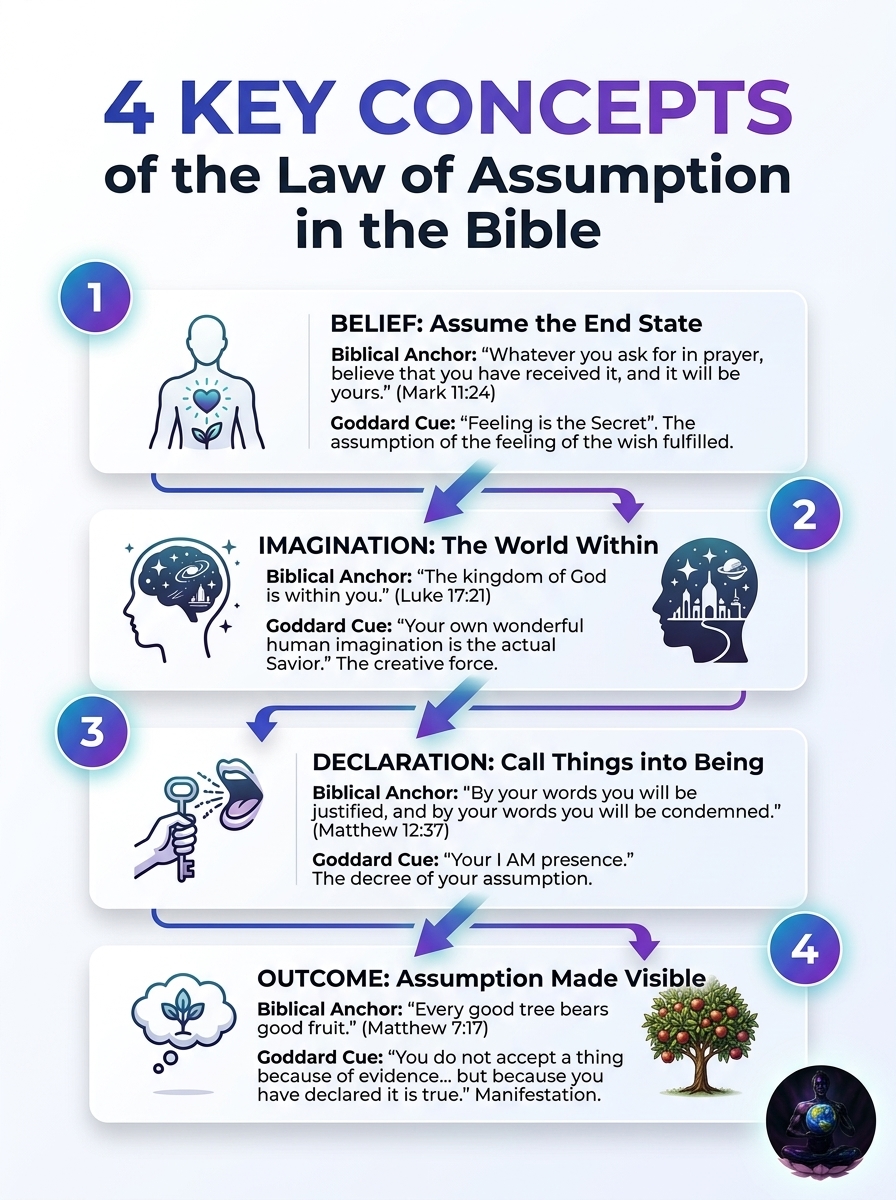
Explore how the Law of Assumption is interpreted in biblical context through four core concepts. This infographic breaks down the ideas visually to aid understanding.
For the complete guide to the Law of Assumption, see our definitive resource: The Law of Assumption — The Complete Guide.
To learn more about Neville Goddard’s life and complete body of work, read our definitive guide: Neville Goddard — The Complete Guide.
For the complete step-by-step guide to the SATS technique, see: The SATS Technique — Neville Goddard’s Complete Guide.
Organised religion will rarely tell you this. But Paul’s letters, read carefully through the lens Neville provides, say it plainly: the Christ is not a historical figure to be worshipped from a distance. The Christ is the human Imagination itself.
Colossians 1:27 becomes the key: “Christ in you, the hope of glory.” Not Christ beside you. Not Christ above you. Christ in you. The creative power of the entire creation, already resident within your own inner state.
When Neville says “In Goddard’s reading, the Word is the recognition that the Imagination is resident within every individual as the instrument of creation,” he is pointing directly at this. The Word of God is not a text. It is the Imaginal act. It is the assumption you carry inside you, spoken into the inner silence with enough conviction to reach the subconscious.
This changes everything about what it means to be a Christian. It is not adherence to doctrine. It is the full awakening to the creative faculty you carry. The Christ consciousness is not something you earn through behaviour. It is something you remember through inner experience.
For a deeper reading of how Neville reinterpreted key biblical passages, this understanding of Christ as Imagination is the thread that connects everything.
Once you accept that the Bible is a psychological manual, the entire cast of characters shifts in meaning. These are not individuals recorded by history. They are inner states you enter, inhabit, and move between throughout your life.
How often do we behave like Joseph’s brothers? How often does a new assumption within us get attacked by the old inner talking, the inner critic, the voice that says the evidence doesn’t support it?
Joseph held the dream anyway. That is the instruction. That is the Law of Assumption in the Bible stated in narrative form.
Neville’s most practical technique, SATS (State Akin to Sleep), has a direct biblical counterpart. Scripture is filled with moments where revelation and transformation happen not in waking activity but in the threshold state between sleeping and waking.
Jacob wrestles with the angel at night and emerges as Israel. Joseph receives his prophetic dreams in sleep. Peter falls into a trance and receives his vision. Paul is struck from his horse and enters a temporary darkness before transformation.
The pattern is consistent. The outer sensory world goes quiet. The inner state intensifies. The Imaginal act is performed. And what follows in the outer experience is the crystallisation of what was assumed in that borderline state of consciousness.
SATS is not a modern invention. It is a recovery of a practice that scripture points to again and again, written in the symbolic language of sleep, vision, and dream. The instruction is simple: in the drowsy state before full sleep, construct a scene that implies the wish fulfilled. Repeat it. Hold it. Allow it to feel natural within that inner state.
The bridge of incidents Neville Goddard’s teaching describes is already at work the moment the assumption is sincerely accepted as the current inner truth.
Here is where most people abandon the practice entirely. They understand the principle. They perform the Imaginal act. They wait. And then, when the outer world begins to move, it moves in a direction they did not anticipate. The specific phone call does not come. But another door opens. And because it was not the specific door they had nominated in their mind, they declare the method broken.
What they have done is committed the most common error in working with the Law of Assumption. They decided not only what they wanted, but exactly how it should arrive.
The subconscious mind, working from a sustained inner state, has access to infinite pathways toward any desired end. Restricting it to one route is like telling an ocean it can only move through one pipe.
The Bible addresses this directly in Isaiah 55:8: “For my thoughts are not your thoughts, neither are your ways my ways.” The creative intelligence within your own inner state has a reach and an ingenuity your conscious mind cannot map in advance. Your job is to hold the end. Not engineer the middle.
This is the practice. Not the collection of more techniques. One stable inner state, held consistently, without managing the how.
If there is one statement that defines the entire teaching of the Law of Assumption in the Bible, it is this one: the God of scripture is your Imagination.
Not a being in the sky. Not an external judge. Not a force that must be appeased with the right rituals, the right church, the right doctrinal box ticked. Your own Imagination. The same faculty you use when you daydream, when you plan a holiday, when you picture the face of someone you love. That faculty, raised to full deliberate use, is what the Bible calls God.
For anyone who grew up inside a religious tradition built on fear, this is not just a new idea. It is liberation.
Michael, the founder of TrueCosmic, spent his early years inside a strict Jehovah’s Witness and Baptist framework where God was conditional, distant, and frequently threatening. When Neville’s reading arrived in his life during a personal crisis, it did not just give him a new theology. It gave him back the scripture he had loved in a form he could actually inhabit. The external God who might judge and condemn was replaced by the immediate, internal, endlessly creative Imagination that was always there. No intermediary required. No pastor required. No building required. The relationship was already established. You and God are not two.
This is what TrueCosmic is built on. Not the comfortable version of spiritual teaching. The full version. The one that places the creative responsibility exactly where it belongs: within your own inner state.
Understanding the Law of Assumption in the Bible intellectually is one thing. Living it is another. And the gap between understanding and living is filled almost entirely by what Neville called the mental diet, specifically by the inner conversations you run constantly without noticing them.
“Little did I realise just how harmful this inner talking was to me and my ability to manifest the things that I said that I wanted.”
The inner conversations are where your real assumptions live. Not in the Imaginal scenes you deliberately construct at night before sleep, but in the running commentary your mind offers all day about what you are, what others think of you, what is possible, what is fixed, what is broken. That commentary, sustained consistently, is the assumption your subconscious acts on.
Scripture calls it the Word. The Word made flesh. What you speak internally, day after day, becomes your lived experience. The mental diet is the practice of monitoring and deliberately replacing that inner talking with conversations that imply the wish fulfilled.
It is not glamorous. It does not make for a viral clip. But it is the actual daily practice that separates those who occasionally see results from those who live the Law continuously. The Law of Assumption in the Bible is not a one-time event. It is a sustained inner state.
Neville Goddard did not arrive at this reading of scripture alone. His most formative teacher was a man known as Abdullah, an Ethiopian rabbi and metaphysician who taught Neville in New York for years. Abdullah’s method was blunt, experiential, and uncompromising. He told Neville that if he wanted to go to Barbados, he was already there in his inner state, and he should not move until the outer world confirmed it.
Neville held that inner state. The ticket arrived. The journey happened exactly as assumed.
This is not a legend. It is the living proof behind the teaching. And it maps directly onto every biblical narrative where an inner state of conviction preceded an impossible outer event. The Red Sea does not part before the people move. It parts as they move into it. The outer world yields to the inner state that has already accepted the end as fact.
For more on the man who shaped Neville’s understanding of scripture, Abdullah the Mystic remains one of the most fascinating figures in the entire lineage of this teaching.
The Law of Assumption in the Bible is not a modern overlay on an ancient text. It is the ancient text, read with the clarity it was always intended to be read with. Every patriarch, every miracle, every impossible event is a description of what happens when a human consciousness holds a chosen inner state with enough conviction and consistency to override the evidence of the senses.
God is your Imagination. The Christ is the human Imagination fully activated. I AM is the name of your own awareness. For a guide to more Old Testament figures read this way, see Old Testament Metaphysical Symbolism. Prayer is the recognition of yourself as that which you desire. And every story from Genesis to Revelation is a map of the inner states you pass through on the way to the full awakening that is every soul’s birthright.
No matter what you are currently facing, housed within you lies the solution to every problem and the fulfilment of every desire. The same power that animates and created every state of consciousness in existence is within you, at your beck and call. Only you are the operant power. You have to activate it. And when you do, no problem, no circumstance, no situation can stand in its way.
Fear not.
The Bible does not use the phrase directly, but passages like Mark 11:24 (“believe you have received it”), Proverbs 23:7 (“as a man thinks in his heart, so is he”), and the I AM declaration in Exodus 3:14 all point to the same principle. Neville Goddard’s reading of the Law of Assumption in the Bible identifies these as consistent instructions about inner state and creative consciousness, not historical observation.
That depends entirely on your starting framework. Neville argued he was recovering the original and deepest meaning of scripture, not contradicting it. His position is that the external-God model is the deviation from the text, not his reading. Whether that constitutes blasphemy or liberation is something each reader has to decide for themselves through direct inner experience.
The core application is to identify the inner state of the wish fulfilled and occupy it persistently, particularly during SATS. Use the I AM name consciously by completing it with what you desire rather than what your current circumstances suggest. Revise inner conversations that contradict your desired assumption, and trust the bridge of incidents that forms without managing the specific route it takes.
In Neville’s framework, the question dissolves because God is defined as your own Imagination and inner state, not an external being whose belief in you is conditional. You are already using the creative faculty regardless of religious belief. The difference is whether you use it deliberately or by default, with chosen assumptions or inherited ones.
Esau represents your sensory evidence, the outer world as it currently appears. Jacob represents your Imagination actively assuming a different reality than the senses report. The practical importance is this: most people let Esau run the show, reacting to circumstances and letting outer evidence dictate inner state. The Law of Assumption in the Bible teaches you to reverse that order, to let Jacob, your deliberate inner assumption, determine what Esau eventually presents.
It’s worth being direct about this: knowing that Jacob represents your deliberate inner assumption doesn’t, on its own, change anything. The Law is a practice, not a trick. Think of a concert pianist — even the most accomplished hands hit bum notes in rehearsal, for years, before any performance looks effortless. Letting Jacob actually determine what Esau presents requires consistency and devotion, practiced especially on the days outer evidence is loudest.
Over 14,000 people across 95 countries told Deloitte the same thing this year: imagination, not…
The "Other non-Christian" faith segment, which includes esoteric systems built on hermeticism laws, has grown…
When you search for kabbalah tree of life pictures, you are not just looking for…
A real frequency chart is not decoration, it is a map for the inner state…
You can feel like you are doing “everything right,” yet nothing changes. In 2026, over…
You can love the law of assumption persistence in theory, and still quit when your…