Neville Goddard Manifestation Method
When I first discovered Neville Goddard, I did what most people do: I picked the technique that sounded the most powerful and tried to force it. SATS every night, regardless of my emotional state, regardless of whether the scene felt real or like an empty mental exercise. Months passed. Very little moved. It wasn’t until I understood that the method is a vehicle, not the destination, that things started to shift.
Knowing how to choose the right Neville Goddard manifestation method can make the difference between a practice that feels natural and one that stalls before it begins. Neville Goddard taught several distinct techniques, and each one works best in specific circumstances depending on your goal, personality, and current mental state.
| Question | Answer |
|---|---|
| What is the most beginner-friendly Neville Goddard method? | The “I Remember When” technique is one of the easiest starting points because it uses simple past-tense framing to shift your perspective. |
| Which method works best before sleep? | The SATS (State Akin to Sleep) technique is specifically designed for the drowsy state just before sleep, making it ideal for nightly practice. |
| How do I choose between Revision and SATS? | Use the Revision technique when you want to rewrite a past event; use SATS when you want to plant a fresh future scene into your subconscious mind. |
| What is the “Live in the End” principle? | Living in the End is the core principle behind most Neville Goddard methods, meaning you embody the feeling of your desire already fulfilled. |
| Can I combine multiple Neville Goddard techniques? | Yes. Many practitioners use Revision during the day and SATS at night, or combine sensory imaginal acts with the “I Remember When” framing. |
| What is the foundation behind all Neville Goddard methods? | All methods are grounded in the Law of Assumption, which states that assuming the feeling of your wish fulfilled reshapes your outer reality. |
| How do I know which method suits my personality? | Auditory and kinesthetic learners often prefer SATS; analytical minds tend to connect with Revision; visual thinkers gravitate toward sensory imaginal acts. |
Before you can choose the right Neville Goddard manifestation method, you need a solid grasp of the principle that connects all of them. Neville taught that consciousness is the only reality, and that your imagination is the creative power shaping your experience.
This framework, called the Law of Assumption, means that whatever state you dwell in mentally becomes your physical reality. Every technique Neville taught is simply a different pathway into that same assumed state.
Knowing this gives you a clear filter. If a method helps you genuinely feel as though your desire is already real, it is the right method for you. If it leaves you feeling disconnected or performing an empty ritual, it is worth trying a different approach.
Not every goal calls for the same technique. Choosing the right method often comes down to whether you are working on a future desire or a past event you want to change.
If you are focused on creating something entirely new in your life, such as a job, a relationship, or a financial situation, techniques like SATS and sensory imaginal acts are well-suited because they help you plant vivid scenes of that desired future into your subconscious mind.
If you are dealing with a difficult memory, an argument that went wrong, or a situation that created a limiting belief, the power of Revision is your strongest tool. Revision allows you to rewrite past events in your imagination so that the emotional residue no longer shapes your present behavior and self-concept.
The State Akin to Sleep, commonly called SATS, is one of Neville Goddard’s most frequently recommended methods. It involves entering the deeply relaxed, hypnagogic state just before you fall asleep, and in that state, looping a short scene that implies your desire is fulfilled.
You should choose SATS if you find it easy to relax your body fully, if you have a specific scene in mind, and if you can sustain imagination without your analytical mind interrupting the process. The drowsy state naturally quiets mental resistance.
SATS is also a strong choice if you have struggled with other methods because of overthinking. The mental state just before sleep bypasses your critical faculty, delivering the imagined scene directly to the subconscious mind where real change occurs.
“Enter the drowsy, sleepy state. In that state, the conscious mind is partially suspended. Your imagined acts are impressed on the deeper mind with extraordinary force.” — Neville Goddard
A practical SATS session lasts between five and fifteen minutes. You choose one simple scene, such as a friend congratulating you, a hand shaking yours in a new office, or holding an object that represents your desire. You loop that scene over and over until you drift into sleep.
Revision is the method to reach for when past experiences are generating emotional patterns that block your desired state. Neville described Revision as the most liberating of all his techniques because it frees you from the weight of what has already happened.
The process involves entering a relaxed state, recalling the event or conversation that felt wrong, and then replaying it in your imagination exactly as you wish it had gone. You hold the revised version until it feels real and emotionally complete.
Choose Revision when you notice that current circumstances feel like a direct echo of a painful past event. You may also use it at the end of each day to rewrite any moment that did not meet your ideal. This daily practice, sometimes called the “Daily Revision” habit, is one of the most powerful ways to compound change over time.
The “I Remember When” technique is one of the gentlest and most accessible methods in Neville Goddard’s body of work. It works by speaking and thinking about your current unwanted reality in the past tense, as though it has already been replaced by your desire.
For example, instead of saying “I am struggling financially,” you shift to thinking “I remember when money used to be tight.” This reframing creates a psychological gap between your current identity and the old problem, making space for the new reality to fill.
This method is especially effective for people who feel emotionally stuck in their current situation or who find visual imagination difficult. Because it relies primarily on language and feeling rather than vivid mental imagery, it works well for verbal and analytical thinkers.
It is also an excellent companion to Revision. You can Revise a past memory first, then shift into “I Remember When” framing to reinforce the idea that the old pattern belongs to a version of yourself that no longer exists.
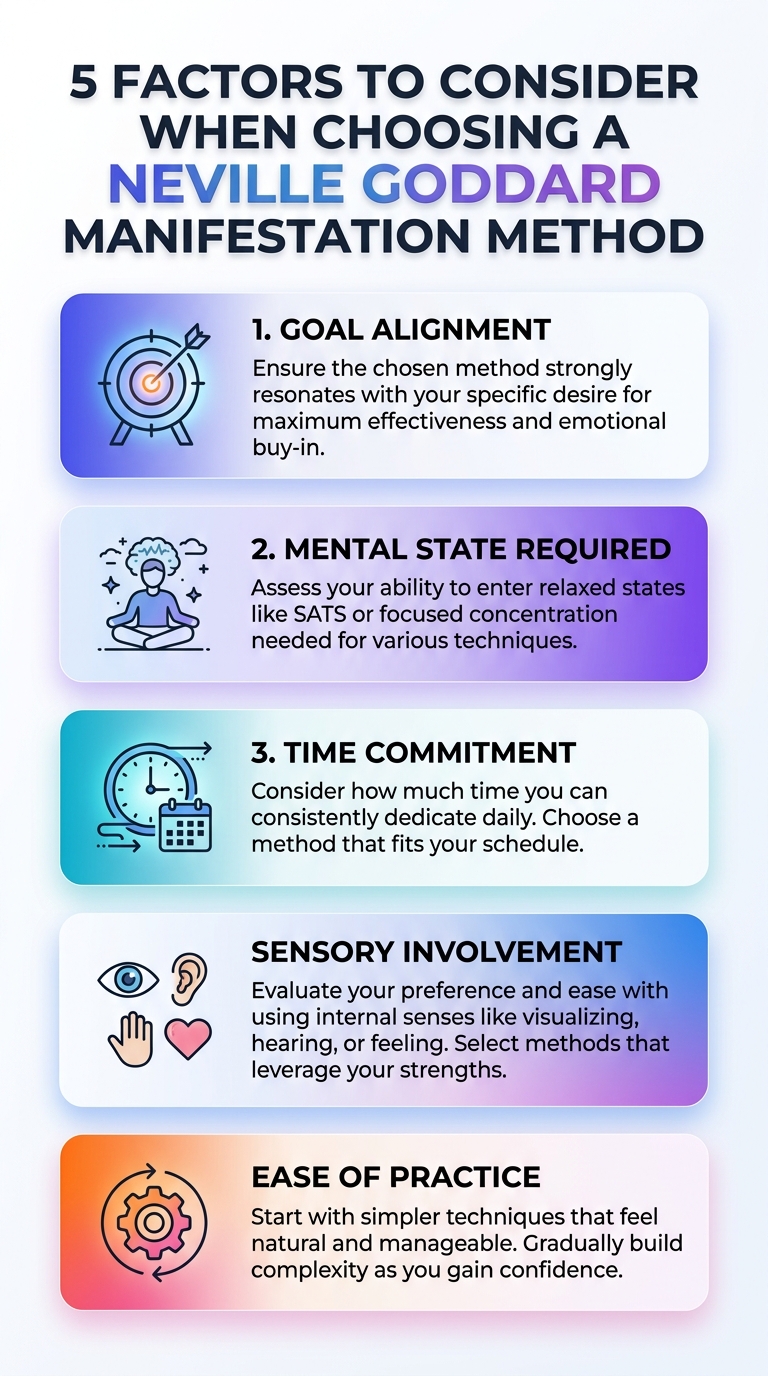
Discover the five factors to consider when choosing the right Neville Goddard manifestation method. This infographic helps you compare approaches and pick what resonates.
Sensory imaginal acts take the practice of visualization to a deeper level by engaging all five senses during the imagined scene. Rather than simply picturing an outcome, you feel the texture of objects, hear the sounds of your desired environment, smell the air, and inhabit the scene fully.
This approach is rooted in Neville’s teaching that the “feeling of the wish fulfilled” is the true engine of manifestation. The more real and complete your sensory experience during imagination, the more convincingly your subconscious mind accepts the scene as fact.
Choose sensory imaginal acts if you are a naturally kinesthetic or sensory person, if you find pure visual imagination feels flat, or if you want to deepen an existing SATS practice. Read the best practices for sensory imaginal acts to build a structured approach to this method.
“Live in the End” is less a discrete technique and more a continuous mental posture. It means spending your waking hours in the assumed state of your desire already being real, rather than waiting for conditions to change before you allow yourself to feel good.
This is arguably the most direct expression of the Law of Assumption in action. Every other technique, whether SATS, Revision, or sensory imaginal acts, is ultimately a tool for achieving this state. Once you can maintain it naturally throughout your day, the specific techniques become supports rather than requirements.
Choose “Live in the End” as your primary practice if you are comfortable with the concept of assumption and find structured imagination sessions disruptive to your daily flow. People with busy schedules often find this approach more sustainable because it does not require dedicated session time.
If you are newer to Neville’s teachings, use structured techniques to build the feeling first, then carry that feeling forward into your day using the Live in the End principle. Explore the full guide on the art of manifesting by living in the end for a detailed breakdown of how this works in practice.
One of the most practical ways to narrow down your options is to consider how you naturally process information and emotion. Neville Goddard’s methods each lean on different cognitive strengths.
| Learning Style | Best-Fit Method | Why It Works |
|---|---|---|
| Visual | SATS, Sensory Imaginal Acts | Rich imagery comes naturally; mental scenes feel vivid and real |
| Verbal / Analytical | “I Remember When,” Affirmations | Language-based framing is easier to sustain than pure imagery |
| Kinesthetic / Emotional | Sensory Imaginal Acts, Live in the End | Feeling-based approach aligns with natural emotional intelligence |
| Reflective / Introspective | Revision, “I Remember When” | Examining the past and rewriting it leverages analytical depth |
| Routine-Oriented | SATS (nightly), Daily Revision | Structured, repeatable sessions fit naturally into a fixed schedule |
Many people approach the question of how to choose the right Neville Goddard manifestation method by picking whichever technique sounds most impressive rather than whichever fits their current state and goal. This is the most common source of frustration.
Here are the mistakes worth avoiding:
Once you have a working understanding of how to choose the right Neville Goddard manifestation method for a specific purpose, you can begin combining techniques in a way that covers multiple dimensions of your practice.
A well-rounded daily practice might look like this:
This structure addresses past events, present awareness, and future planting in a single day. You do not need to practice all four elements every day. Even two of these consistently applied will generate noticeable momentum over time.
For a broader overview of all the techniques and where each fits, explore the complete Neville Goddard techniques guide and the full Neville Goddard article library for in-depth reading on each approach.
Choosing the right Neville Goddard manifestation method is not a permanent decision. Your emotional state on any given day should influence which technique you reach for, because resistance changes the effectiveness of each method in real time.
When you feel calm, open, and mentally clear, SATS and sensory imaginal acts work extremely well. Your relaxed state makes it easier to construct vivid, feeling-rich scenes without intrusion from doubt.
When you feel frustrated, anxious, or emotionally reactive, Revision is often more productive. Instead of trying to force a positive imaginal scene against a wall of negative emotion, Revision lets you work with that emotion by addressing its origin directly.
When you feel emotionally neutral but mentally busy, “I Remember When” framing requires less effort than full scene construction and can shift your inner state simply through the consistent use of past-tense language about your old limitations.
“You are already that which you want to be, and your refusal to believe it is the only reason you do not see it.” — Neville Goddard
Learning how to choose the right Neville Goddard manifestation method is not about finding the one perfect technique and applying it forever. It is about developing a fluid understanding of what each method does well, which situations it suits, and how your own mind responds to it.
Start with a single technique that matches your goal and cognitive style. Give it genuine, consistent effort for at least two to three weeks before drawing conclusions. Bring the feeling of the wish fulfilled into every session, because without that feeling, no method reaches its potential.
As you grow more comfortable with Neville’s framework, you will find that choosing the right Neville Goddard manifestation method becomes intuitive. You will recognize which approach your mind and emotional state need on any given day, and you will move between them with confidence rather than confusion.
The techniques are roads. The destination is always the same: a deeply held assumption that what you desire is already real.
And here is what took me years to understand. You were never broken. You never lacked the power. You simply had not been shown that the power was yours to direct. Once you understand that your imagination is not a nice hobby but the literal creative faculty of the universe operating through you — you stop looking for the perfect technique. You start using whatever tool gets you into the state. And the state does the rest.
As a beginner, the best way to choose the right Neville Goddard manifestation method is to start with either the “I Remember When” technique or SATS. Both require minimal setup, and “I Remember When” in particular does not demand strong visualization ability, making it approachable for anyone new to conscious imagining.
SATS remains one of the most consistently praised Neville Goddard methods because of how effectively it bypasses mental resistance through the hypnagogic state. However, “most powerful” depends entirely on the individual. The right technique is always the one you can feel most genuinely, not the one most frequently discussed online.
Revision works on past events by reimagining them as you wish they had occurred, rewriting emotional memory to shift your current self-concept. SATS works on future desires by looping a short wish-fulfilled scene in the drowsy state just before sleep. Choosing the right Neville Goddard manifestation method between these two depends on whether your focus is clearing the past or planting a new future.
Yes, combining methods is a common and effective approach. Many practitioners use Revision in the evening to clear the day’s limiting events and SATS at night to plant a desired scene. The key is not to scatter your focus across too many unrelated desires at once, but to apply different techniques toward the same core goal.
For specific person goals, SATS with a congratulatory or intimate scene involving that person is widely considered effective because it embeds the desired relational dynamic directly into the subconscious. The “I Remember When” framing also works well here, shifting your self-concept away from the story of rejection or distance and into one of natural connection.
Every method in this guide is a doorway into the same truth: that the power to reshape your reality lives in you, not in the technique itself. Whatever you are working to change — a relationship, a career, a financial situation, a state of health — the intelligence capable of rearranging the circumstances already exists within your own consciousness. The method is simply how you learn to trust it. Choose the one that lets you do that most naturally, and practice it with the devotion it deserves.
How long should I practice a Neville Goddard method before switching?
Give any single Neville Goddard manifestation method at least two to three weeks of consistent daily practice before deciding it is not working for you. Most practitioners who switch too early do so because of temporary doubt or inconsistency rather than a genuine mismatch between the method and their goal.
Yes, the “I Remember When” technique is particularly effective for financial goals because financial lack is often heavily tied to longstanding identity beliefs about scarcity. By consistently speaking and thinking about financial struggle in the past tense, you shift your self-concept toward one of someone for whom abundance is the norm, which is the psychological foundation Neville Goddard described as necessary for sustained material change.
For the complete guide to the Law of Assumption, see our definitive resource: The Law of Assumption — The Complete Guide.
For the complete step-by-step guide to the SATS technique, see: The SATS Technique — Neville Goddard’s Complete Guide.
To learn more about Neville Goddard’s life and complete body of work, read our definitive guide: Neville Goddard — The Complete Guide.
This is where most teaching gets it wrong. Most platforms sell instant manifestation — say the words once, feel the relief, and watch reality rearrange itself overnight. That isn’t the Law. It’s a practice, not a trick. Think of a concert pianist: even the greatest hands hit bum notes in rehearsal. What separates the people who occasionally manifest from those who live it isn’t talent or luck — it’s consistency and devotion, practiced when no one is watching. If it isn’t working yet, that’s never the Law’s fault. It’s always the application. Examine the practice, not the principle.
No matter what you are facing right now — housed within you lies the solution to every problem and the fulfilment of every desire. The same power that animates and created this entire universe exists in you, at your beck and call. Only you are the operant power. You have to activate it. And when you do, no problem, no circumstance, no situation can stand in its way. Fear not.
Over 14,000 people across 95 countries told Deloitte the same thing this year: imagination, not…
The "Other non-Christian" faith segment, which includes esoteric systems built on hermeticism laws, has grown…
When you search for kabbalah tree of life pictures, you are not just looking for…
A real frequency chart is not decoration, it is a map for the inner state…
You can feel like you are doing “everything right,” yet nothing changes. In 2026, over…
You can love the law of assumption persistence in theory, and still quit when your…