I know that gap intimately. I studied these principles for years before I experienced what I can only describe as complete confirmation. In 2018, during deep meditation, I felt an electrical current rise from the base of my spine and move upward, vertebra by vertebra. It was so intense I genuinely thought if it reached my head I would die. It did reach my head. And then it subsided. What followed over the next year — the out of body experiences, the movements along the spinal cord, the sensations inside the skull — was not something I had imagined. It was something that happened to me as a result of years of consistent inner practice.
The theory had become lived experience. And that is precisely what learning how to enter a state of consciousness is ultimately about — not understanding it, but inhabiting it so completely that it transforms you. rather than living inside it. Research on new learning shows that people retain only 30% of new information after an initial study session, which means most people are walking around with just enough knowledge of Neville’s teaching to understand it intellectually and not quite enough to actually occupy the inner state it points toward. That gap is exactly what this guide is designed to close.
Neville Goddard taught that every circumstance, relationship, and condition you experience is the outward projection of an inner state of consciousness. The key word here is entering.
Most people who study this teaching spend their time observing states. They think about what it would be like to have the thing they want. They analyze the concept of a state. They read about it, discuss it, and understand it quite well on paper.
But Neville’s entire teaching rests on one distinction: there is a difference between observing a state and assuming it. To assume a state means to put it on, the way you put on a coat. You are no longer standing outside looking at the coat. You are inside it. The coat is now your skin.
“Man’s chief delusion is his conviction that there are causes other than his own state of consciousness.” — Neville Goddard
This is also why Neville spoke of imagination as the only reality. Your imagination is not a tool you use. It is what you are. Your imagination is the Christ, the creative power Neville referenced throughout the scripture. When you enter a state through imagination, you are not pretending. You are exercising the most fundamental creative faculty in your nature.
Understanding this difference, between intellectual familiarity with a state and actually occupying it, is the foundation on which everything else in this guide rests.
Neville described several practical techniques across his lectures and books. Three of them are the most consistently applicable. Each one addresses a different entry point into a new inner state.
SATS is the practice of using the hypnagogic threshold, the drowsy borderland between waking and sleep, to bypass the critical, analytical mind and drop directly into a new inner state.
Here is how to do it in practice:
The hypnagogic threshold matters because the subconscious mind accepts instruction much more readily when the analytical layer is quiet. You are not telling yourself a story from the outside. You are planting an assumption directly into the inner state you are occupying.
For a full technical breakdown of this method, our SATS State Akin to Sleep guide walks through each step in detail.
If you want structured support for this practice, Mastering The State Akin To Sleep ($7.00) is a focused guide specifically designed to help you move from theory to consistent execution with this technique.
This method inverts the common approach. Most people wait until they can visualize a scene clearly before attempting to generate feeling. Neville’s instruction was the opposite: generate the feeling first, and allow the imaginal scene to follow naturally from it.
The feeling Neville described is not forced emotion. It is the quiet, settled sense that a thing is already done. It is the inner atmosphere of someone who has received what they wanted and is simply living from that reality now.
To practice this:
The feeling is the state. When you are genuinely in the feeling of the wish fulfilled, you are already inside the desired inner state of consciousness. That is the whole practice.
Revision is the practice of rewriting the past in imagination. Each night, before sleep, you review the events of the day. Any interaction or moment that left you in an undesired inner state, you revise in imagination so that it played out as you would have wished.
This is not denial. This is an active, imaginative rewrite that changes the emotional residue those events left in your inner state of consciousness.
Neville taught that by revising the past you are not only changing your current inner state but planting new assumptions into the creative medium of your imagination. The outer world, he insisted, will reflect the revision in time.
Revision is especially useful for people who find fresh SATS sessions difficult because their current inner state carries too much noise from the day. Revision clears that residue first, creating space for a cleaner entry into the desired state.
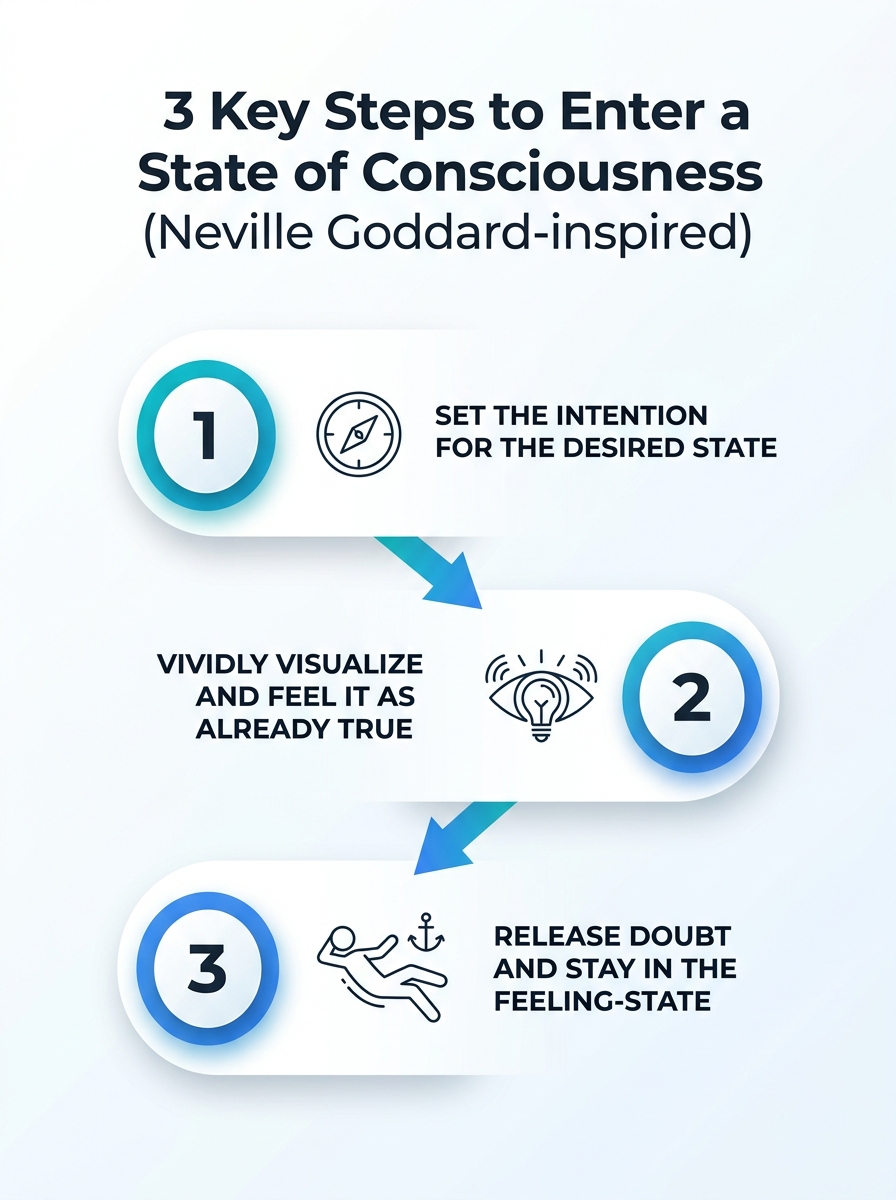
Neville Goddard-inspired visual guide outlining three practical steps to enter a state of consciousness. Use this infographic to visualize and apply the process.
This is where most people get stuck. They complete a SATS session or a revision and immediately ask themselves: did that work? That question is itself an exit from the state.
The internal signals that tell you a genuine entry has occurred are subtle. They are not dramatic. Here is what to look for:
If you are waiting for a powerful rush of certainty before believing you have entered the state, you are waiting for the wrong signal. The right signal is quiet and almost unremarkable. That quietness is what genuine assumption feels like.
Neville’s book The Power of Awareness is one of his most direct treatments of this exact question. It focuses entirely on the relationship between inner awareness and outer experience, and it is particularly useful for people who struggle to trust the subtle signals of state entry.
Neville’s instruction was not to visit a state once and expect a result. He taught that you must persist in the assumption. This is where persistence and obsession need to be carefully distinguished.
Persistence means returning to the inner state of consciousness regularly, gently, and without desperation. You revisit the feeling of the wish fulfilled each day. You do your SATS session. You revise when needed. You hold the assumption as your general inner orientation.
Obsession is something different. It is checking for results, forcing the session when you are not relaxed enough to enter the state properly, and treating each practice as urgent evidence-gathering. Obsession is actually a form of doubt. It is born from the assumption that the state has not taken hold yet, which contradicts the very assumption you are trying to occupy.
In practical terms, a single daily SATS or feeling-the-wish-fulfilled session is sufficient for most people. The session does not need to be long. Five minutes of genuine inner state entry is more useful than forty minutes of strained effort.
For a broader practical framework on working with your inner state day to day, our guide on moving to the right state of consciousness covers the day-to-day mechanics in detail.
These are the patterns we see most consistently interfere with genuine state entry.
Effort creates resistance. The inner state of consciousness Neville describes is entered through relaxation and acceptance, not through concentration or willpower. If you are straining, you are working against the process.
Entering a state requires a kind of mental softening. You are dropping into a new inner reality, not constructing one. The difference in felt sense is significant. Construction feels like pushing. Entering feels like allowing.
This is the most common pattern. A person enters a genuine inner state of consciousness during their session, feels the shift, and then in the next breath starts reviewing whether it was real, whether it will last, or whether they did it correctly. Each one of those doubt-thoughts is an exit from the assumed state. The practice is not just entering the state. It is remaining in it long enough for the assumption to register.
Many people wait until they can visualize a scene vividly before attempting to generate the feeling of the wish fulfilled. Neville’s method reverses this. The feeling comes first. The scene is secondary. If you cannot visualize clearly, the feeling alone is sufficient.
Every session that feels like a test for whether this teaching works is a session where you are already outside the state. The inner posture required is certainty, not experimentation.
Neville’s original texts remain the clearest and most direct source for understanding how to enter a state of consciousness. The following titles are particularly useful for practitioners at the stage of moving from theory into lived application.
The Law and The Promise is perhaps the most practically focused of Neville’s books. It pairs the mechanical instruction of state entry with documented accounts of people who applied the method. For someone who understands the theory but needs to see it in action, this is the right next read.
Neville’s approach to prayer is also deeply relevant here. His understanding of prayer is not petition to an external being. It is the act of occupying the inner state that corresponds to your desire, which is exactly the same process as state entry. Our detailed guide on how Neville Goddard approached prayer unpacks this connection fully.
For a complete grounding in the foundational principles behind all of these practices, the complete guide to Neville Goddard’s Law of Assumption is a strong starting point before working with the specific entry methods above.
Learning how to enter a state of consciousness Neville Goddard describes is not a matter of more information. You already have the information. It is a matter of crossing the threshold from understanding a state to actually occupying it from the inside.
The three methods in this guide, SATS, feeling the wish fulfilled, and revision, each offer a practical path across that threshold. The signals of genuine entry are subtle: naturalness, quietness, reduced resistance. The most important rule is surrender over effort.
Your imagination is the creative power Neville called the Christ, the God of scripture working through you. When you enter a desired inner state of consciousness through your imagination and hold it with persistence rather than obsession, you are doing exactly what Neville taught. The outer world, in time, reflects the inner state you have genuinely occupied.
Start with one method tonight. Choose SATS if you are a visual person. Choose the feeling of the wish fulfilled if feeling comes more naturally to you. Choose revision if your current inner state carries too much noise to enter anything fresh. The method matters less than actually entering. That is where the real work begins.
A: No. Neville consistently taught that a brief, genuine moment of inner state entry is enough. You do not need a sustained, vivid, or perfectly controlled experience. A single quiet settling into the feeling of the wish fulfilled, even for a few seconds, is functional. Perfection is a distraction from actually entering the state of consciousness.
A: Falling asleep during SATS is not a failure. Neville himself noted that sleep during the practice often allows the assumption to pass more deeply into the subconscious, where it can take root without interference from the waking analytical mind. If you consistently fall asleep before completing the scene, simply shorten the scene to a single impression rather than a full sequence.
A: Once daily is sufficient for most people. Neville’s instruction was persistence, not frequency for its own sake. One genuine session per day, done with real inner relaxation and actual state entry, is considerably more effective than multiple strained sessions motivated by anxiety about results. Consistency over time is what builds a permanent inner state.
A: This is almost always a sign that you are approaching the practice with effort rather than surrender. If nothing feels real, stop trying to make it feel real. Instead, simply ask: what is the most natural, undramatic version of how this would feel? Start there, with the smallest, quietest version of the feeling, rather than reaching for a complete experience. The state of consciousness does not need to feel cinematic to be genuine.
A: Neville’s teaching was that your dominant inner state at any given time is singular. You can work on different desires across separate sessions, but within each session you occupy one specific assumed state. Trying to hold multiple assumed states simultaneously typically results in occupying none of them fully. Focus on one clear inner state per session and allow each practice to be complete in itself.
Discover Neville Goddard’s teachings, manifestation, consciousness and daily inspiration inside our thriving Facebook community.
For the complete guide to the Law of Assumption, see our definitive resource: The Law of Assumption — The Complete Guide.
For the complete step-by-step guide to the SATS technique, see: The SATS Technique — Neville Goddard's Complete Guide.
To learn more about Neville Goddard's life and complete body of work, read our definitive guide: Neville Goddard — The Complete Guide.
Join The Facebook Group →Over 14,000 people across 95 countries told Deloitte the same thing this year: imagination, not…
The "Other non-Christian" faith segment, which includes esoteric systems built on hermeticism laws, has grown…
When you search for kabbalah tree of life pictures, you are not just looking for…
A real frequency chart is not decoration, it is a map for the inner state…
You can feel like you are doing “everything right,” yet nothing changes. In 2026, over…
You can love the law of assumption persistence in theory, and still quit when your…