If you have spent any meaningful time with Neville Goddard’s work, you already understand that learning how to interpret the Bible using state of consciousness is not a supplementary reading method — it is the only method Neville ever endorsed. For him, the Bible was never a chronicle of historical events or a moral rulebook. It is a precise psychological document describing the movement of human awareness through inner states, and every character, location, and miracle within it refers to processes happening within you right now.
Neville Goddard was unambiguous on this point: the Bible is not history. It is, in his precise language, a drama taking place in the soul of man. Every prophet, every king, every enemy, every miracle recorded in scripture corresponds to a definable psychological reality — a state of consciousness that a human being can enter, inhabit, and depart from.
This is not a fringe interpretation grafted onto the text. Neville argued that the authors of scripture wrote entirely in this psychological language, and that reading it literally is the error that has kept its teachings inaccessible. When you read that the children of Israel were enslaved in Egypt, you are reading a description of what it feels like to be imprisoned by sense evidence — to believe only what the physical world confirms rather than what imagination declares.
The moment you grasp this, the entire Bible opens in a way that no amount of theological study could produce. You stop asking whether events happened and start asking what inner movement each story is describing. That shift in reading posture is the foundation of everything that follows.
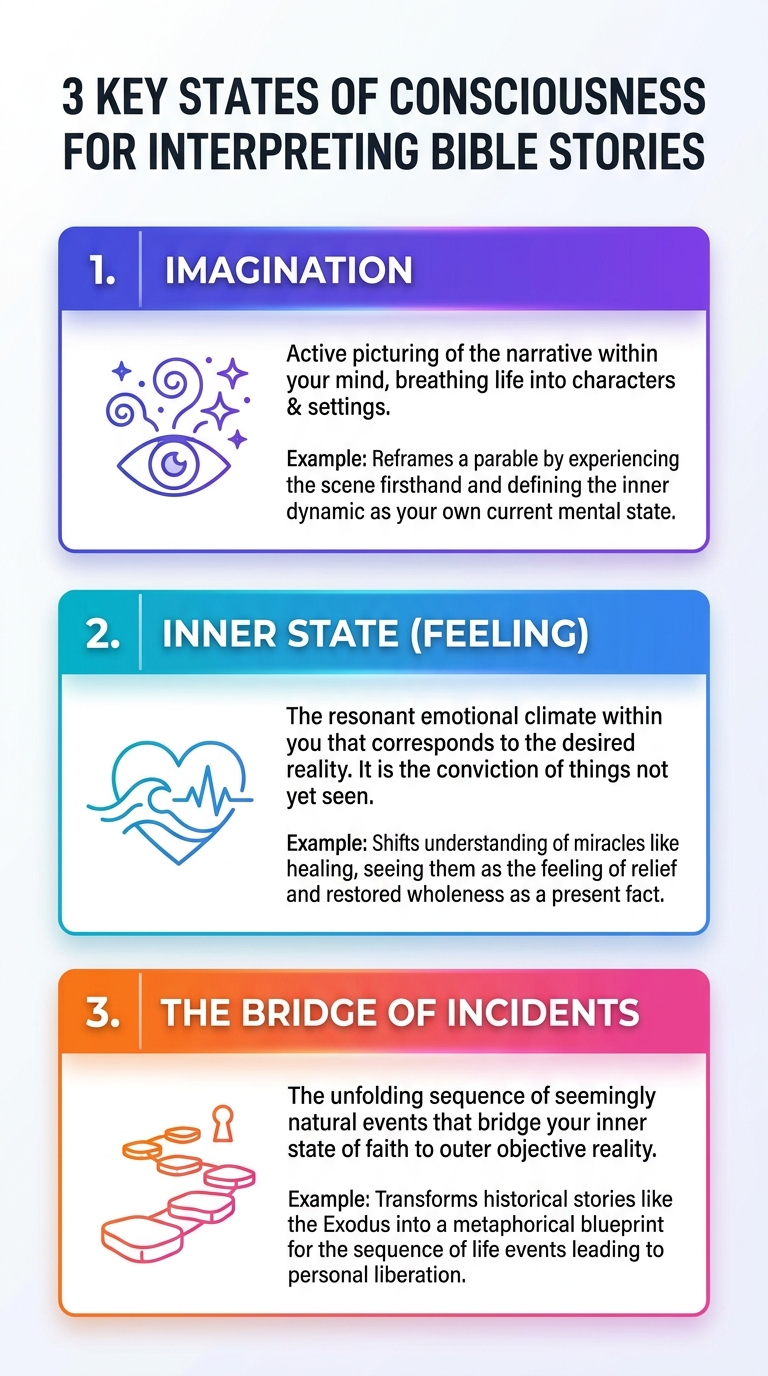
Three states of consciousness guide the interpretation of Bible stories. This infographic helps readers see biblical narratives through different perceptual lenses.
For the complete guide to reading scripture as a consciousness map, see: Esoteric Bible Interpretation — The Complete Guide.
To learn more about Neville Goddard’s life and complete body of work, read our definitive guide: Neville Goddard — The Complete Guide.
The phrase “state of consciousness” is used so often in Neville’s circle that its precision can be taken for granted. It is worth pausing here to define it exactly, because the quality of your scriptural reading depends on this clarity.
A state of consciousness is the totality of what you accept as true about yourself and your world at any given moment. It includes your assumptions, your self-concept, the feelings that arise automatically when you think about specific areas of your life, and the inner conversation you run without effort. You do not build a state consciously. You occupy it. And the outer events of your life are the faithful projection of whatever state you are currently inhabiting.
Neville identified specific states as having biblical names. Poverty, illness, conflict, and fear each have their scriptural equivalents: Egypt, the wilderness, Babylon, the valley of dry bones. Fulfillment, abundance, peace, and creative power also have their equivalents: the Promised Land, Jerusalem on the mountain, the resurrection, the feast at Cana. Scripture moves its characters between these states, and in doing so it is teaching you how to move between them yourself.
Once you accept that scripture is psychological, the characters become immediately intelligible in a new way. Abraham is not simply a Mesopotamian patriarch. He is the state of one who has heard the call of a greater identity and left behind the familiar limits of the sensory world to follow an inner promise. His journey from Ur of the Chaldeans is the journey out of reasoning based entirely on what the physical senses report.
Moses represents a state of intense desire for liberation — the consciousness of one who has recognized bondage and is willing to confront the entrenched belief systems that maintain it. Pharaoh, correspondingly, is the hardened reasoning mind that refuses to release its grip on what it knows. The plagues are not punishments inflicted from without but the natural dissolution of a state that can no longer sustain itself when a higher consciousness presses against it.
David is the state of the beloved, the man after God’s own heart, who knows that imagination is his sovereign faculty. Goliath is the state of the seemingly overwhelming external problem — and David’s victory is a precise instruction: the problem is never as real as the inner certainty you bring to meet it.
The deeper you move into Neville’s approach to these teachings, the more you find that no character in scripture is merely a person. Every one of them is a state you have already occupied or will occupy, and their stories are your story told in advance.
Knowing that scripture is psychological is the beginning. Applying that knowledge requires a specific reading practice that Neville developed through decades of teaching. Here is how we recommend approaching any passage:
This method is developed thoroughly in Neville’s own books. The Law and the Promise remains one of the clearest demonstrations of this approach in print, with documented accounts of people applying scriptural states consciously and producing specific outer results.
No element of Neville’s biblical reading is more central than his interpretation of the name I AM. When God speaks to Moses from the burning bush and declares “I AM THAT I AM,” Neville reads this as the disclosure of the creative mechanism within every human being. Your awareness of being — the simple, undeniable fact that you exist and are present — is what that name points to.
Every time you say “I am poor,” “I am sick,” “I am unloved,” you are filling the creative name with a specific state. Every time you say “I am well,” “I am fulfilled,” “I am free,” you are filling the same name with a different state. The outer world, in Neville’s framework, has no choice but to arrange itself around whichever state you have consistently occupied. This is not metaphor. It is the operating instruction of the entire biblical text.
The Christ of the New Testament is, for Neville, the human imagination itself — the creative power within you that can receive the wish fulfilled as real and hold it there until it externalizes. The crucifixion is the fixing of a desired state in imagination despite the contradiction of present sense evidence. The resurrection is that state breaking through into physical manifestation. Understanding this makes the entire New Testament readable as a manual for conscious creation rather than a biography of a singular historical figure.
Neville’s The Power of Awareness addresses this creative identity directly, and we consider it essential reading for anyone working seriously with scriptural states.
A few specific narratives illustrate this reading method with particular clarity.
The entire Exodus narrative is the story of a state of awareness moving from bondage to freedom. Egypt is the state of complete identification with physical evidence — believing that what is seen, measured, and confirmed by the senses is all that is real. Pharaoh represents the intellectual arguments and habitual beliefs that enforce this identification. The plagues are the systematic failure of every rational justification for remaining in that state. And the crossing of the Red Sea is the moment of complete psychological release from the prior state — a crossing that must be made decisively and without looking back.
Joseph is the imagination itself — the dreamer whose visions seem grandiose and offensive to the brothers, who represent the rational, sense-bound faculties. The pit, the slavery in Egypt, and the imprisonment are the experiences imagination endures when the reasoning mind attempts to suppress it. Joseph’s eventual elevation to the position of authority over Egypt — the position from which he feeds the world during famine — is imagination in its sovereign role, providing substance from inner resources when the outer world appears barren.
Water is turned to wine. This is not a conjuring trick. In Neville’s reading, water represents ordinary consciousness — the natural state of unelevated awareness. Wine represents the heightened state of imagination operating from the assumption of fulfillment. The instruction to fill the jars “to the brim” is an instruction to hold the desired state with completeness, without reservation. The servants who carry out the instruction without understanding how it works are the subconscious processes that faithfully serve whatever state the conscious mind commits to fully.
If you want a structured reference that maps these and many other narratives in detail, our complete Neville Goddard biblical interpretation guide is the most thorough resource we offer for this purpose.
One of Neville’s most repeated instructions was to “live in the end” — to inhabit the state of the wish fulfilled before any outer evidence supports it. This is not a technique Neville invented. He drew it directly from his reading of scripture.
When Abraham is given the promise of a son, the instruction is accompanied by a name change: Abram becomes Abraham, meaning “father of multitudes,” long before Isaac is born. He is required to occupy the state of fatherhood — to wear it, speak from it, and move through his days as a man who is already what the promise declares — before any biological evidence appears. That is living in the end.
When Joshua is told that the Promised Land has been given to the children of Israel, the giving is declared in the past tense before a single city has been entered. The state of possession must precede the physical entry. This is the consistent instruction of the entire biblical narrative, and it is why Neville found the text so inexhaustibly useful as a practical guide.
We explore this principle in depth in our article on Neville Goddard’s live in the end technique, which covers both the scriptural basis for the method and practical ways to apply it in daily life.
Within this framework, prayer takes on an entirely different character than its conventional religious meaning. For Neville, prayer is not petition. It is not asking a being outside yourself to intervene on your behalf. Prayer is the deliberate act of entering a state of consciousness — specifically, the state of the wish already fulfilled — and persisting in that state until it externalizes as physical fact.
The biblical instruction to “pray believing you have already received” is not a poetic flourish. It is a technical instruction. The feeling of having — not wanting, not hoping, but having — is the substance of effective prayer in Neville’s reading. This makes the entire practice of prayer an internal act of assuming a specific state and holding it with emotional reality.
Neville’s text Prayer: The Art of Believing addresses this at length, and we find it one of the most precise practical guides to understanding biblical prayer as a state-based practice rather than a verbal exercise.
For those who are ready to approach the Bible this way consistently, the question of where to start is worth addressing directly. We do not recommend beginning with the most allegorically dense passages. Start with the narratives that carry the most emotional weight for you personally — the stories that have always seemed most significant, even if you could not previously articulate why. Those stories are likely addressing the states most relevant to your current inner life.
Read slowly. Read one passage at a time. After identifying location, protagonist, and state change, ask yourself a direct question: what state am I currently occupying, and what state is this passage calling me to enter? Then apply the answer to your own inner conversation, your assumptions about yourself, and your imaginative activity before sleep.
The Neville library we maintain at TrueCosmic is organized to support this kind of methodical reading. The lectures and texts available there provide both scriptural commentary and practical instruction in the same body of work, which makes the movement between theory and application relatively seamless.
For foundational texts, Your Faith Is Your Fortune and Seedtime and Harvest both translate specific scriptural passages into direct psychological instruction. They are among the most accessible entry points into this method for readers who are new to Neville’s work, while still offering depth for those who have been engaged with his teachings for years.
Learning how to interpret the Bible using state of consciousness is not an academic project. It is a living practice that changes how you read, how you think, and ultimately how you move through your own life. Neville Goddard’s approach removes the distance between the reader and the text by insisting that you are not studying scripture from the outside — you are reading your own psychological autobiography, written in advance, by an awareness that knows every state you will ever occupy.
Every enslaved Israelite is you in a state of limitation. Every resurrected figure is you in a state of renewal. Every promised land is a desired inner state awaiting your conscious occupancy. The Bible does not describe what God did for people long ago. It describes what imagination does within you now, and what it will continue to do as you become more deliberate about the states you choose to inhabit.
We have built TrueCosmic’s resources around this conviction, and if you are ready to go deeper, our esoteric knowledge resources and the full range of Neville’s texts in our library are the most direct path forward we can offer.
A: No. Neville consistently taught that the value of his scriptural reading lies precisely in its independence from religious tradition. The method of interpreting the Bible using state of consciousness is a psychological reading practice, not a theological one, and it works whether you come from a religious background or none at all. The only requirement is a genuine willingness to read the text as a description of inner experience.
A: Look at the location, the emotional condition of the protagonist, and the direction of movement in the narrative. Where is the character starting (Egypt, wilderness, bondage) and where are they moving toward (Canaan, freedom, promise)? That movement maps directly onto the inner shift the passage is asking you to make. Neville’s own books provide consistent examples of this mapping applied to specific texts, which makes them invaluable as a reference.
A: Symbolic reading tends to stop at identifying what a figure or event represents in an abstract sense. Reading the Bible through state of consciousness goes further: it asks you to identify the precise inner condition each symbol describes and then to physically enter that condition through imagination and assumption. The difference is between analysis and participation. Neville was interested only in the latter.
A: Neville drew from both Testaments extensively and considered them a single unified psychological document. The New Testament, in his reading, describes the fulfillment of what the Old Testament promises — the full awakening of the imagination to its creative identity as Christ. The life of Jesus in the Gospels is, for Neville, a precise psychological biography of the human imagination moving through states of assumption, trial, death to a prior state, and resurrection into a new one. Both Testaments read as one continuous instruction in the same method.
Over 14,000 people across 95 countries told Deloitte the same thing this year: imagination, not…
The "Other non-Christian" faith segment, which includes esoteric systems built on hermeticism laws, has grown…
When you search for kabbalah tree of life pictures, you are not just looking for…
A real frequency chart is not decoration, it is a map for the inner state…
You can feel like you are doing “everything right,” yet nothing changes. In 2026, over…
You can love the law of assumption persistence in theory, and still quit when your…