Stop Self-Doubt with Powerful Affirmations
If you want to stop self-doubt with affirmations, you need more than a list of positive phrases — you need to understand why the method works. I grew up being told that doubt was spiritual failure. That if you wavered, you lacked faith. What I eventually understood — after years of searching, and one full breakdown of everything I thought I knew — is that doubt is not the enemy. Untrained doubt is. The mind that has never been shown how to redirect itself will default to fear every time. That is not weakness. That is just an unpractised skill.
Affirmations are how you practise it. Not as wishful thinking — as deliberate mental conditioning. And when you understand why they work, learning to stop self-doubt with affirmations becomes one of the most powerful tools you have.
If you’ve ever wanted to stop self-doubt with powerful affirmations but weren’t sure where to begin, you’re not alone. Self-doubt is one of the most common mental barriers people face, and affirmations, when used correctly, are one of the most direct tools for addressing it at its root.
Self-doubt doesn’t arrive out of nowhere. It builds slowly over time, shaped by repeated experiences of criticism, failure, comparison, and the stories we tell ourselves about those experiences.
The mind is remarkably good at pattern recognition. Once it forms a belief, it tends to look for evidence that confirms it. If you believe you’re not capable, your mind will notice every small mistake and filter out your successes. This confirmation loop is what keeps self-doubt in place long after the original cause has passed.
This is why simple willpower or positive thinking rarely breaks the cycle. Telling yourself to “just be more confident” doesn’t work because it doesn’t address the underlying pattern. What’s needed is a consistent, deliberate practice that gradually replaces old thought patterns with new ones.
That’s precisely where affirmations come in. They aren’t magic words. They’re a method of deliberately redirecting mental attention, again and again, until a new pattern takes hold.
Self-doubt often lives in the space between who you are and who you think you should be. Most people never question whether that gap is real or simply a story they’ve accepted. Affirmations create a habit of questioning that story.
They prompt you to ask: What if I actually can do this? What if my doubts are wrong? That subtle shift in questioning is where real change begins.
When you learn how to stop self-doubt with affirmations, you are working with a simple psychological principle: repeated thoughts shape beliefs, and beliefs shape behavior. When you consistently speak or think a statement that reflects confidence, capability, or worth, you begin to build a new internal reference point.
This process isn’t instant, and it isn’t passive. It requires active engagement. The person who reads a list of affirmations once a day while distracted will get very little from the practice. The person who pauses, breathes, and actually feels what they’re saying will notice a genuine shift over time.
Research in cognitive psychology has consistently shown that self-talk, the internal conversation running in your mind, has a measurable effect on performance, confidence, and emotional regulation. Affirmations are a structured way to take control of that self-talk rather than leaving it to default patterns.
The most important thing to understand is this: an affirmation is not a lie you tell yourself until you believe it. It’s a statement of intention and identity. It describes the person you are choosing to become, and it gives your mind a clear direction to move toward.
When you repeat a phrase like “I trust my own judgment” or “I face challenges with calm and clarity,” you are not pretending those things are already fully true. You are training your mind to treat them as real, possible, and worth moving toward.
Over time, that training changes how you respond in difficult situations. The confident response begins to feel natural because you have rehearsed it, mentally and verbally, hundreds of times.
One of the most important distinctions in learning to stop self-doubt with affirmations is feeling. Affirmations that work versus affirmations that don’t come down to one thing: Words alone carry limited weight. Words paired with genuine emotion carry a far greater impact on the mind.
Think about how easily a cruel or dismissive comment from someone you respect can stick with you for years. The words were short, maybe only a sentence or two, but the feeling attached to them made them memorable. The same principle works in your favor when you use affirmations with deliberate emotional engagement.
Neville Goddard explored this idea extensively in his work. In Feeling Is the Secret, he argued that the feeling behind a thought, not the thought itself, is what impresses the deeper mind and produces lasting change. This idea aligns closely with what we now understand about how memory and belief are formed.
When you speak an affirmation, try to actually feel what it would feel like to believe it. If you’re affirming “I am capable and confident,” pause for a moment and let that feeling settle. Recall a time when you did feel capable. Let that memory color your words.
This isn’t about forcing fake emotions. It’s about deliberately bringing warmth, sincerity, and intention to your words rather than reciting them on autopilot.
The difference in outcome between these two approaches, automatic recitation versus emotionally engaged repetition, is significant. The latter tends to produce noticeably faster shifts in both mood and mindset.
The most effective way to stop self-doubt with affirmations is through consistent, structured practice — not sporadic effort when you feel low. If you approach affirmations like a daily habit, something you do at the same time each day with intention, you’ll get far more from them than if you dip in and out whenever you feel low.
Here is a practical structure that works well for most people:
The key is regularity over intensity. Fifteen minutes a day, every day, will outperform two hours once a week. Your mind changes through repetition, not through occasional effort.
You’ll also find that as the practice becomes familiar, the resistance drops. The affirmations that once felt hollow begin to feel possible, and then natural. That shift, from disbelief to genuine inner recognition, is the moment the practice is working.
The specific words you choose in your affirmations matter. Vague, sweeping statements tend to be less effective than precise, grounded ones. Compare these two examples:
“I am amazing and successful at everything.”
“I trust myself to handle what comes my way.”
The first statement is so broad that your mind may immediately reject it. The second is specific enough to feel believable while still pushing past your current comfort zone.
Good affirmations tend to have a few qualities in common:
If you struggle with self-doubt in your work, write affirmations about your professional capability. If your doubt shows up in relationships, write affirmations about your worthiness of connection and your ability to communicate clearly.
The more targeted your affirmations are, the more direct their impact on the thought patterns causing your doubt.
Affirmations and visualization are natural partners. When you combine a spoken or written statement with a mental image of what that statement looks like in practice, you give your mind two forms of input at once, verbal and visual.
For example, if your affirmation is “I speak clearly and confidently in front of others,” you might close your eyes after repeating it and see yourself doing exactly that. You imagine the room, the faces, the steady sound of your own voice. You let the scene feel real for a moment before returning to your normal state.
This kind of guided mental rehearsal has a long history in performance psychology, used by athletes, speakers, and musicians. It works because the mind processes a vividly imagined experience in ways that overlap significantly with how it processes a real one.
We have a practical guide called the Meditation Visualization Exercise, available for just $2.99, that walks you through this process step by step. It’s designed to help you move past surface-level positive thinking and into a deeper, more engaged mental state where real reconditioning takes place.
The combination of spoken affirmations and clear visualization is more than just a feel-good practice. It builds a concrete mental model of the version of yourself you’re working toward, and that model becomes a reference point your behavior begins to align with.
Neville Goddard was a mid-twentieth century teacher whose work focused on the relationship between inner states and outer experience. His core argument was simple: consciousness creates reality, and you have far more control over your consciousness than you might think.
While his framework has a spiritual dimension, much of what Goddard taught aligns naturally with what we now understand about the psychology of belief and self-concept. His writings are particularly useful for anyone working to overcome deeply held self-doubt because they speak directly to the question of identity.
In The Power of Awareness, Goddard makes the case that what you are aware of, meaning what you hold as true about yourself in your own mind, is the deciding factor in how your life unfolds. Not your past. Not your circumstances. Your present awareness of self.
This is a meaningful idea for anyone struggling with self-doubt, because it reframes the problem entirely. The question becomes not “how do I fix my past?” but “what am I choosing to be aware of right now?” Affirmations are a direct, practical answer to that question.
In Your Faith Is Your Fortune, Goddard explores how belief functions as a creative force. He wrote that faith, in this context meaning genuine inner conviction, is not something you wait to receive. It is something you cultivate through practice and intention.
That perspective is highly relevant to affirmation work. You don’t wait until you feel confident to begin affirming confidence. You build the inner sense of confidence through consistent practice, and behavior follows.
His book At Your Command is another useful resource for understanding how to direct your own mental state deliberately rather than reacting to whatever thought patterns happen to arise.
Generic affirmations have their place, but targeted ones tend to work faster because they speak directly to the mental pattern causing trouble. Here are examples across the most common areas where self-doubt tends to show up.
Work with a small set of three to five affirmations at a time rather than an overwhelming list. Depth of engagement with a few statements is more effective than shallow contact with many.
Our resource Your Powerful Mind provides structured guidance on building this kind of focused mindset practice, drawing on affirmation techniques alongside mental clarity work that helps you identify and address the specific thought patterns behind your doubt.
Even people who are genuinely committed to affirmation practice often get less from it than they could because of a few consistent errors. Understanding these mistakes makes it much easier to avoid them.
If you’re saying an affirmation while simultaneously thinking “this is stupid and it won’t work,” the skeptical thought is louder than the affirmation. You don’t need to believe the statement fully from the start, but you do need to approach it with at least a degree of openness.
A useful way to bridge that gap is to add the phrase “I am open to the possibility that…” at the beginning of an affirmation when the direct statement feels too far from your current reality. “I am open to the possibility that I am capable of this” is more honest and thus more effective than a statement your mind immediately rejects.
Many people choose affirmations based on what they’ve seen online rather than what specifically addresses their own pattern of self-doubt. This leads to generic practice with minimal personal resonance.
Take time to identify exactly where your doubt lives. What specific thought comes up most often? What do you say to yourself when you fail or feel embarrassed? Work backward from that to write affirmations that speak directly to it.
Affirmations replace deeply ingrained mental patterns. Those patterns didn’t form overnight, and they won’t dissolve overnight either. Most people who give up on affirmations do so too early, often just before a genuine shift would have occurred.
Commit to a practice for at least 30 days before evaluating its effectiveness. Track subtle changes in how you feel, how you respond to criticism, and how often the self-doubting voice shows up. Progress is often quieter than people expect.
Affirmations are most effective as a preventative practice, not just a crisis management tool. Using them only when self-doubt has already peaked is like drinking water only after you’re already severely dehydrated. A daily practice that builds your baseline confidence makes you far less vulnerable to acute episodes of doubt in the first place.
To truly stop self-doubt with affirmations at the deepest level, you have to work on self-concept: the story you carry about who you are and what you’re capable of. For many of us, that story was handed to us by religion, by family, by institutions that told us we were fundamentally flawed — born sinful, born lacking, needing external authority to be whole. That is a story. And stories can be rewritten.
Affirmations work at the level of self-concept, not just at the level of individual thoughts. This is what makes them more than just temporary mood boosters.
When your self-concept shifts, your behavior shifts with it. You stop second-guessing your decisions because you genuinely trust yourself more. You stop avoiding challenges because they no longer feel like threats to your identity. You stop interpreting neutral feedback as personal attack because your sense of self is no longer fragile.
This is why Neville Goddard’s emphasis on self-concept resonates so strongly within the affirmation community. His framework in Seedtime and Harvest explores how the seeds we plant in our inner mental life are what grow into our outer experience. Affirmations are those seeds.
He also addressed the relationship between belief and prayer in Prayer: The Art of Believing, where the act of sincere internal declaration is treated not as wishful thinking but as a genuine creative act that reshapes experience from the inside out.
You can explore the breadth of Goddard’s written work through the Neville Teachings collection, which brings together his core texts in one place.
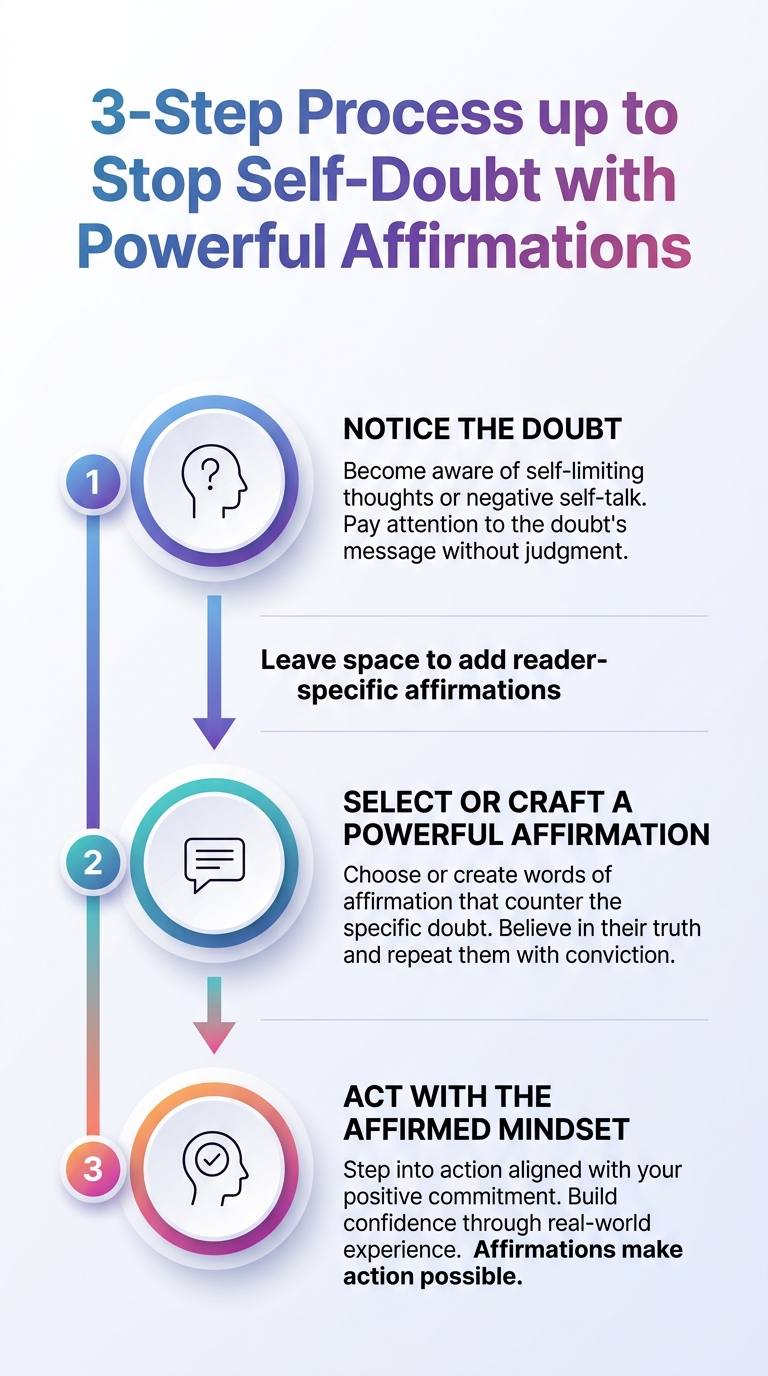
A visual guide that breaks down a practical 3-step approach to stop self-doubt with powerful affirmations.
To learn more about Neville Goddard’s life and complete body of work, read our definitive guide: Neville Goddard — The Complete Guide.
One of the genuine challenges when you stop self-doubt with affirmations is maintaining the practice during periods of stress, disappointment, or setback. These are precisely the moments when self-doubt tends to rush back in, and when consistent practice becomes most important and most difficult.
A few strategies help here:
When you’re overwhelmed, a full affirmation ritual may not be realistic. On those days, one sentence repeated quietly to yourself is enough. “I am still capable. I am still here.” The point is to maintain the habit, even in minimal form, rather than abandoning it entirely.
Write an affirmation specifically for the moments after failure or rejection. Something like “I recover from setbacks because they are part of the process” is far more useful in a difficult moment than a generic statement about abundance or joy.
If you miss several days, the worst response is to shame yourself about it. That simply reinforces the self-critical pattern you’re trying to change. Notice that you drifted, return to the practice, and move forward without making the gap mean anything negative about you.
Affirmation practice isn’t only for damage control. Using it immediately after a success, to reinforce what went right and why, is equally valuable. “I handled that well because I trusted myself” builds the same mental pathway as any morning practice, perhaps even more effectively because the emotion tied to it is genuine and immediate.
Affirmations are a daily tool, but they work best within a broader commitment to understanding your own mind. The more you understand how belief is formed and how your inner state shapes your experience, the more intentionally you can work with affirmations.
Neville Goddard’s audiobook Imagination Creates Reality explores how the imaginative mind, not just conscious thought, plays a role in shaping what we experience. Listening to this kind of material, especially during walks or quiet time, reinforces the principles behind affirmation work in a format that doesn’t require dedicated reading time.
For those who are ready to go beyond individual affirmations into a fuller understanding of how mental states create outcomes, the Manifesting Mastery section of our site covers these principles in depth. It connects the practical daily habit of affirmations with the broader philosophical and psychological framework they sit within.
You can also browse our complete Affirmations resource library, which includes content on daily affirmation routines, self-concept work, and targeted practices for specific life areas.
If you prefer structured programs, our full collection brings together digital guides, affirmation programs, and mindset resources at accessible price points, most under $10, so getting started doesn’t require a major financial commitment.
Learning to stop self-doubt with powerful affirmations is not about pretending to feel something you don’t. It’s about building a disciplined, consistent practice that gradually replaces old thought patterns with ones that actually serve you.
The process takes time. It takes genuine engagement, not passive repetition. And it works best when you understand the principles behind it — why feeling matters, why self-concept is the real target, and why daily practice outperforms occasional intensity.
Self-doubt is a habit of mind. For more on handling doubt specifically while you are manifesting, see How to Deal with Negative Thoughts While Manifesting. Confidence is also a habit of mind. The difference between them is what you choose to practise.
And I want to leave you with this. Every person who ever told you that you were not enough — every voice, internal or external, that convinced you the power was somewhere else, in someone else, beyond your reach — was wrong. You were born with the same creative intelligence that runs this universe. It has never left you. The only question is whether you are willing to practise claiming it.
Start today. One affirmation. Spoken with feeling. Meant.
There is no single timeline that applies to everyone, because it depends on how deeply held the self-doubt is and how consistently the practice is maintained. Most people who engage genuinely with a daily affirmation practice, spoken aloud with emotional engagement, begin to notice subtle shifts in their thinking within two to four weeks. A more thorough change in baseline confidence typically develops over two to three months of consistent practice.
That discomfort usually means the affirmation is genuinely challenging a belief you currently hold, which is exactly the point. The resistance you feel when saying “I am confident and capable” is the sound of an old belief being questioned. Rather than stopping, try softening the statement to something like “I am becoming more confident each day” and work your way toward the stronger version as the practice becomes more familiar.
Affirmations work on their own as a starting point, but they tend to produce faster and deeper results when combined with related practices. Visualization, journaling, meditation, and working to understand the root of your self-doubt all reinforce what affirmations begin. Think of affirmations as the foundation of a larger mindset practice rather than the entire structure.
Affirmations are deliberate, structured, and targeted. Random positive thoughts float through the mind without direction or intention behind them. Affirmations are chosen specifically to address identified patterns of self-doubt, repeated at consistent times with genuine emotional engagement, and designed to build a new self-concept over time. The structure and intention are what separate affirmation practice from casual positive thinking.
Enter your email and get instant FREE access to your report.
No credit card required. 🔒 Your details are secure. You can unsubscribe at any time.
When people ask me for the crossing the Red Sea meaning, I do not reach…
The parable of the hidden treasure meaning, as I now understand it, is the simplest…
Alchemy in the Bible is not found in a laboratory, a crucible or a secret…
What does the Bible say about witchcraft? It is a question I have a personal…
Who were the Amalekites? On the page of scripture they are a desert people who…
I grew up in a working-class family, and we believed our fortunes hinged on which…