
Esoteric Knowledge
Christ Consciousness in the Bible: The Esoteric Interpretation
Only 20% of Americans now say they view the Bible as the literal word of God, a record low according to Gallup. That collapse in literal reading has opened space for something older than the modern debate over history versus myth: a reading of scripture that treats “the Christ” not as a surname belonging to one man two thousand years ago, but as a state of consciousness available to anyone who meets its conditions. This is the esoteric interpretation of Christ consciousness in the Bible, and it runs quietly alongside the historical reading in Gnostic texts, in nineteenth and twentieth century mystical schools, and in the teaching of Neville Goddard, who put the matter as plainly as it has ever been put: Christ is the human imagination.
Most people encounter the word “Christ” in the Gospels and assume it functions the way “Smith” or “Johnson” does , a name attached to a person. It doesn’t. In the Greek of the New Testament, “Christ” translates the Hebrew idea of the anointed one, a title describing a condition of consciousness rather than an identity. Jesus, in this reading, is the biblical figure who fully embodied that anointed state , the man who realized it completely and demonstrated what a life lived from it looks like. “The Christ,” by contrast, is the state itself: the awakened, unified awareness that scripture insists is available to all, not reserved for one. Holding these two things apart , Jesus the man, and the Christ as an inner state he embodied , is essential to everything that follows, because the Gospels themselves keep pointing past the man toward the state.
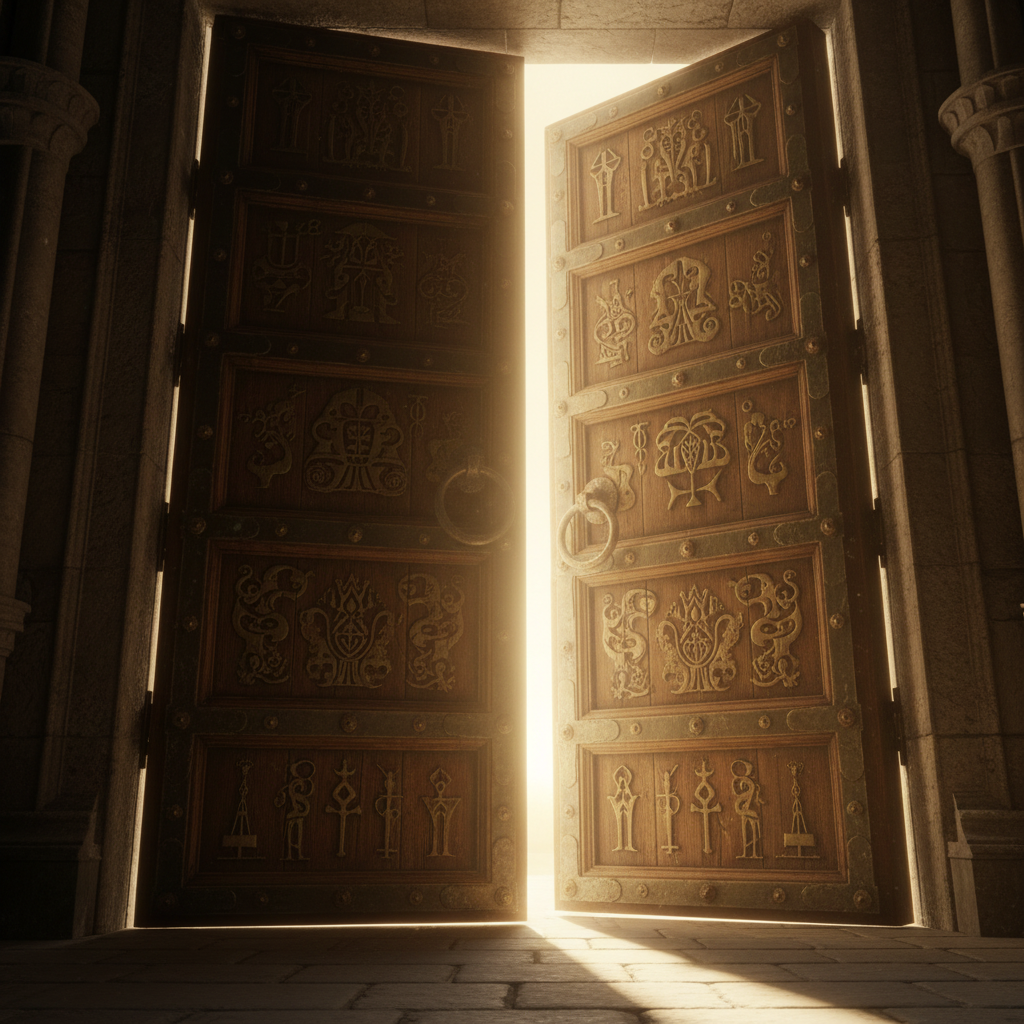
Christ Consciousness in the Bible: Key Gospel Passages
Two verses carry an unusual amount of weight in this reading, and both reward slow attention. The first is John 10:30, where the Gospel writer records the line, “I and the Father are one.” Read historically, this is a claim of divine sonship made by a specific man in first-century Judea. Read through the lens of consciousness, it becomes something closer to a description of realized identity , the moment awareness recognizes that it and its source are not separate, that the creative power traditionally called “the Father” is not distant or external but the very ground of one’s own inner state. The claim isn’t “I, alone, am uniquely God.” It’s closer to “awareness and its origin are not two things.” That is a claim scripture repeats in different clothing throughout both testaments, and it is the claim this esoteric tradition holds to be the actual center of what “Christ” means.
The second passage, Luke 17:21, is even more direct: “the kingdom of God is within you.” Notice what this verse refuses to do. It does not point to a place. It does not point to an institution, a mountain, a temple, or a future event. It points inward, to the interior of the individual reading or hearing the line. If the kingdom is within, then the God of scripture , the creative, animating power the text keeps describing , is not an external monarch ruling from somewhere outside creation. It is your own imagination, operating at a depth most people never bother to examine. This is not a modern liberty taken with the text; it is what the text says, plainly, once you stop assuming “kingdom” must mean a geographic or political territory. The kingdom is a state of consciousness, entered not by travel but by a shift in what you believe is true about yourself and your circumstances.
Taken together, these two verses form a kind of hinge. John 10:30 describes union between the individual and the source. Luke 17:21 relocates the entire kingdom , the whole promised state of blessing, provision, and dominion , inside the person reading the words. Neither verse, read this way, is describing a future reward for good behavior. Both are describing a present, internal condition that can be recognized now.
Extending the Israel Framework: Jacob’s Renaming as Christ Consciousness
This reading of Christ consciousness doesn’t arrive out of nowhere in the Gospels. It has roots stretching back through the Hebrew scriptures, and one of the clearest threads runs through the story of Jacob. After his long night of wrestling at the ford of Jabbok, Jacob is given a new name: Israel, meaning one who has struggled with God and prevailed. This is not a reward handed down for good conduct. It is a revealed state , the recognition of a condition that was, in some sense, already latent, now made conscious through struggle and confrontation. Jacob doesn’t earn Israel through achievement in the ordinary sense. He wrestles until he sees who he already is.
This matters because the Gospel writers, working centuries later within a tradition steeped in that same Hebrew imagination, appear to be describing the same interior event under a different name. Israel is the revealed state , awareness that has confronted its lower, grasping nature (symbolized in the Jacob narrative by the trickster who stole a birthright and fled a brother’s anger) and emerged renamed, elevated, no longer defined by scarcity and deception but by direct encounter with the divine. Centuries later, “the Christ” describes the fulfillment of that same trajectory: not a new revelation unrelated to what came before, but the fullest expression of the very state Israel already named. The anointed consciousness the Gospels describe is Israel matured, Israel completed, Israel recognized in its fullest possible expression within a human life.
Seen this way, the entire arc from Genesis through the Gospels stops looking like a chain of unrelated historical episodes and starts looking like a single unfolding description of consciousness moving from concealment toward full recognition. Esau and Jacob’s original struggle over birthright and blessing describes the tension between the lower, appetite-driven self and the self that reaches for the unseen promise. Jacob’s renaming to Israel describes the moment that reaching self is confirmed and revealed. And the Christ of the Gospels describes that same revealed state at its most complete, most conscious, most fully lived expression. Nothing new is being invented here. The later text is reading the earlier one back to itself, in clearer language.

Daniel, the Lions, and the Shift of Attention
Nowhere in scripture is the psychological mechanics of this reading clearer than in the story of Daniel in the lions’ den. Read historically, it’s an account of a court official’s political persecution and miraculous survival. Read through the consciousness lens, Daniel represents every man and woman’s own awareness, and the lions represent whatever threat currently looks unsolvable , the diagnosis, the debt, the broken relationship, the situation that appears, by every rational measure, to have teeth.
The detail worth sitting with is what Daniel does inside the den. He does not spend the night staring at the lions, cataloguing their size, rehearsing their danger, reinforcing their reality through sustained attention. The text describes him turning toward “the light that was God” , attention redirected away from the visible threat and placed instead on the desired outcome, already felt as real, already inhabited as fact rather than hope. The lions don’t vanish because Daniel out-argues them or overpowers them by force. They lose their grip on him because his attention stops feeding them. This is the entire mechanism this esoteric tradition claims scripture is trying to teach: not the denial of a difficult circumstance, but the deliberate withdrawal of attention from the problem and its relocation onto the solution already assumed as settled.
Daniel doesn’t defeat the lions. He stops attending to them, and turns instead toward the light that was already God within him , the state he wanted to be true, felt as already true.
This is the same maneuver embedded in Jacob’s wrestling and in the Christ of the Gospels. In every case, the seemingly impossible threat is not resolved by external intervention arriving from somewhere outside the person. It’s resolved by a change of state inside the person, a redirection of the imagination toward the end already desired, held with enough conviction that the outer circumstance eventually rearranges itself to match. Whether it’s lions, a hostile brother, or a cross, the pattern is identical: the solution is not “out there.” It is a shift available in your own awareness, right now, regardless of what the visible situation currently shows you.
Neville Goddard’s Reading: Scripture as a Psychological Map
No modern teacher stated this position more bluntly than Neville Goddard, who insisted that Christ is the human imagination. Not a metaphor for it, not something imagination merely points toward , the thing itself. In Goddard’s reading, every figure, every miracle, every parable in scripture is a description of an internal, psychological event dressed in the language of ancient history and geography, because that was the only vocabulary available to the writers who first recorded it. The God of scripture, in this framework, is your imagination: the faculty by which you assume a state, feel it as real, and eventually see it made flesh in your circumstances. This is not a claim that the Bible is only fiction with no historical referent. It is a claim that the historical referent was chosen, shaped, and preserved specifically because it also functions as an exact description of how consciousness creates.
Goddard’s method was to take a familiar story and ask what it would mean if every character represented a faculty or movement within a single mind rather than a separate historical person. Under that method, the crucifixion is not simply an execution that happened once to one man; it is a description of what happens whenever the old, limited sense of self is put to death so that a new, larger identity can rise in its place. The virgin birth is not simply a biological claim; it describes an idea conceived in consciousness without the “father” of past evidence or present fact, born purely of assumption held to be true. None of this requires denying that Jesus lived. It requires recognizing that the text was also built, layer upon layer, to teach the operation of the imagining faculty to anyone willing to read it that way. For a closer look at how this framework treats other well-known biblical events, including specific miracles read through this same lens, the fuller treatment sits elsewhere on this site.

Why This Reading Has Been Treated as Unorthodox
It’s worth being honest that this interpretation has not always been welcome in mainstream religious settings. Reading Christ as an internal state rather than an external, singular historical event has, at various points across the centuries, been treated as a departure from orthodox doctrine, and some of the texts most sympathetic to this view , including material found among the Nag Hammadi library, buried around 367 AD not long after Athanasius’s Easter Letter narrowed which texts the church considered acceptable , were removed from circulation rather than debated openly. The fuller history of how and why this reading was pushed to the margins is covered at length elsewhere on this site; here, it’s enough to note that unorthodox has never meant untrue, and that the suppression of a reading is not evidence against it.
What This Means for Your Own Practice
If the Christ described in the Gospels is a state rather than a person, then the practical question stops being “what happened to someone else, once, long ago” and becomes “what state am I currently occupying, and is it the one I want to be living from.” This shift did not stay confined to obscure Gnostic circles. Theosophist Alice Bailey popularized the specific term “Christ Consciousness” in the early to mid twentieth century, describing it as an attainable stage of unfolding awareness rather than a historical curiosity. Edgar Cayce, working from trance readings until his death in 1945, spoke of Christ Consciousness in similar terms , a unity available to anyone willing to develop it, not a status reserved for a single ancient figure. Both were, in their own vocabulary, pointing at the same target Goddard would later name directly: the imagination, disciplined and assumed into a particular state, is the operative power scripture keeps describing under different names.
In practical terms, this means the work is the same work Daniel did in the den and the same work described at the Jabbok ford: noticing where your attention currently rests, and deliberately moving it away from the “lions” of your present circumstance and onto the state you want realized, held as already true rather than merely hoped for. It means treating “I and the Father are one” not as theology to admire from a distance but as a description of your own relationship to the creative faculty inside you. It means recognizing the kingdom Luke describes is not a place you’re waiting to enter, but a state you can occupy the moment you decide to assume it.

Christ consciousness in the Bible is easiest to trace by reading the Gospels alongside a concordance. The Bible Gateway search tool is useful for readers who want to check these passages directly.
\n\n
Frequently Asked Questions
Is “Christ Consciousness” a term used in the Bible itself?
No. The specific phrase does not appear in the Gospels or anywhere in scripture. It’s a term that gained popularity through Theosophy in the early to mid twentieth century, largely through Alice Bailey’s writing, and was later used by figures such as Edgar Cayce. The concept it describes , an anointed, awakened state of awareness , is present throughout scripture even though the exact wording is a later addition.
Does this interpretation deny that Jesus was a real, biblical figure?
No. This reading treats Jesus as the biblical figure who fully embodied the anointed state, distinct from “the Christ,” the title describing that state itself. The emphasis here isn’t on settling questions of history one way or the other, but on what the state itself makes available to you, right now.
Where does this reading come from historically?
Its roots trace back to early Gnostic texts, including the Gospel of Thomas and the Gospel of Philip, found among the Nag Hammadi manuscripts buried around 367 AD. It was later carried forward by Theosophical writers, referenced in Edgar Cayce’s readings, and articulated most directly in the twentieth century by Neville Goddard, who taught that Christ is the human imagination.
What does “the kingdom of God is within you” actually mean in this framework?
Read through the consciousness lens, Luke 17:21 relocates the entire promised state , provision, dominion, peace , inside the individual rather than in an external location or future event. It suggests the “kingdom” is a state of awareness you can occupy now, through a deliberate shift in what you assume to be true.
How does the story of Daniel in the lions’ den fit into this interpretation?
Daniel represents ordinary human awareness, and the lions represent an overwhelming, seemingly unsolvable problem. Rather than fixating on the threat, Daniel turns his attention toward “the light that was God” , the desired outcome, felt as already true. This shift in attention, rather than any external rescue, is presented as the operative cause of his safety.
Is this interpretation considered heretical or unorthodox?
Historically, yes, this reading has often been treated as a departure from orthodox doctrine, and texts sympathetic to it were suppressed rather than debated. That history does not settle the question of whether the reading is accurate; it simply explains why it has remained on the margins rather than in mainstream teaching.
Practice, Not Perfection
Understanding all of this intellectually is only the beginning. Mastery here is never a single dramatic event. It is daily, unglamorous repetition, the kind no one applauds and no story gets told about. Recognizing Christ as a state of consciousness available to you is the equivalent of learning where the piano keys are. Living from that state , the way Daniel turned from the lions without flinching, the way Jacob held on until the blessing came, the way the state described as “Christ” was fully and consistently embodied rather than glimpsed once , is the years of daily practice a pianist puts in long before the concert. Consistency and devotion are what separate someone who occasionally manifests a desired outcome from someone who simply lives from that state as a matter of course. Most teaching sells the instant result. What actually changes a life is the daily return to the practice.
No matter what you are facing , housed within you lies the solution to every problem and the fulfilment of every desire. The same power that animates and created this entire universe exists in you, at your beck and call. Only you are the operant power. You have to activate it. And when you do, no problem, no circumstance, no situation can stand in its way. Fear not.

Michael Sutherland is the founder of TrueCosmic and a devoted student and practitioner of Neville Goddard teachings. His path to this work was not academic — it was forged in crisis.
Raised as a devout Jehovah Witness and Baptist, Michael walked away from the church at eighteen and spent the next 25 years in what scripture calls the far country — the prodigal son, wandering. He built a life by the world rules, searching without knowing what he was searching for.
When the biggest crisis of his life arrived, he turned back — not to the church, but to scripture itself. Through Neville Goddard teachings he found what the church had never shown him: that the God of scripture is not an external being to be feared and appeased. God is your own awareness. Your own consciousness. Your own imagination. The I AM within.














0 Comments