

For me, the prodigal son meaning is not something I absorbed from a pulpit. I lived it. I was raised as one of Jehovah’s Witnesses and later schooled in the Baptist church, and at 18 I walked away from all of it. I spent the next 25 years in the far country, the prodigal son, wandering.
When at last I came home, I did not return braced for judgment. I returned to something I had never been shown, and no one stood waiting at the door with a ledger of my sins.

I do not read this parable as a chronicle of something that befell one family in first century Judea. The sages and teachers who shaped scripture chose story deliberately, because a story can carry what a sermon cannot. Our work is to decipher it gently. And when we do, we discover that it describes us, and that the recognition begins to stir a power that has lain quietly within us all along.
This is written for anyone who still holds the Bible as sacred but has grown weary of how it was taught to them, or worn down by the hypocrisy they witnessed in religious institutions. It is no attack on faith. If you read this parable as a simple moral lesson about repentance, I honour that. But I will not pretend the two readings are equals: the moral lesson is where we begin, and the inner meaning is the way home.
The story as Luke tells it
The parable of the prodigal son is told by the Jesus of scripture in Luke 15. A man has two sons. The younger asks for his share of the inheritance early, takes it, and departs.
“And not many days after the younger son gathered all together, and took his journey into a far country, and there wasted his substance with riotous living.” (Luke 15:13, KJV)
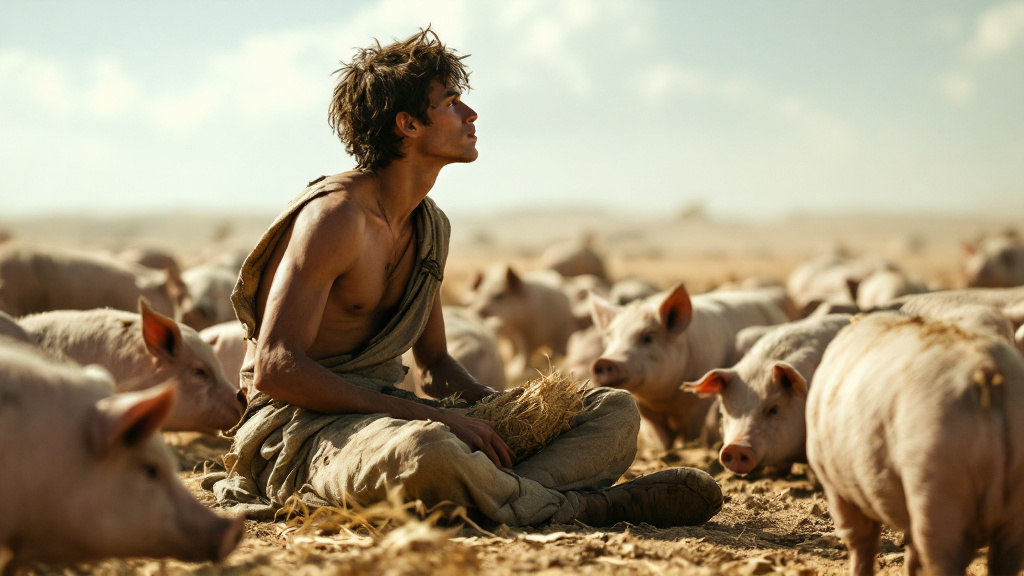
When the money runs dry, a famine descends. He ends up feeding swine and longing to eat what they eat. Then comes the hinge on which the whole story turns:
“And when he came to himself, he said, How many hired servants of my father’s have bread enough and to spare, and I perish with hunger!” (Luke 15:17, KJV)
He rehearses a speech of contrition and sets off for home, intending to ask for a place as a hired servant. He never gets to finish it.
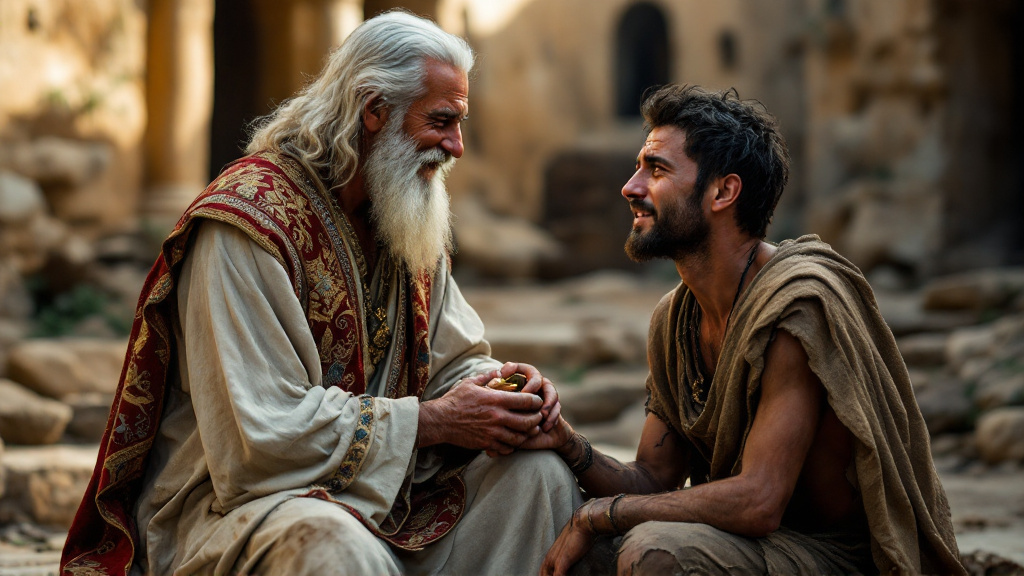
“But when he was yet a great way off, his father saw him, and had compassion, and ran, and fell on his neck, and kissed him.” (Luke 15:20, KJV)
The father calls for the best robe, a ring for his hand and shoes for his feet (Luke 15:22, KJV), and commands that the fatted calf be killed for a feast. His reason is simple:
“For this my son was dead, and is alive again; he was lost, and is found.” (Luke 15:24, KJV)
Then the older brother comes in from the field, hears the music, and refuses to enter. He protests that years of faithful service have earned him nothing. The father answers: “Son, thou art ever with me, and all that I have is thine” (Luke 15:31, KJV). The story ends there, with the older son still standing outside.
My twenty-five years in the far country
After I left the church, I fell foul of the law and joined a gang. I had been a virgin at 18, and I became promiscuous and struggled to remain faithful in any relationship. I was shallow and materialistic. I believed our purpose in life was simply to grow wealthy, at any cost.
I will not dress that up. It was wasted substance, precisely as Luke describes. Nor do I tell it in order to dwell on it, because the point of this parable was never the far country. The point is the way home, and what awaits there.
The famine and coming to himself
My famine came when I faced bankruptcy and ruin. I could see no logical solution to my problems. Every avenue my reasoning mind could conceive of was closed.
That is what a famine is in this story. It is not a punishment dispatched from without. It is the crisis that awakens you.
Then come five of the most momentous words in scripture: “And when he came to himself.” Not to a preacher, not to a doctrine. To himself. Read inwardly, the far country is simply forgetting who you are. The return begins the instant you remember.
Neville understood the prodigal’s turning in exactly these terms. In At Your Command he wrote:
“Follow the example of the prodigal son. Realize that you, yourself brought about this condition of waste and lack and make the decision within yourself to rise to a higher level where the fatted calf, the ring, and the robe await your claim.”
That line does not condemn. It restores the power to your own hands. If you brought about the condition, you can equally resolve to rise out of it.
The far country in the ancient Mysteries
The prodigal’s journey is far older than Luke. The mystic Manly P. Hall, in The Secret Teachings of All Ages (1928), describes in “The Ancient Mysteries and Secret Societies, Part Three” how the Eleusinian Mysteries of Greece portrayed the soul as Persephone, borne down into the underworld while her mother searched the earth for her. The initiates were taught that the soul is essentially spiritual:
“Its true home is in the higher worlds, where, free from the bondage of material form and material concepts, it is said to be truly alive and self-expressive.”
(Manly P. Hall, The Secret Teachings of All Ages)
That is the Father’s house. And the famine? Hall says the gloom of the lesser rites “represented the agony of the spiritual soul unable to express itself because it has accepted the limitations and illusions of the human environment.” That is the far country exactly: not a punishment, but the anguish of a soul that has accepted an identity smaller than its own.
Listen again to the father: “this my son was dead, and is alive again.” The Eleusinians spoke the very same language. For them, Hall writes, “the only true birth was that of the spiritual soul of man rising out of the womb of his own fleshly nature.”
Hall is describing an ancient rite, not the Law of Assumption, but he confirms that the inner reading of this parable did not originate with Neville. Neville gave it its practical edge. In TrueCosmic’s reading, the son need not earn his way back. He need only wake, to come to himself, and the robe is waiting the moment he remembers.
Prodigal son meaning: the father who ran
Facing that crisis, I turned back to scripture. But I did not re-enter through the old door. Through Neville I discovered that God is not external. God is your own awareness, your consciousness, your imagination. The father in this story is no distant judge enthroned in the sky. He is the I AM within you, the very life you are aware of being.
Observe the order of events in Luke 15:20. The son is still “a great way off.” He has not finished his apology. He has not proved that he has changed. And the father sees him, is moved with compassion, runs, falls on his neck and kisses him. There is no lecture. The rehearsed speech about unworthiness is simply drowned out by a father calling for a robe.
Neville wrote in Awakened Imagination:
“It is the awakening of the imagination, the returning of His Son, that our Father waits for.”
The returning son is your own imagination stirring awake and turning back towards its source, which has been watching the road the entire time.
In his lecture “A Riddle”, Neville told the story this way:
“Remembering his father, he turned and went home to receive the great robe, the ring, the fatted calf, and shoes for his feet.”
No condemnation: why I felt no guilt or shame
People sometimes assume that a homecoming after 25 years like mine must have been steeped in guilt. It was not. I did not expect judgment, because I did not return to scripture from the old perspective that we are sinners in need of saving.
Neville’s teaching gave me a deeper understanding of who we truly are and why we have this experience called life. It showed me that we are all saved. None shall be lost, as scripture says: “And this is the Father’s will which hath sent me, that of all which he hath given me I should lose nothing” (John 6:39, KJV). And so I felt no guilt or shame.
Neville said it plainly in At Your Command:
“There was no condemnation of the prodigal when he had the courage to claim this inheritance as his own.”
And in his lecture “Prophetic Sketches 1967”:
“Each one of us is unique in the eyes of God, and each has his place in God’s body; therefore, not one can be lost, but everyone will be called individually, in his own time.”
In his own time. Read in that light, 25 years in the far country are no disqualification. They are part of the road home. If you have ever wondered whether working with your imagination somehow runs counter to your faith, I have written an honest guide to whether manifesting is a sin in Christianity that speaks to exactly that fear.
Beyond good and evil: there is no bad way to awaken
When we look at life through the lens of separation, God and evil, them and us, judgement comes easily, and condemnation follows close behind. Look at society today. Our prisons are full, and so much of public life is organised around deciding who deserves to be shut out. That is the older brother’s way of seeing: standing in the field, keeping the ledger, certain of who is in and who is out.
Neville offered another way to look. He taught that we must distinguish between the state a person is in and the person who occupies it. In his lecture Blake on Religion he admitted how easily we confuse the two:
“I identify him with the state I dislike, but I think it is the occupant. It is not the occupant. He could come out at any moment in time”
In Enter the Dream he quoted William Blake, who saw the whole drama of good and evil as a kind of sleep: “I do not consider either the Just or the Wicked to be in a Supreme State, but to be every one of them States of the Sleep into which the Soul may fall in its deadly dreams of Good and Evil when it leaves Paradise following the Serpent.” The just and the wicked alike are passing through states. Neither is the final truth of who they are.
From that higher awareness, the whole picture changes. If we come to earth to experience every trial and tribulation, and if those trials are the very events that lead us at last to come to ourselves, then how, ultimately, can any of it be wrong? The famine was not a punishment the prodigal had to survive before he could go home. It was the thing that woke him. Without the far country, there is no “he came to himself”. I have come to believe that there is no bad way to awaken.
This is not a licence to cause harm, and it does not make suffering trivial. It is a refusal to make any soul’s condition final. Paul wrote: “There is therefore now no condemnation to them which are in Christ Jesus, who walk not after the flesh, but after the Spirit” (Romans 8:1, KJV). And Neville, in The Pruning Shears of Revision, said that once the spirit is awake in you, “you will realize in him there is no condemnation, only forgiveness”. The father in the parable sees his son “a great way off” and runs. He does not ask where the boy has been. He already knows the road was the way home.
The robe, the ring, the shoes and the fatted calf
Every gift the father bestows is a declaration of identity, and not one of them is what a servant would receive.
- The best robe is restored identity. The son is clothed once more as who he truly is, covering the rags of the state he had been in.
- The ring is authority. Inwardly, it is the return of your creative power, your right to assume and to watch that assumption harden into fact.
- The shoes mark a son, not a slave. They are the freedom to walk your own path again, within the household rather than outside it.
- The fatted calf is celebration and abundance. The waste and lack of the far country yield to a feast that was always being kept for this day.
The older brother: the dutiful, resentful religious mind
The Neville passages above do not address the older brother, so this is TrueCosmic’s own reading.
The older brother is the part of us that keeps the rules and keeps score. He is the dutiful religious mind that believes love must be earned through service, and he is incensed when grace is given freely. He stands outside the celebration, near enough to hear the music, unable to go in.
Mark the father’s answer to him: “thou art ever with me, and all that I have is thine.” The older son never lacked for anything. He simply never claimed it. The story leaves him outside on purpose, so that each of us may ask which son we are being today.
How to apply it
- Name your far country. Be honest about the state you have been dwelling in: lack, fear, resentment, an outworn identity. Do not condemn it. Simply see it clearly.
- Come to yourself. Remind yourself that you brought about this condition from a state of consciousness, and so a new state can bring about a new one. Make the decision within yourself to rise.
- Decide the end, not the road. The son did not plan how his father would receive him, and his own plan was far smaller than what came to pass. The gravest mistake is micromanaging how the result arrives. Decide what being home looks like and leave the route open.
- Choose one scene of the robe and ring. Select a brief, simple moment that could only occur if your wish were already fulfilled: an embrace, a handshake, a friend saying “congratulations.”
- Enter it nightly. In the drowsy state before sleep, step into that one scene and feel it as accomplished. Let it be the feast, not the rehearsed apology.
This is a practice, not a trick. Picture someone learning a new language. You do not become fluent simply because you wish to by Friday. You stumble over words, tangle your grammar and feel awkward, and you keep speaking regardless. Then one day you notice you are thinking in it. Living from the wish fulfilled is a new language for consciousness, and fluency comes through daily use, not a single dramatic effort.
Deciphering this parable is like discovering a door left ajar. However long you have been away, the house was never locked. The power you were told dwelt somewhere outside you has been within all along, dormant, waiting for you to walk back through.
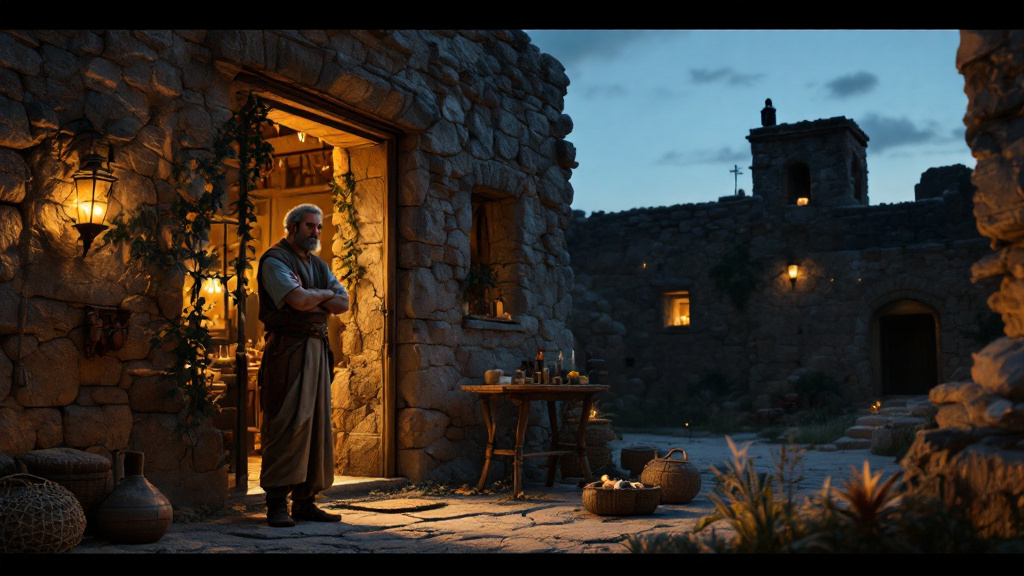
Keep reading: the Cain and Abel story. For the bigger picture, see our complete guide to esoteric Bible interpretation.
Frequently Asked Questions
What is the main message of the prodigal son?
The central message is that no one is ever too far gone to come home, and the welcome awaits before you have finished apologising. Read inwardly, the far country is forgetting who you are, and coming home is remembering that the creative power of God dwells within you. The father’s response is compassion, not condemnation.
Who does the older brother represent?
On the surface, he represents those who resent grace being extended to people they deem undeserving. In TrueCosmic’s inner reading, he is the dutiful, resentful religious mind that believes love must be earned through service. The father reminds him that everything was already his, which means he only ever needed to claim it.
What do the robe, ring and fatted calf mean?
The robe is restored identity, the ring is restored authority and creative power, and the fatted calf is celebration and abundance after lack. Together with the shoes, they reveal the son welcomed back as a son, not a servant.
Why is there no condemnation in the parable of the prodigal son?
Because, read inwardly, the far country is not a crime but a state the soul passes through, and the very hardship of it is what leads the son to come to himself. Neville taught that we must distinguish the person from the state they occupy; when the spirit is awake in you, “you will realize in him there is no condemnation, only forgiveness.” The father runs to meet his son before a word of apology is finished.
Is it heretical to read the prodigal son as an inner story?
Reading scripture for its inner meaning is an ancient practice, not a modern invention. Paul himself described a story from Genesis as an allegory when he wrote of Sarah and Hagar. The literal reading is the older brother: it comes first and keeps the rules. The inner reading is the son who comes home, and in this story it is the returning son the father runs to meet. Nor is that realisation a mere footnote: it is the very catalyst for transformation. The ancient Mysteries of Eleusis told a kindred story of a soul that leaves its true home and is sought and restored, as Manly P. Hall describes in The Secret Teachings of All Ages.
Did Neville Goddard teach about the prodigal son?
Yes. In At Your Command he urged readers to follow the prodigal’s example by resolving within themselves to rise to the level where “the fatted calf, the ring, and the robe” await. He also emphasised that there was no condemnation of the prodigal when he claimed his inheritance as his own.
Conclusion: coming home to yourself
The prodigal son meaning, read from within, is that the far country is only forgetting, the famine is the crisis that awakens you, and the father is your own awareness running down the road to meet you. I spent 25 years away, and when I came home there was no lecture, only a robe. Our guide to what manifesting really is is a fitting next step.
Whatever you are walking through right now, the answer is not out in the far country. It already dwells within you, together with the same power that formed the stars, and it answers to you alone. You are the one who must turn and set it in motion, and when you do, there is no circumstance, no debt and no past that can bar the way home. Fear not.

Michael Sutherland is the founder of Truecosmic, a global platform dedicated to Neville Goddard’s teachings and the Law of Assumption. Passionate about empowering individuals through conscious creation, Michael blends esoteric wisdom with practical insight to help people transform their lives from within.
Enter your email and get instant FREE access to your report.
No credit card required. 🔒 Your details are secure. You can unsubscribe at any time.













0 Comments