pillar-236997
A Kundalini awakening is, without question, the most misunderstood spiritual experience in the modern world — and perhaps the most profound one available to a human being. Research from Frontiers in Psychology found that 73% of participants in studies on spontaneous spiritual awakenings reported at least one specific awakening-related experience, suggesting that what the yogic traditions have documented for millennia is not a rare anomaly but a recurring feature of human consciousness. This guide exists because that experience happened to me — in 2018 — and because everything I encountered that night had already been written down, centuries and millennia before I was born, hidden in plain sight across every major mystical tradition on earth. What follows is the most comprehensive account of Kundalini awakening I know how to give: the signs, the Kundalini awakening stages, the scriptural record, the connection to Neville Goddard’s teachings, and — above everything else — the truth that this is not a privilege for the spiritually elite. It is every soul’s birthright.
The word Kundalini comes from Sanskrit — kundala, meaning “coiled.” It refers to a primordial energy described in yogic and Tantric traditions as lying dormant at the base of the spine, coiled like a serpent, waiting.
But here is what most platforms get wrong: what is Kundalini is not a question that belongs only to Hinduism or yogic philosophy. The concept — an indwelling divine energy, sleeping within the body, that rises through channels of consciousness and ultimately produces an encounter with the infinite — appears across virtually every serious mystical tradition in human history.
In Kabbalah, it is the movement of divine light through the sefirot. In Christian mysticism, it is the fire of the Holy Spirit, the “tongues of flame” at Pentecost. In Sufism, it is the awakening of the latent ruh — the divine breath. In Gnostic literature, it is the serpent of wisdom ascending. The language shifts. The underlying phenomenon does not.
At TrueCosmic, we define Kundalini not as a religious category but as a feature of consciousness itself — the dormant awareness of your own infinite nature, housed within you from before birth, moving toward full self-recognition. The question is not whether this energy exists. The question is whether you are ready to meet it.
And — perhaps more importantly — whether you know that you do not need to be “spiritually advanced” to receive it. Grace does not require a curriculum. It requires surrender.
Looking back now, the signs were everywhere. I simply did not have the framework to read them.
The first precursor — one I dismissed for months as stress — was a persistent tingling on the crown of my head. Not painful. Not dramatic. A low, almost electrical hum at the very top of the skull, sometimes spreading down the back of the neck. I mentioned it to a doctor. He said it was tension. I believed him. It was not tension.
The second precursor was what I can only describe as breadcrumb manifestations. Small things — too specific to be coincidence, but too small to fully arrest my attention. A thought about a person, then a message from them within minutes. A desire held in imagination, appearing in physical form within days. These were not miracles, not yet. They were the field testing whether I was paying attention. They were consciousness showing me its own mechanics in the gentlest possible language, before turning up the volume entirely.
The third precursor was the most disruptive — and the most necessary. Social structures began crumbling. Friendships that had felt foundational simply dissolved, not through conflict but through a quiet, growing incompatibility. The ego — that identity scaffolding built from other people’s approval, social belonging, and external validation — began to strip back. Layer by layer. This was not depression. It was preparation. The self that was going to survive a full Kundalini awakening could not carry the weight of a false identity into it.
During this period, two mentors were instrumental. Roupa Jetto — a hypnotherapist and Buddhist practitioner — helped me understand that the internal shifts I was experiencing were not pathological but initiatory. And Dr Bruno R Cignacco, author of How to Become a Miracle Worker in Your Life, provided frameworks for understanding how inner states produce outer realities in ways that were both spiritually grounded and intellectually rigorous. Without both of them, I would have explained away what was happening rather than leaning into it.
The awakening was grace, not achievement. But those precursors were the field being prepared.
The signs of Kundalini awakening can be subtle over months and explosive in a single night. Knowing the spectrum matters — not to frighten you, but to help you recognise what is already in motion.
Here are the most commonly documented Kundalini awakening signs, drawn from both the experiential literature and peer-reviewed research:
It is worth noting that Kundalini awakening symptoms are not uniformly dramatic. For many people, the awakening is gradual — a slow brightening rather than a lightning strike. For others, it is sudden and overwhelming. Neither is more valid than the other. Consciousness meets each soul where it is.
The stages of Kundalini awakening are not a neat, linear progression. But there is a broad arc — documented across traditions, confirmed by experiencers — that gives us a map. Not a route. A map.
You can explore this in more depth at TrueCosmic’s guide to the three powerful stages of Kundalini awakening, but here is the foundational framework:
This is the long, often invisible stage. Inner practices deepen — not because you are “doing the work” in a self-improvement sense, but because something within you has been activated and is drawing you inward. The precursors described above belong here. The ego begins to loosen its grip. Life restructures itself around the emerging inner reality, often without your conscious cooperation.
This stage can last weeks, months, or years. It is not wasted time. It is the ground being prepared for a seed that will shatter the ground when it breaks open.
This is the stage that gets all the attention — and the most fear-laden descriptions. The actual Kundalini awakening event. In my case, on a night in 2018, it began with a sound. A sound like wind — in both ears simultaneously, rising in pitch and volume until it was no longer a sound but a presence. Then the current. An electrical charge moving from the base of the spine upward, through the chest, into the skull, with an intensity that I can only describe as the feeling of dying — not of being harmed, but of the self as I knew it ceasing to be the relevant unit of experience.
This happened after six months of nightly SATS practice — the State Akin to Sleep — a specific inner state of receptive, drowsy awareness in which imaginal activity becomes extraordinarily vivid and generative. Not a single session. Not a single technique applied once. Six months of nightly devotion, consistent and faithful, without knowing what was coming.
The awakening was not earned. It was given. The practice created the conditions. Grace gave the gift.
This is the longest stage and, in many ways, the most important. The awakening changes everything — but the self that lives inside the change must be rebuilt. New perceptions must be integrated into daily life. Old emotional patterns, now deprived of their unconscious fuel, must be consciously resolved. The extraordinary must become, slowly, the ordinary ground of being.
Integration is where most people need support — and where the absence of a community or mentor can turn what should be a passage into a protracted disorientation. This is why TrueCosmic exists: not to trigger your awakening, but to be present for all of it.
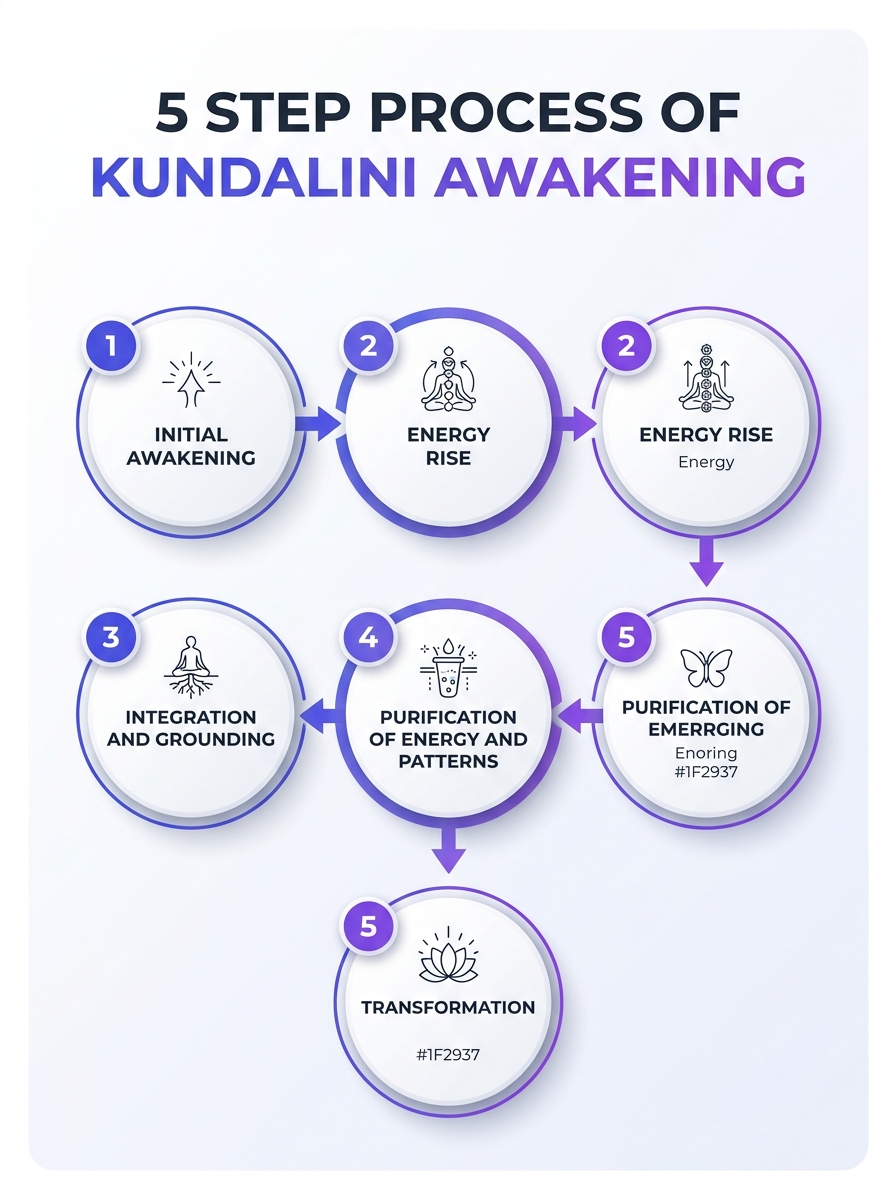
This infographic breaks down the 5-step process of Kundalini awakening, outlining key stages and insights for practitioners. It provides a concise visual guide to understanding transformative experiences.
This is where things get uncomfortable for those who have been raised within a literalist religious framework. And this is where, for me, one of the deepest liberations of the awakening occurred.
Because when you have experienced a Kundalini awakening — when you have felt that serpent energy rise through your own spine, when you have heard that wind-sound in both ears, when the crown of your head has opened — you read the Bible differently. You stop reading it as history and start reading it as instruction. As prophecy about your own inner life.
The serpent in Genesis is not a villain. It is the Kundalini itself — the coiled wisdom energy, offering the fruit of the tree of the knowledge of good and evil. The eating of that fruit is consciousness awakening to its own dual nature. The exile from Eden is not punishment — it is the soul entering the dream of material life, temporarily forgetting its divine source, so that it may remember it consciously.
Moses’s staff turning into a serpent and back again — the serpent of brass raised on a pole, healing all who look upon it — these are not tribal folklore. They are maps of the same internal geography that the Kundalini traditions describe. The spine is the pole. The serpent is the energy. The looking is the turning of attention inward.
In Numbers 21:9, Moses makes a bronze serpent on a pole and whoever looks upon it is healed. In John 3:14, Jesus says: “As Moses lifted up the serpent in the wilderness, even so must the Son of Man be lifted up.” The Son of Man is not someone external. It is the I AM — the divine awareness within you, rising through the spine of your own being.
In Acts 2, at Pentecost, the disciples receive the Holy Spirit. It arrives as a sound — “as of a rushing mighty wind.” Then fire appears, resting on each person’s head. This is not metaphor. Or rather: it is not only metaphor. It is a precise description of what Kundalini awakening symptoms feel like when they manifest at the crown. The wind-sound. The crown activation. The tongues of flame — the intense heat that 20% of research participants have described clinically, and that every Kundalini experiencer will recognise immediately.
For a deeper exploration of how scripture maps onto inner experience, the complete guide to esoteric interpretation of ancient scripture at TrueCosmic takes you further into this material.
The liberation that came with this understanding — the liberation that is part of V5 of this entire journey — was the dissolution of religious fear. God, as I understood it before the awakening, was an external judge. Watchful. Demanding. Capable of wrath. After the awakening, that conception was simply impossible to sustain. God is I AM. Not a being looking at you from outside. The very being that you are when you say “I am.” The awareness before the thought. The witness before the content.
Fear not. That phrase appears in the Bible 365 times — once for every day of the year. It is not a platitude. It is the most important instruction in the entire text, given to a consciousness that has been frightened into smallness by a false picture of what it is. When you know that God is I AM — that the divine is not external but is the very fabric of your awareness — fear dissolves. Not because the world becomes safer. Because you understand, at the level of experience rather than belief, that housed within you is the only power that has ever existed.
Kundalini and Neville Goddard is a connection that most people miss — because Neville did not use the word “Kundalini.” He did not need to. He described the experience so precisely, in such anatomical and phenomenological detail, that anyone who has had the experience recognises it immediately.
Neville Goddard divided his teaching into two streams: the Law and the Promise. The Law — the principle that consciousness is the only creative reality, that imaginal activity produces outer events — is what most people engage with first. But Neville was explicit: the Law is not the destination. It is the schoolroom. The Promise is the graduation.
The Promise, as Neville described it, begins with an experience he called “the awakening.” The meditator — in a state of deep inner stillness, often at the threshold of sleep — suddenly perceives a vibration at the base of the spine. It moves upward. The skull opens. There is a sound like wind. Light. And then a series of symbolic visions — the sign of David, the birth of the divine child, the dove, the Father-Son revelation — that constitute the full unfoldment of the Promise.
This is Kundalini. Named differently. Mapped in the language of Hebrew scripture. Experienced by a man who had spent years in the practice of the state akin to sleep — that same drowsy, receptive, imaginal state in which I practised, nightly, for six months before my own awakening.
Neville’s teaching on the Promise is the most neglected aspect of his entire body of work — and arguably the most important. Because it tells you what consciousness is moving toward. Not just manifestation. Not just the fulfilment of desires. But the full awakening of the divine within the human, the complete liberation of I AM from the sleep of mortality.
As Neville once said, real spirituality is learned through experience, not just knowledge. You can read every book he wrote. You can memorise every lecture. But until the fire moves through the spine, until the wind-sound fills both ears, until the skull opens and the light pours in — you are reading the menu, not eating the meal. The meal is available. It is yours. It has always been yours.
You can explore the direct overlap between Kundalini awakening stages and Neville’s Promise framework in more depth through the TrueCosmic deep-dive on Kundalini awakening stages.
This section exists not because a Kundalini awakening is primarily a dangerous event — it is not — but because clarity here is genuinely useful. The difference between an awakening and a spiritual emergency is real, and knowing it can determine whether an experience becomes a doorway or a storm without shelter.
A spiritual emergency — a term coined by Stanislav and Christina Grof — refers to a spiritual opening that has outpaced the individual’s ability to integrate it. The experience itself may be identical to a Kundalini awakening in its phenomenology. The problem is not the experience. It is the absence of context, support, or tools for integration.
You can find a fuller account of the warning signs and when to seek guidance in the Kundalini warning signs of awakening guide at TrueCosmic. But here are the key distinguishing markers:
You’ve got absolutely nothing to worry about if you have support, context, and a framework for what is happening. The challenge arises precisely when someone undergoes a Kundalini awakening in isolation — no mentor, no tradition, no community — and cannot name what is happening to them. This is why TrueCosmic bridges ancient wisdom and modern application: not to gatekeep the awakening, but to ensure that when it happens, you are not alone inside it.
Here is what most platforms get wrong: they imply that Kundalini awakening can be triggered by a single technique, a specific breathwork session, a retreat, or a plant medicine experience. And while all of these can catalyse movement along the Kundalini pathway, the awakening itself — the full, sovereign, irrevocable rising — does not come from a shortcut.
It comes from devotion. Consistent, patient, surrendered devotion to inner practice over time.
In my case, it was six months of nightly SATS practice. Not a weekend intensive. Not a single profound meditation session. Six months of lying at the threshold of sleep, entering the imaginal state, holding specific states of consciousness with intention and consistency, night after night — until the field was prepared enough to receive what grace had already decided to give.
The triggers that genuinely contribute to a Kundalini awakening include:
It is also documented that Kundalini awakening can arise spontaneously — without any deliberate practice at all. Near-death experiences, profound grief, intense creative immersion, and certain life crises can apparently strip the ego back far enough that the Kundalini rises of its own accord. This is consistent with the understanding that the Kundalini is always already present and moving. Practice does not create it. Practice removes the obstacles to its self-expression.
One of the most important conversations in contemporary consciousness studies is whether the Kundalini of the yogic traditions and the Holy Spirit of the Christian tradition describe the same phenomenon. At TrueCosmic, we have explored this comparison in depth — you can read the full analysis at Kundalini Spirit versus Holy Spirit.
The short answer: the phenomenology is strikingly convergent. The theological frameworks diverge — but the reported experience of the experiencers across both traditions is almost identical. The sound like wind. The heat or fire. The crown activation. The dissolution of the personal self into a greater awareness. The overwhelming sense of love and presence. The irreversible nature of the change.
In Pentecostal Christianity, the Baptism of the Holy Spirit is described in identical physical terms to a Kundalini awakening. In Sufi Islam, the experience of fana — dissolution of the self in the divine — maps directly onto the ego dissolution that Kundalini experiencers describe. In Jewish mysticism, the descent of the Shekhinah — the divine presence — into the prepared vessel is the same architecture: a divine energy, present but dormant, activated by devotion and received as grace.
The tradition names the experience differently. The experience itself appears to be singular.
The morning after my Kundalini awakening, I woke up in the same body, in the same room, with the same name — and everything was different. Not in the way that a profound dream is different. Different in the way that seeing colour for the first time is different from a world you have only ever known in grey.
The world had not changed. My relationship to the world had changed at a level so fundamental that the change was irreversible. There was no pathway back to the previous state of consciousness. There was only forward.
Here is what the after-period typically involves for most Kundalini awakening experiencers:
What mattered before the awakening — status, approval, accumulation, validation — largely stops mattering. Not through effort or renunciation, but simply because the awakening makes it obvious that these things were never the source of what you were actually seeking. The seeking restructures itself around something more real.
For months after a Kundalini awakening, many people find that their senses are recalibrated. Emotions — yours and others’ — become more transparent. Environments carry weight that they did not carry before. Crowds, noise, and low-frequency social environments can feel genuinely exhausting rather than merely unpleasant. This is not pathology. It is the nervous system adjusting to a more finely tuned instrument.
Paradoxically, after an awakening, practice deepens rather than ends. There is more to explore, not less. The map has proven itself to be pointing at real territory — and the territory is vast. Nightly SATS practice, meditation, study, service — these do not become unnecessary after awakening. They become more richly meaningful.
Almost universally, Kundalini awakening experiencers feel a growing impulse to share what they have discovered — not from ego, but from a recognition that others are carrying unnecessary suffering in the absence of this knowledge. This guide is part of that impulse. The TrueCosmic Academy is the structured version of it — a place where the knowledge, the practice, and the mentorship that made this journey navigable are available to anyone who is ready.
Yes.
Without exception. Without qualification. Without a prerequisite list of spiritual accomplishments or a particular religious background or a number of years of formal practice. A Kundalini awakening is every soul’s birthright — not because you deserve it in the way that a reward is deserved, but because it is what you already are. Fully. Always.
The Kundalini is not external to you. It is not a gift that arrives from somewhere else. It is the truth of what you are, pressing from within toward recognition. Practice does not earn it. Devotion prepares the conditions for it. Grace gives it when those conditions have been met — and sometimes before those conditions have been fully met, because grace operates on a logic beyond the transactional.
The idea that Kundalini awakening is reserved for monks, mystics, yogis, or the spiritually advanced is — to put it plainly — wrong. It is a misreading of the tradition that serves nobody except the ego’s desire to maintain a hierarchy of spiritual achievement. The divine does not have a waiting list. It has a timing — and that timing belongs to a wisdom infinitely greater than the personal will.
What you can do — what every practice, every tradition, and every teacher worth following will tell you — is make yourself available. Show up consistently. Surrender the need to control the outcome. Create the conditions, and trust the conditions to do what they were always going to do.
No background can stand in its way. No history disqualifies you. No amount of previous confusion about what you are prevents the recognition of what you have always been. Only you are the operant power — and that power is the Kundalini itself, already housed within you, already alive, already moving toward the light it is.
A Kundalini awakening is the activation and rising of dormant spiritual energy from the base of the spine through the body’s energy centres, producing a wide range of physical, psychological, and perceptual Kundalini awakening symptoms. You typically know it is happening through a combination of involuntary physical sensations (particularly electrical currents or heat in the spine), profound shifts in perception, and an irreversible change in how you relate to your own identity and the nature of reality.
The initial Kundalini awakening event itself can last minutes to hours — though its effects unfold over months and years. The integration phase, in which the nervous system adjusts and the new state of consciousness stabilises, typically takes one to three years of active engagement, though elements of the opening can continue deepening indefinitely.
Yes — Kundalini awakening can and does arise spontaneously, without formal practice or a teacher. However, sustained inner practice — particularly consistent meditation and the state akin to sleep — significantly deepens the conditions in which a Kundalini awakening becomes possible. A teacher or mentor is not required for the awakening itself, but is often critical for navigating the integration period that follows.
The phenomenological overlap is striking — the sound like wind, the fire at the crown, the dissolution of the personal self, the overwhelming sense of divine presence — and many scholars and experiencers across both traditions regard them as describing the same fundamental spiritual event in different cultural and theological languages. TrueCosmic’s analysis of Kundalini Spirit versus Holy Spirit explores this overlap in depth.
Kundalini and Neville Goddard are connected through Neville’s own description of “The Promise” — a series of experiences beginning with a vibration at the base of the spine, a skull-opening, a wind-sound, and a sequence of symbolic visions that constitute the full awakening of divine consciousness within the human form. Neville described this in the language of Hebrew scripture rather than yogic terminology, but the experience maps directly onto classical Kundalini awakening accounts.
Kundalini awakening symptoms are not inherently dangerous, though they can be intense and disorienting without context or support. The most important factor in navigating them safely is integration — having a framework for what is happening, a mentor or community for support, and practices that help the nervous system stabilise alongside the expanded states of consciousness. The symptoms themselves are the signature of a profound opening, not a warning sign of harm.
The most reliable preparation involves consistent daily inner practice — particularly meditation and the state akin to sleep (SATS), combined with emotional integration work and a deepening relationship with your own consciousness rather than external authority. There is no single technique that reliably triggers a Kundalini awakening, but devoted, patient, sustained practice over months creates the conditions in which grace can move. The TrueCosmic Academy provides structured support for exactly this kind of journey.
A Kundalini awakening is not the end of the spiritual journey. It is the moment the journey reveals what it was always about.
Everything before it — the practices, the seeking, the manifestations, the dissolution of old structures, the gradual stripping back of the ego — was preparation. And everything after it is integration: learning to live as what you have always been, in a world that has not yet caught up with what you now know.
The signs of Kundalini awakening are real. The Kundalini awakening stages are documented across traditions. The Kundalini awakening symptoms are not pathology — they are the nervous system adapting to a truth it was built to hold. And the connection between Kundalini and Neville Goddard, between the rising serpent energy and the Promise, between the I AM within you and the God that scripture has always pointed toward — this connection is not a coincidence. It is the same map, drawn in different languages, pointing at the same destination.
No matter what you are facing — housed within you lies the solution to every problem and the fulfilment of every desire. The Kundalini is not something you acquire. It is something you are. The practice is not the price of admission. It is the love letter you write to the part of yourself that is already awake, asking it to reveal itself.
Only you are the operant power. Only you can prepare the ground. And when grace is ready — it will come. Not because you earned it. Because it was always, only, inevitably, yours.
Fear not.
At TrueCosmic, our position on this is clear: the Law of Assumption is a practice, not a trick. Like a pianist who hits bum notes before performing concerts, consistency and devotion are what separate those who occasionally produce results from those who live from the wish fulfilled as a default state. Most platforms promise instant transformation. What actually produces lasting change is daily discipline — the kind that compounds quietly over weeks and months until the inner world becomes more real than the outer.
For the complete guide to the Law of Assumption, see our definitive resource: The Law of Assumption — The Complete Guide.
To learn more about Neville Goddard’s life and complete body of work, read our definitive guide: Neville Goddard — The Complete Guide.
For the complete step-by-step guide to the SATS technique, see: The SATS Technique — Neville Goddard’s Complete Guide.
For the complete guide to reading scripture as a consciousness map, see: Esoteric Bible Interpretation — The Complete Guide.
What is manifesting? Manifesting is the practice, rooted in Neville Goddard's Law of Assumption, of…
The david and goliath meaning starts in 1 Samuel 17, where a young shepherd meets…
What did Ham do to Noah? Genesis 9:20 to 27 says Ham saw his father…
The daniel in the lions den story begins when jealous officials trap Daniel with a…
As in the days of Noah, says the Jesus of scripture, people will be living…
The question of noah's ark meaning became personal for me at about eighteen, when a…