pillar-236998
Neville Goddard may be the most radical spiritual teacher who ever lived, and in 2026, his work is arguably more relevant than at any point since his death in 1972. He didn’t teach self-help. He didn’t teach positive thinking. He taught one thing, and he taught it with absolute conviction: you are God, and your imagination is the proof. At his peak, Neville commanded a reported weekly audience in excess of 300,000 through television broadcasts alone, and yet, even now, most people have never heard his name. That is about to change for you.
This is the complete guide to Neville Goddard. His life, his biography, his books, his techniques, his Bible interpretation, and the one core truth that, once you really get it, will never let you see the world the same way again.
You’ve got absolutely nothing to worry about as you move through this. Whether you’re brand new to Neville Goddard’s teachings or you’ve been circling them for years, this guide is going to meet you exactly where you are.
—
Neville Goddard was born on February 19, 1905, in St. Michael, Barbados. He was the fourth of nine sons in a family of modest but industrious means, and from the earliest age, there was something different about the way he perceived the world.
At seventeen, Neville left Barbados and sailed to New York City to study drama. He pursued theatre seriously, and for a time, he was a working actor on Broadway, performing in productions that drew real audiences in the 1920s and 1930s. But the theatre, as remarkable as it was, was only the stage on which his real education would begin.
Because it was in New York that Neville met the man who would change the entire course of his life. His name was Abdullah, and we’ll come to him in a moment.
Neville began lecturing publicly in the late 1930s. His first book, At Your Command, was published in 1939. Over the next three decades, he would deliver hundreds upon hundreds of lectures across New York, Los Angeles, San Francisco, and beyond, gathering devoted followings who recognised in him something they had never encountered in any church, school, or self-help seminar.
He was not a guru in the traditional sense. He dressed well. He spoke with poise and a West Indian lilt that gave his voice a gentle, hypnotic quality. He made no financial empire from his teaching. His books were inexpensive, often freely available. His lectures were open to anyone who wanted to come and sit and listen.
In the 1950s and 1960s, Neville underwent a series of profound mystical experiences that he described as the literal fulfilment of biblical prophecy within his own body and consciousness. He called these experiences “the Promise,” and they fundamentally shifted the emphasis of his later teaching away from practical manifestation and toward the deeper spiritual birth that he believed was the ultimate destiny of every human being.
Neville Goddard passed away quietly on October 1, 1972, in Los Angeles. He left behind no institution, no organisation, and no appointed successor. What he left behind were his books, his recorded lectures, and a body of teaching that continues to expand in reach and influence more than fifty years after his death.
For a deeper dive into his life and the events that shaped him, visit our full Neville Goddard biography.
—
If Neville Goddard is the most important mystic of the twentieth century, then Abdullah is the most important person in Neville Goddard’s life. And yet, almost no one outside of serious Neville students has ever heard his name.
Abdullah was an Ethiopian rabbi, a Black Jewish teacher living in New York City whom Neville encountered in the early 1930s. The story goes that Neville was walking past a building when a stranger appeared and said, simply, “Neville, you are six months late.” As if he had been expected.
Neville had never met this man before in his life.
What followed was five years of intensive daily instruction. Abdullah taught Neville the Hebrew Bible in its esoteric, mystical depth. He taught him Kabbalah. He taught him how to interpret scripture not as historical record, but as psychological drama, with every character, event, and name representing a state of consciousness within the individual human being.
He taught Neville how to use imagination as a creative force, not as wishful daydreaming, but as the deliberate act of consciousness that shapes physical reality from the inside out.
Abdullah also demonstrated something to Neville that proved foundational. When Neville desperately wanted to return to Barbados but had no money for the passage, Abdullah told him to simply live in the end of the desire already fulfilled. Neville did exactly that. Within days, his passage was arranged through a sequence of events he could never have engineered himself. The lesson was sealed into him permanently.
Abdullah appears in Neville’s lectures repeatedly, always as the voice of a deeper truth, the teacher who could say the hard thing with clarity and love. We’ve dedicated an entire deep-dive to him at Abdullah: Neville Goddard’s Teacher, and if you want to understand where Neville’s teaching actually comes from, that page is essential reading.
—
Here is the one thing Neville Goddard taught. Everything else is elaboration.
Human imagination is God. God is not a being outside of you. God is the I AM within you, and that I AM is your imagination.
Now, you must sit with that. Because your entire religious and cultural conditioning is working right now to soften it, to find an exception, to reframe it into something more comfortable. Neville would not let his audiences do that. He insisted, again and again, that this is not a metaphor.
The name of God revealed to Moses in Exodus is simply “I AM THAT I AM.” Neville pointed to this as the single most important statement in scripture. “I AM” is not a name in the conventional sense. It is a declaration of being. It is the awareness behind all your states, behind all your moods, behind all your identities.
And here is the operative truth: whatever you attach to “I AM” becomes your experienced reality.
Say “I am poor” with enough feeling and conviction, and your life will conform to that assumption. Say “I am wealthy, healthy, loved, and free” with equal conviction, and your outer world will begin to rearrange itself to confirm that state. Not because you’ve tricked the mind with affirmations, but because imagination, used deliberately and persistently, creates reality.
This is what Neville called the Law of Assumption. You assume the feeling of the wish fulfilled. You persist in that assumption. And the outer world, which is nothing more than a shadow of the inner world, has no choice but to catch up.
V5: This teaching is also one of the most liberating things you will ever encounter if you’ve been raised in a tradition that placed God outside you and above you, as a judge, a punisher, a distant authority to be feared or appeased. Neville’s teaching dissolves that fear completely. The being you’ve been approaching as “other” is the I AM within you. You are not a sinner begging for mercy. You are God individualised, and your imagination is the proof and the power. You’ve got absolutely nothing to worry about in terms of punishment or divine wrath. The only question is how consciously you’re using the creative power that is your birthright.
—
Neville’s body of work is vast. Hundreds of lectures. Dozens of books. But if you want a clean map through the entire territory, here it is: The Law and The Promise.
These are not just the title of one of his most important books. They are the two great movements of Neville Goddard’s entire teaching career, and understanding the difference between them is the key to understanding why his work goes so far beyond anything else in the self-help or spiritual space.
The Law is the practical side. It is the teaching that your consciousness, specifically your imaginal activity, is the cause of your outer reality. If you want to change your world, you change your assumptions. You imagine the end result as already achieved. You feel into it. You persist. And the world reshapes itself accordingly. This is the part of Neville’s teaching that has helped millions of people manifest specific desires: jobs, relationships, health, money, experiences. It works. It works reliably, when applied properly.
But Neville always said that The Law, as extraordinary as it is, is not the end of the story.
The Promise is the deeper teaching. It is the mystical experience that Neville himself underwent beginning in 1959, a series of profound inner awakenings that he described using the framework of the Bible. The birth of the Christ child within. The discovery of David. The splitting of the temple veil. The ascent on the winds. These were not symbolic events for Neville. They were lived experiences that he testified to with the clarity and precision of a witness who was absolutely certain of what he had seen.
The Promise is Neville’s insistence that every human being will eventually have these experiences, that the entire drama of scripture is not historical record but the map of human spiritual evolution, and that you are destined to know yourself as the God who dreamed this world into existence.
You can explore the full depth of this framework in Neville Goddard: The Law and The Promise.
—
No Neville Goddard complete guide would be finished without pointing to the primary texts themselves.
\n\n
Neville Goddard’s books are some of the most concentrated spiritual literature ever written. They are short. They are clear. And they are dense with meaning that keeps opening up the more you return to them.
Here are the ones you need to know.
At Your Command is Neville’s first book, published when he was just 34 years old. It is short, only a few dozen pages, but do not let the length fool you. This is the clearest, most direct statement of the Law of Assumption you will find anywhere in his writing.
The central argument is simple: your consciousness is the only reality. What you are conscious of being, you become. At any moment, you are issuing commands to the creative power of consciousness, and those commands are your assumptions about yourself and your world. Change the assumption, change the command, and the outer world has no choice but to obey.
This is where Neville instructs you on the I AM, on the power of the feeling of the wish fulfilled, and on the absolute authority your consciousness holds over what manifests in your life.
Feeling Is The Secret is perhaps the most beginner-friendly of all Neville’s books, and it remains one of the most practically actionable things he ever wrote.
The core teaching is this: it is not enough to think about what you want. You must feel it. The subconscious mind does not respond to thought alone. It responds to the emotional tone, the feeling-state, the inner sense that something is already real. When you fall asleep feeling the reality of your desire, you plant a seed in the soil of the subconscious that must, by law, grow into your outer experience.
This book is the foundation for Neville’s State Akin to Sleep technique, which we’ll cover in detail shortly. Read it first if you are new to Neville Goddard’s teachings.
The Power of Awareness is widely regarded by serious Neville students as his masterwork. This is where the philosophy becomes truly complete.
Here, Neville makes the case most fully that consciousness is the only reality, that the world of external appearances is entirely a projection of inner states, and that the radical acceptance of this truth is the beginning of genuine freedom. The writing is precise, measured, and deeply serious. It covers revision, the concept of I AM, the nature of assumptions, and what it really means to live as a conscious creator in every moment of every day.
This is the book you return to when you want the deepest possible grounding in Neville Goddard’s teaching.
This is the book that documents the shift in Neville’s own teaching from the practical to the mystical. The first half covers the Law, illustrated with dozens of testimonials from real people who applied Neville’s techniques and got extraordinary results. Scenes of impossible coincidences, health recoveries, financial reversals, reunions. Real people. Real names. Real outcomes.
The second half turns to the Promise: Neville’s account of his own mystical experiences and the biblical map through which he understood them. It is unlike anything else he wrote, or that anyone else has written, and it is the book that separates Neville Goddard from every other teacher in this space.
Your Faith Is Your Fortune is an essential companion to the earlier books. Here, Neville develops the concept of faith as the subjective certainty that something is already true, before any outer evidence appears to confirm it. This is the faith that moves mountains in scripture, not belief in a doctrine or creed, but the felt conviction of the wish fulfilled.
This book also contains one of Neville’s clearest explanations of why the Bible, read literally, is a distraction, and how reading it as the drama of your own consciousness transforms it from a book about ancient history into a living manual for your own awakening.
These are not a single book but a series of transcribed lectures delivered in 1948 that many consider the single most important body of Neville’s teaching. The 1948 Classroom Series covers the full scope of the Law in a classroom format, including detailed instruction on SATS (State Akin to Sleep), imaginal conversations, inner speech, revision, and the principle of living in the end.
If you want to understand not just what Neville taught but how he taught people to actually do it, this series is indispensable.
You can access an extensive collection of Neville’s works through the Neville Library at TrueCosmic, and our full TrueCosmic library holds 292 of his lectures in one place.
—
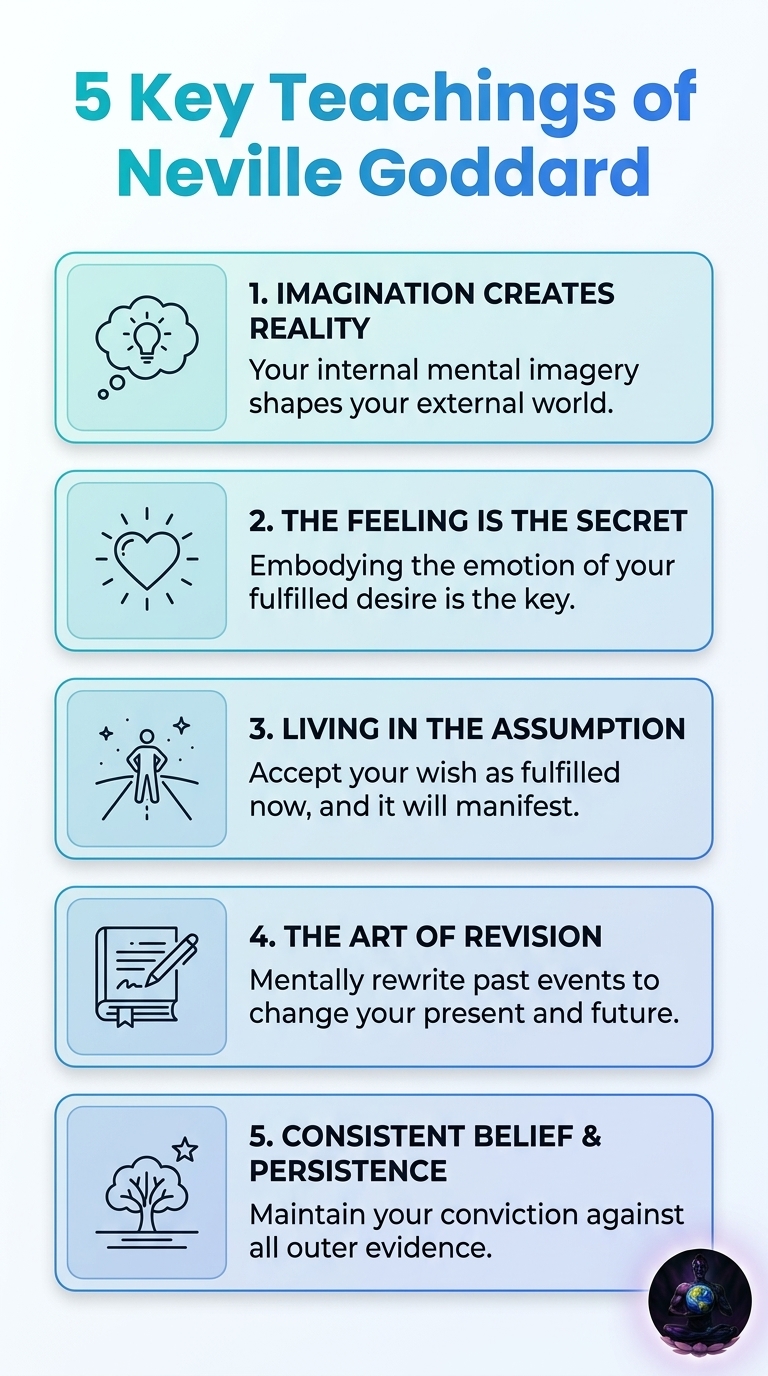
This infographic distills Neville Goddard’s five key teachings into practical takeaways. It highlights who he was, his notable works, and core techniques.
—
Reading a Neville Goddard complete guide without the practical techniques would leave the theory disconnected from anything you could actually do tonight.
\n\n
Neville Goddard’s techniques are not rituals or ceremonies. They are practical tools for directing consciousness. Each one is rooted in the same underlying principle: your imagination is God, and what you make real in imagination will become real in your outer world.
Here is a working overview of the most important ones.
This is Neville’s foundational technique, drawn directly from the teaching he received from Abdullah and developed across his decades of lecturing.
The idea is that the hypnagogic state, the threshold between waking and sleep, is the most receptive state of consciousness for planting imaginal seeds into the subconscious. When your body is relaxed and your critical faculty is quiet, the images and feelings you hold in imagination pass directly into the subconscious without the interference of doubt or logic.
The practice is this: as you’re drifting into sleep at night, hold a single imaginal scene in your mind’s eye. A scene that implies your desire is already fulfilled. Feel the reality of it. Loop it gently. Fall asleep in the feeling of it already done.
You must understand, this isn’t passive fantasy. This is deliberate creative work performed at the most powerful point in your daily cycle. Become excessively persistent and even obsessive in this practice and magical things will take place in your life. Read the full breakdown at our State Akin to Sleep guide.
This is perhaps the most misunderstood and most important of all Neville Goddard’s techniques. Living in the end means you do not imagine getting to the desire. You imagine from the desire already obtained.
The difference is everything.
If you imagine the journey toward your goal, you are reinforcing the state of “I am not yet there.” You are planting the seed of separation. But if you imagine from within the reality of the goal already achieved, if you feel the feelings you would feel, if you hold the inner conversations you would hold, if you carry yourself with the confidence of someone who already has what they seek, then your imagination is creating from the right end of the equation.
Living in the end is really living by faith. What you place firmly in your imagination and live by in faith must manifest into your physical world. Your infinite power, your imagination, makes it real. See the complete practical guide at Neville Goddard: Live in the End.
Revision is one of Neville’s most powerful and least talked-about techniques, and when you understand it, it will change how you relate to every single negative event in your past and present life.
The technique is this: at the end of the day, review the events that happened. Wherever something went wrong, wherever you felt hurt, embarrassed, disappointed, or angry, you do not accept that experience as fixed fact. You revise it. In your imagination, you replay the event as it should have gone. You see the ideal outcome. You feel the ideal feeling.
Neville insisted that this is not self-deception. It is the conscious use of the Law to alter the content of consciousness, which then alters the future events that flow from that content. Revise your past, and you revise your future. This is radical, and it works.
Your inner conversations are not neutral commentary on life. They are creative instructions. Whatever you habitually say to yourself, about yourself, about others, about your circumstances, is a constant stream of assumptions being planted into your consciousness.
Neville taught that you must become aware of the inner speech running in the background of your mind, and you must begin to direct it. Start talking to yourself as the person you want to be. Hear others congratulating you. Hear yourself confirming the reality of your desire. That inner speech, held persistently, will externalise itself.
You must learn to retrain your imagination so it accepts the idea that anything placed there isn’t for a future experience, but represents your reality, right here right now.
Neville taught that every imaginal act is a real act. When you construct a scene in imagination with full sensory vividness and emotional reality, you have performed a real creative act. That act has consequences in the outer world.
An imaginal act is not a vision board or a casual daydream. It is a deliberate, focused moment of creative work in which you construct the reality you intend to experience, feel it completely, and then let the world catch up.
The key is to make it first-person, present-tense, and sensory. Not “I will have a beautiful home.” But you are standing in the kitchen of that home right now, feeling the countertop under your hand, hearing the sounds of it, smelling the morning coffee. The more real you make the imaginal scene, the more power it carries.
—
A Neville Goddard complete guide has to include his reading of scripture, since it sits at the center of everything else he taught.
\n\n
This is the section that separates serious students of Neville Goddard from casual readers, and it is one of the most extraordinary aspects of his entire teaching.
Neville was emphatic: the Bible is not a history book. It is a psychological drama. Every character in it is a state of consciousness. Every event in it describes an inner experience. And when you read it that way, with the key that Neville provides, it becomes the most precise map of human consciousness ever written.
The story of Esau and Jacob is one of the most important passages in all of scripture, read through Neville’s lens.
Esau is the natural man. He is the outer self, the personality shaped by the world, by what the senses can perceive and what the rational mind can accept. Esau is the man of the field, the hunter, the one who deals in what is already visible. He is your current state, your current identity, your current assumptions about who you are and what you can have.
Jacob is the supplanter. Jacob is the imaginative self, the inner man, the one who reaches for what has not yet appeared in the outer world. Jacob is cunning and persistent. He deceives the outer man, the senses, the consensus of what is “real,” in order to claim the birthright. That birthright is the conscious ability to create your own reality through imagination.
When Jacob wrestles with the angel and prevails, he is renamed. He is no longer Jacob the supplanter. He becomes Israel, which Neville translates as “one who rules as God.” This is not the name of a nation. It is the name of a state of consciousness. It is the state of a man or woman who has claimed full dominion over their own imagination, who has made the conscious choice to live from the end, to persist in faith, to let the outer world conform to the inner rather than the other way around.
You are Esau when you react to the world. You are Jacob when you begin to use imagination deliberately. You are Israel when you have fully internalised the truth that your imagination creates reality, and you live from that place with unwavering conviction.
Every step of that journey is described in the Bible, if you have the eyes to see it. Neville spent decades teaching that map, and its precision is remarkable once you begin to see it.
—
In 2026, the self-help and conscious creation space is enormous. There are thousands of teachers, courses, and philosophies competing for your attention. So you need to understand precisely why Neville Goddard’s teaching is different, and why so many people who have spent years with other approaches eventually arrive at Neville and don’t look elsewhere again.
Abraham Hicks has reached millions of people with the idea that your emotional state determines what you attract, and there is genuine value in that framework. But it stops short of where Neville goes. Abraham’s teaching operates largely within the framework of “you and the thing you want are separate, and you must align your emotions to close the gap.” Neville’s teaching dissolves that gap entirely. There is no gap. There is no “out there” separate from consciousness. The thing you want is not something you attract from a distance. It is something you create through the assumption that it is already yours.
Wayne Dyer did more than perhaps anyone else in the mainstream to introduce Neville Goddard’s ideas to modern audiences. Dyer openly credited Neville in his later work, particularly in “Wishes Fulfilled,” and brought thousands of people to Neville’s books for the first time. But Dyer’s framing remained largely within the lens of self-help and personal development. Neville’s actual teaching is ontologically more radical. He is not saying “believe in yourself more.” He is saying “you are God.”
Bob Proctor built an empire around the idea that thoughts become things, rooted in a reading of Napoleon Hill and classical success literature. The concept of paradigms, of conditioning, of replacing old mental patterns with new ones, is genuinely useful. But it is still working from a model in which the mind is a machine to be reprogrammed. Neville’s teaching is not about reprogramming a machine. It is about recognising that you are the programmer, the machine, the power source, and the outcome, all at once.
The fundamental difference is this: most teachers in this space work with the mind as a tool. Neville teaches that you are the mind itself, that consciousness is the only reality, and that imagination is not a technique you use but the very nature of God as you.
—
This is a question that comes up often, and it deserves a direct answer rather than deflection.
The honest answer is: not confirmed in full, and not dismissed either. The picture is more nuanced, and more interesting, than either camp wants to admit.
What modern neuroscience and psychology do support, with increasing confidence, is the core premise that the brain cannot fully distinguish between a vividly imagined experience and a real one. Mental rehearsal studies in sports psychology, motor learning research, and performance training consistently demonstrate that imagining an action activates much of the same neural architecture as performing it physically.
The reticular activating system, the brain’s filtering mechanism, is known to prioritise information that matches what you’ve decided is important or real. When you hold an assumption persistently, your brain literally begins to notice confirmation of that assumption in ways it previously filtered out. Neville didn’t have the neuroscience language, but the functional reality he described maps onto what researchers are now documenting.
The deeper claims of Neville’s teaching, that consciousness is the ultimate ground of reality, that imagination creates the outer world in a genuinely causal sense, these are not scientifically confirmed. But they are also not scientifically refuted. The hard problem of consciousness remains genuinely unsolved. The relationship between subjective experience and physical reality is, in 2026, still an open question in philosophy and physics alike.
Neville himself was not interested in scientific validation. He taught from direct experience and biblical metaphysics. He invited his students not to believe him on authority, but to test the teaching for themselves. That invitation remains the most honest thing any teacher can offer.
Apply the techniques. Persist. Document what happens. The results will be your own evidence.
—
Every Neville Goddard complete guide eventually has to answer the practical question: where do you actually begin.
\n\n
Here is the contrarian position, and it is the most important thing in this entire guide: Neville Goddard is not a quote collection. He is a practice.
There is an entire subculture built around Neville’s words on social media. Aesthetic posts. Beautiful captions. “Your imagination creates reality.” “Consciousness is the only reality.” “Live in the end.” And people screenshot them, share them, feel inspired for forty-five seconds, and then go back to reacting to their circumstances the same way they always have.
That is not Neville Goddard’s teaching. That is the decoration around his teaching.
The teaching is the practice. The SATS session tonight before you sleep. The revision of the conversation that went wrong this afternoon. The inner speech you run when you’re walking to the kitchen. The imaginal scene you construct and inhabit with full sensory commitment, right here right now, not “someday when I believe more.”
So here is how to actually start.
Step one: Choose one desire. One specific, clear, measurable desire. Not a vague feeling of abundance. A specific thing you want to experience in your life.
Step two: Construct a short imaginal scene, lasting no more than ninety seconds, that implies your desire is already fulfilled. A handshake, a phone call received, a look in the mirror, a moment with another person. Something small, specific, and emotionally real.
Step three: Perform that scene every single night using the State Akin to Sleep technique. Relax. Enter the threshold state. Play the scene. Feel it fully. Fall asleep in the feeling of it done.
Step four: During the day, monitor your inner speech. When you catch yourself in the old story, the old assumption, gently redirect. Not with force or frustration. With the quiet authority of someone who knows what they know.
Step five: Persist. This is non-negotiable. The bridge of incidents, the sequence of outer events that leads to the manifestation, may not be visible from where you stand right now. That is fine. That is not your department. Your department is the inner state. The outer world is God’s department, which is also your department, because you are that God. But you don’t have to engineer the how. You just have to hold the end.
V1: TrueCosmic exists because this work changes lives. Not theoretically. Actually. The mission of this platform has always been to take the most important spiritual teaching of the twentieth century and make it accessible, practical, and applied for anyone willing to do the work. That is why we’ve built the courses, the library, the deep-dive articles, and the community around Neville Goddard’s teaching specifically. Because we’ve seen what happens when people stop collecting quotes and start living the practice.
If you want structured guidance through the fundamentals, the Neville Goddard Fundamentals Crash Course is the fastest and most direct path from intellectual interest to actual practice.
And if you want to go deep into the teachings across all his major themes, the Neville Teachings category gives you exactly that.
—
This Neville Goddard complete guide has walked through his biography, his core teaching, his key books, and his practical techniques. Return to any section of this Neville Goddard complete guide whenever you need a refresher on a specific piece of the practice.
\n\n
Neville Goddard was a Barbadian-born mystic and lecturer (1905-1972) whose teaching centres on one radical claim: human imagination is God, and your assumptions about reality create your experienced life. He is important in 2026 because his work goes far deeper than any trend in the self-help or conscious creation space, and his techniques produce real, documented results when consistently applied.
Most serious students recommend starting with Feeling Is The Secret for its clarity and brevity, followed immediately by At Your Command. Both are short, accessible, and give you everything you need to begin the practice within days of picking them up. The 1948 Classroom Series is the essential next step once you have the foundations.
SATS stands for State Akin to Sleep. It is Neville’s primary practical technique, involving the deliberate use of the hypnagogic state between waking and sleep to plant imaginal scenes into the subconscious. You relax deeply, construct a scene implying your desire is fulfilled, feel its reality completely, and fall asleep inside that feeling. Practiced nightly with persistence, it produces results that many students describe as nothing short of miraculous.
No. Neville Goddard’s teaching is fundamentally different from what is typically called the law of attraction. Neville’s framework is not about sending signals out and attracting corresponding signals back. It is about the recognition that consciousness is the only reality, that there is no “out there” separate from your own awareness, and that imagination does not attract reality but literally creates it. The ontological claim is far more radical.
Neville taught that the Bible is not a historical document but a psychological and spiritual drama, with every character and event representing a state of consciousness within the individual. He drew heavily on the esoteric interpretation he received from his teacher Abdullah, reading figures like Moses, Jacob, and David as symbols for inner states rather than literal people. This interpretation transforms the Bible from ancient history into a living map of your own spiritual journey.
Neville consistently taught that there is no fixed timeline, and that fixating on the “when” is itself an expression of the doubt that undermines the assumption. Some people report rapid results within days. Others experience a longer bridge of incidents. The operative factor is always the depth and persistence of the inner assumption, not the passage of clock time. Your job is to hold the end with faith. The how and when will take care of themselves.
The TrueCosmic library holds 292 of Neville Goddard’s recorded lectures in a single, searchable collection, making it one of the most comprehensive Neville resources available anywhere online in 2026. This is the place to go when you’re ready to go beyond the books and hear Neville teach in his own voice.
—
V7: Here is what it all comes down to. Neville Goddard spent over thirty years standing in front of audiences and saying the same thing in a thousand different ways: you are God. Your imagination is the creative power that shapes your world. The outer reality you see around you right now is a precise out-picturing of the inner reality you have been assuming, consciously or otherwise. Change what you assume, and you change what you experience. Persist in the new assumption with faith, and the world has no choice but to conform.
This is not positive thinking. This is not motivation. This is not a trick for getting what you want while staying fundamentally unchanged. This is the most radical, most complete, most liberating account of the human condition ever articulated, and it carries within it the end of every fear you’ve ever had about your own worthiness, your own power, your own place in this world.
You are not a passenger in someone else’s story. You are not at the mercy of circumstances, genetics, economy, or luck. You are the God of your own experience, dreaming this world into being, and your imagination, your infinite power, makes it real.
Neville Goddard’s teaching is not something you finish reading and set aside. It is something you inhabit. It is a practice, a daily commitment, a gradual and then sudden awakening to what you have always been.
Start tonight. Use the SATS technique. Revise one thing that went wrong today. Speak to yourself from the end. And keep going, because the magical things that Neville Goddard promised to anyone willing to do the work are not coming to you from somewhere else. They are coming from within you, as you, right here right now.
This is the work. And you are already more equipped for it than you know.
No matter what you are facing, housed within you lies the solution to every problem and the fulfilment of every desire. The same power that animates and created this entire universe exists in you, at your beck and call. Only you are the operant power. You have to activate it. And when you do, no problem, no circumstance, no situation can stand in its way. Fear not.
For the complete guide to the Law of Assumption, see our definitive resource: The Law of Assumption, The Complete Guide.
For the complete step-by-step guide to the SATS technique, see: The SATS Technique, Neville Goddard’s Complete Guide.
For the complete guide to reading scripture as a consciousness map, see: Esoteric Bible Interpretation, The Complete Guide.
Related reading: Kundalini Awakening, Complete Guide.
This is where most teaching gets it wrong. Most platforms sell instant manifestation, say the words once, feel the relief, and watch reality rearrange itself overnight. That isn’t the Law. It’s a practice, not a trick. Think of a concert pianist: even the greatest hands hit bum notes in rehearsal. What separates the people who occasionally manifest from those who live it isn’t talent or luck, it’s consistency and devotion, practiced when no one is watching. If it isn’t working yet, that’s never the Law’s fault. It’s always the application. Examine the practice, not the principle.
What is manifesting? Manifesting is the practice, rooted in Neville Goddard's Law of Assumption, of…
The david and goliath meaning starts in 1 Samuel 17, where a young shepherd meets…
What did Ham do to Noah? Genesis 9:20 to 27 says Ham saw his father…
The daniel in the lions den story begins when jealous officials trap Daniel with a…
As in the days of Noah, says the Jesus of scripture, people will be living…
The question of noah's ark meaning became personal for me at about eighteen, when a…