
When I first read Neville Goddard’s interpretation of the twelve disciples, I had to sit with it for a long time. I had grown up in a church that presented these men as historical figures to be revered. What Neville showed me — drawn directly from scripture — was something far more useful. They are a map of the human mind. Twelve qualities of consciousness that every person already possesses, undisciplined and scattered until deliberately called into order.
This precise interpretation of the disciples as mental states comes directly from Neville’s Your Faith is Your Fortune, one of his most precise and practical works. The twelve disciples as mental states is not a metaphor invented for modern audiences — it is Neville’s direct interpretation of Matthew 10:1: “And when He had called unto Him His twelve disciples, He gave them power against unclean spirits, to cast them out, and to heal all manner of sickness and all manner of disease.”
These twelve are qualities of mind. Undisciplined, Neville writes, “their actions resemble more the actions of a mob than a trained and disciplined army.” Disciplined, they become the foundations of a consciousness that creates reality with intention.
Why the 12 Disciples as Mental States Changes Everything
The moment you stop reading the disciples as external historical figures and start reading them as internal mental qualities, scripture becomes a manual for consciousness. Every storm Jesus calms is a disordered mental state brought under authority. Every healing is a shift in inner assumption. Every miracle is the disciplined imagination producing its inevitable result.
Neville is clear in Your Faith is Your Fortune: “The twelve qualities in man are potentials of every mind.” You are not lacking any of them. You are lacking the discipline to call them into order.
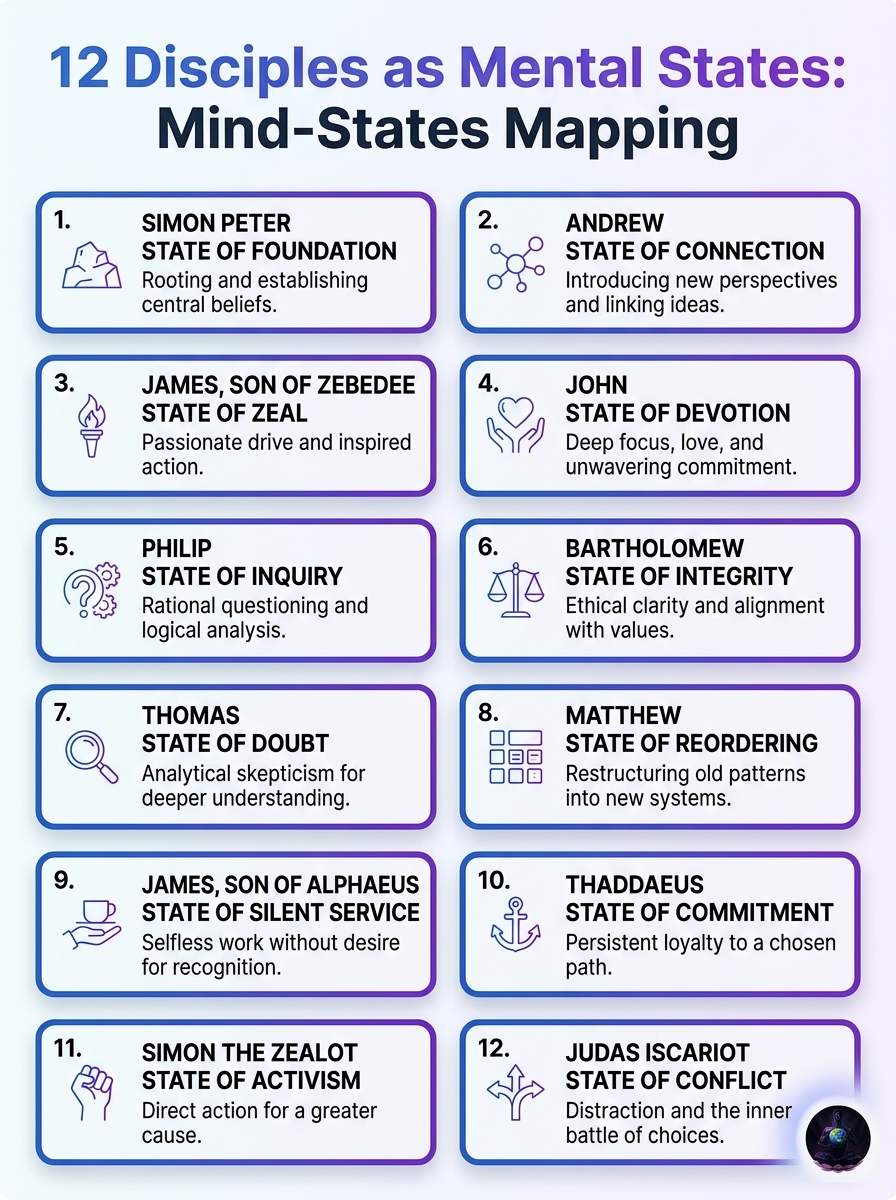
The 12 Disciples as Mental States: Neville’s Complete Map
1. Simon Peter — Disciplined Hearing (Faith in Oneself)
The first quality called is Simon, the attribute of hearing. When disciplined, this faculty permits only impressions into consciousness that align with what the inner man has commanded. No matter what the senses report or what the world suggests, Simon Peter — when disciplined — remains unmoved.
Neville writes: “This is the Simon Peter who discovers the I AM to be Christ, and for his discovery is given the keys to heaven.” Peter means rock — the unmoved disciple. The one who, having heard that I AM is Christ, remains firm in that knowledge regardless of outward contradiction.
In practice: when you choose what to allow into your consciousness and refuse to rehearse evidence of lack, you are calling Simon Peter to discipleship.
2. Andrew — Courage
Andrew is Peter’s brother, and Neville is deliberate about this relationship. Faith in oneself automatically calls courage into being. They are inseparable. Andrew is the disciple “who knows what it is to dare, to do, and to be silent.”
The courage Neville describes here is not bravado. It is the quiet strength of someone who has appropriated a state of consciousness and holds it — alone, without external validation — knowing it must externalise.
In practice: acting from your assumption before any outer evidence exists is Andrew in action.
3. James — Righteous Judgment
James the Just is disciplined judgment. Neville describes him as blindfolded — not to be influenced by the flesh or by appearances. A disciplined mind does not judge what it sees. It judges from the inner state, from what it knows to be true regardless of what the senses present.
In practice: refusing to draw conclusions from current circumstances and instead holding to the inner assumption is James at work.
4. John — Love
James and John are always called together in Neville’s treatment because justice without love is cruelty, and love without judgment is sentimentality. John is the beloved — the quality that forgives all men for being what they are, knowing that everyone perfectly expresses what they are conscious of being.
In practice: blessing rather than resenting the person or situation that seems to oppose you is John in discipleship.
5. Philip — Persistence (Seeing the Father Expressed)
Philip asked to be shown the Father. The answer in scripture — “He that hath seen me hath seen the Father” — reveals the principle. The Father is consciousness. The Son is the expression. Philip, when disciplined, “persists until ideas, ambitions and desires become embodied realities.”
Neville connects Philip to Job: “Yet in my flesh shall I see God.” This is the quality that knows how to make the word flesh — how to give form to what is as yet unseen.
In practice: staying with your assumption until it physically manifests, without abandoning it at the first sign of delay, is Philip.
6. Bartholomew — Imagination
Neville writes plainly: “No quality so separates man from man as does the disciplined imagination.” Bartholomew is the imaginative faculty. When awakened, it places the individual “head and shoulders above the average man.”
This is the quality that makes one a leader rather than a follower. Those who have contributed most to society — artists, scientists, inventors — have done so through vivid, disciplined imagination. Neville argues that education should draw this out, not suppress it.
In practice: deliberately constructing and rehearsing inner scenes with sensory specificity is calling Bartholomew to discipleship.
7. Thomas — Disciplined Doubt
Thomas the doubter is one of the most misunderstood disciples. When disciplined, Thomas does not doubt the assumption — he doubts everything that contradicts it. Neville: “Thomas, the doubter — when disciplined — would deny that sickness or anything not in sympathy with the consciousness to which he belonged had any power to affect him.”
Disciplined denial, Neville clarifies, is not a fight. It is total indifference to suggestions foreign to the desired state.
In practice: remaining genuinely unbothered by news, statistics, or opinions that contradict your assumption is Thomas in full discipleship.
8. Matthew — The Gift of God
Matthew reveals that every desire of the heart is a gift from God — already containing both the power and the plan of its expression. The man who calls Matthew into discipleship never questions how the desire will manifest. He “fully accepts his desires as gifts already received and goes his way in peace.”
In practice: releasing the how and trusting that the desire itself contains its own fulfilment is Matthew. This connects directly to V6 — the biggest manifestation mistake is micromanaging the route.
9. James Son of Alphaeus — Discernment
This James is the quality of clear seeing — not physical sight but the capacity to perceive causes rather than effects. Neville calls this true clairvoyance: the mystic’s ability to interpret what is seen, to diagnose at the level of consciousness rather than circumstance.
In practice: asking “what inner state is producing this outer condition” rather than reacting to the condition itself is James son of Alphaeus at work.
10. Thaddaeus — Praise and Thanksgiving
Thaddaeus is the disciple of praise. Neville: “When this quality of praise and thanksgiving is awake within man, he walks with the words, ‘Thank you, Father,’ ever on his lips.” He knows that thanks for things not yet seen opens the windows of heaven.
Praise and thanksgiving are to desires what rain and sun are to seeds in the earth — they create the conditions for growth in the invisible before anything appears in the visible.
In practice: genuine gratitude for the fulfilment before it arrives — not performed optimism, but actual inner thankfulness — is Thaddaeus.
11. Simon the Canaanite — Hearing Good News
Simon from the land of milk and honey hears only good news. This is abundance consciousness made practical. Neville connects this disciple to Psalm 23: “my cup runneth over.” When called to discipleship, this quality is incapable of hearing anything other than good — and is therefore perfectly equipped to preach the Gospel, which literally means Good Spell: a good story told until it becomes real.
In practice: choosing consistently to interpret events through the lens of abundance rather than lack is Simon of Canaan.
12. Judas — Detachment (Letting Go)
Judas is perhaps the most profound of Neville’s interpretations. The disciple the world has blackened is actually the quality that makes all transformation possible. Judas committed suicide — which Neville reads as the mystic symbol for detachment. He let go of the old self so the new could be born.
“Until man lets go of that which he is now conscious of being, he will not become that which he desires to be.” No greater love, Neville writes, than to lay down your life (your current concept of yourself) for your friend (the desired state).
In practice: willingly releasing your attachment to your present identity — the one that says “I cannot, I am not, I do not have” — is Judas in full discipleship. It is not betrayal. It is the most courageous inner act a person can make.

How to Work with the 12 Disciples as Mental States Daily
Neville’s instruction is not to master all twelve at once. It is to call them one by one. The first — Simon Peter, disciplined hearing — is foundational. Without it, the rest have nothing to stand on. You cannot build a disciplined imagination if you allow every fearful thought and doubting voice to pass unchallenged through the gate of consciousness.
A practical daily approach:
- Morning: identify which disciple quality you most need today. Is it courage (Andrew)? Imagination (Bartholomew)? Detachment (Judas)?
- Through the day: when your mind drifts, ask which undisciplined quality is running — then call the corresponding disciple back to order.
- Evening: practise Thaddaeus — genuine thanks for the state you are building, before any outer evidence arrives.
To study this framework in depth, Neville Goddard – Your Faith Is Your Fortune is the primary source. Read it as a manual, not as history.

Conclusion
The twelve disciples as mental states is one of Neville Goddard’s most practical teachings — and one of the most overlooked. When you read them not as men who walked beside Jesus two thousand years ago but as qualities of your own mind waiting to be disciplined, scripture becomes immediately, personally useful.
You are not waiting for an external saviour to fix your circumstances. You are being shown, through the language of myth and symbol, that the twelve qualities required to transform your life are already in you. They always were.
Call them to discipleship. Start with Simon Peter — guard what you allow into your consciousness. End with Judas — let go of who you have been so you can become who you are meant to be. Between those two, a complete system of inner transformation is waiting.
That is what Neville meant when he wrote that man’s duty is to raise these qualities to the level of discipleship. Not as religious obligation. As the most practical, most powerful work a human being can do.
To learn more about Neville Goddard’s life and complete body of work, read our definitive guide: Neville Goddard — The Complete Guide.

Michael Sutherland is the founder of Truecosmic, a global platform dedicated to Neville Goddard’s teachings and the Law of Assumption. Passionate about empowering individuals through conscious creation, Michael blends esoteric wisdom with practical insight to help people transform their lives from within.














0 Comments