
Most people come to kundalini yoga looking for something the physical body alone cannot give them, and most of what they find online is generic studio-class marketing that misses the entire point. Surveys of yoga practitioners consistently find personal development and spiritual growth among the top reasons people stay with the practice long-term, not just physical fitness. Kundalini yoga sits at the exact intersection of that search.
Key Takeaways
| Question | Answer |
|---|---|
| What is kundalini yoga? | A technology of body, breath, and sound designed to awaken dormant consciousness energy at the base of the spine and direct it upward through the chakras. |
| Is kundalini yoga dangerous? | It can be if practiced improperly or without proper preparation. Rapid or forced breathwork can cause dizziness, panic, or physical strain, and intense kriyas performed without warming up can lead to muscle or joint injury. People with epilepsy, severe anxiety disorders, pregnancy, or cardiovascular conditions should consult a doctor first and work only with an experienced teacher. The risks are real, but they are manageable, the danger comes almost entirely from rushing the process or skipping foundational preparation, not from the practice itself. A grounded, gradual approach with proper guidance is what makes this safe. |
| How is it different from regular yoga? | It combines physical postures, breathwork, mantra, and meditation in specific sequences called kriyas, targeting the nervous system and consciousness simultaneously. |
| Can beginners practice kundalini yoga? | Yes, but beginners should start slowly, work with experienced teachers, and understand that the practice is an outer discipline supporting profound inner transformation. |
| What are the benefits? | Nervous system regulation, expanded awareness, emotional clearing, energetic sensitivity, and a deeper connection to the creative power of Consciousness. |
| Where can I learn more? | Explore our Kundalini Awakening Complete Guide for signs, stages, and scriptural context. |
Why Kundalini Yoga Is a Practice, Not a Quick Fix
Most platforms sell kundalini yoga the way they sell everything else in this space: as a fast track to transformation. It isn’t. A martial artist doesn’t earn a black belt by attending one impressive class, the belt comes after years of repeating the same forms long past the point of boredom, on days when nothing about the practice feels remarkable at all. Kundalini yoga works the same way. What separates students who feel something once from those who genuinely transform isn’t a better kriya or a more advanced breath technique, it’s showing up on the flat, uneventful days, not just the breakthrough ones.
This is also why kundalini yoga maps so naturally onto TrueCosmic’s broader teaching. Scripture itself treats the body the same way it treats symbol and story, not as a literal historical record, but as a map of consciousness. Just as Esau and Jacob represent outer sense and inner imagination in conflict, the rising of energy through the body in kundalini practice represents that same inner movement from sense-bound awareness toward a higher, settled state. The practice is not separate from the inner work TrueCosmic teaches elsewhere. It is that work, expressed through the body.
What Kundalini Yoga Actually Is
Let me be direct with you. Most of what passes for kundalini yoga on social media and in boutique studios is a watered-down fitness class with a few mantras sprinkled on top. That is not what this practice is. The real thing is a precise technology, and I use that word deliberately because the mechanics of it operate with the same exactness as any natural law.
Kundalini yoga is the systematic practice of awakening dormant energy that rests coiled at the base of the human spine. The ancient seers described this energy as a serpent, not because they were being poetic, but because it moves in a spiral. When activated through specific combinations of breath, posture, sound, and focus, this energy rises upward through the central channel of the nervous system.
What happens when it rises is not a workout. It is a rewiring. The energy passes through each energetic center, each chakra, clearing what is stuck and illuminating what has been dormant. This is why the practice has been guarded for centuries and why it demands respect.
The term itself comes from the Sanskrit word “kundal,” meaning coiled. The yoga, the union, is the process of uncoiling that energy and uniting it with Consciousness at the crown. In so many ancient texts the seers and mystics have taught us that this entire creation is the shadow of a higher existence. Kundalini yoga is the method of reaching back into that higher existence through the very body you inhabit right now.
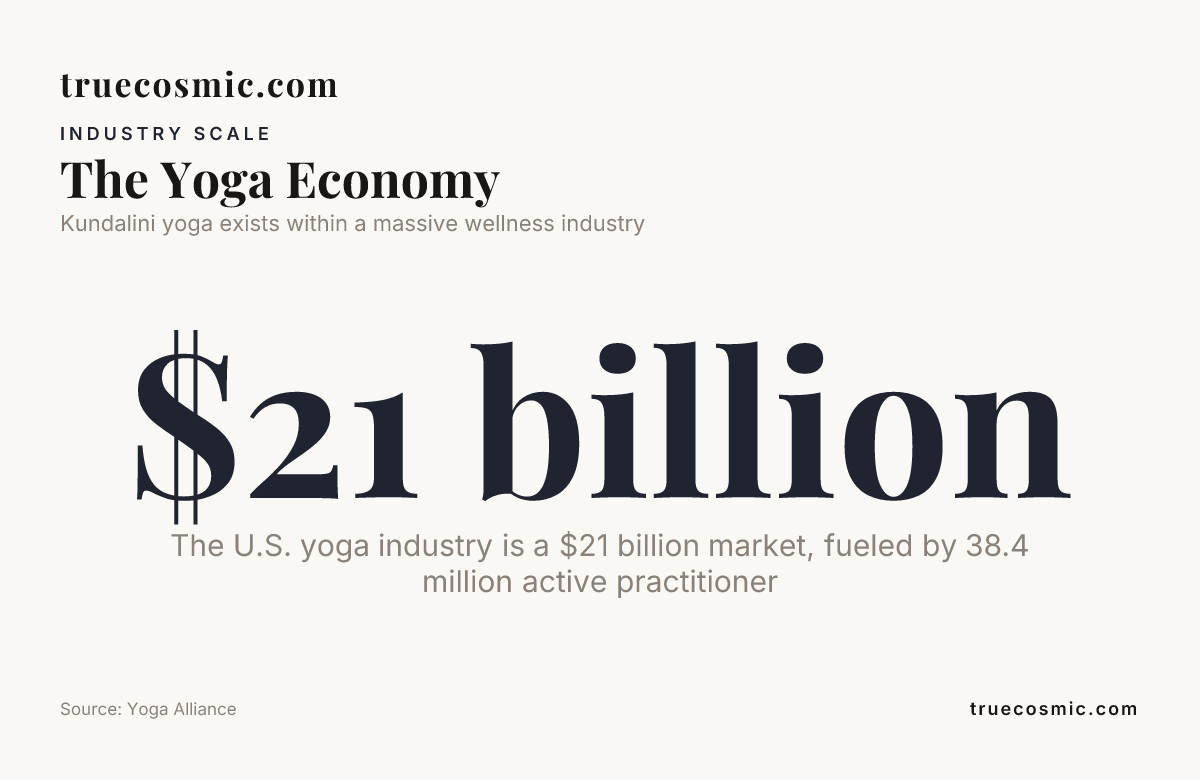
Kundalini yoga exists within a massive wellness industry
The practice was brought to the Western world by Yogi Bhajan in 1969, who began teaching it openly in the United States. Before that, it was passed through a lineage tradition in India, taught teacher to student, with specific protocols for initiation. The opening of this teaching to the public was both a gift and a risk. More access means more people benefit, but it also means more people attempt the practice without the foundational understanding that makes it safe.
A typical session involves a kriya, which is a specific sequence of exercises designed to produce a precise energetic effect. A kriya is not a random flow of poses. It is a formula. You do the same movements, in the same order, for the same duration, with the same breath pattern. The repetition is the mechanism. Through it, the nervous system is pushed past its ordinary thresholds and the energetic body is opened in a controlled way.

The Outer Discipline and Inner Work of Kundalini Yoga
Here is where TrueCosmic’s approach to kundalini yoga diverges from everything else you will read online. The physical practice, the postures and the breathwork and the mantras, is the outer discipline. It is the scaffold. The real work, the work that changes you at the level of identity, is the inner work. It is the work of Consciousness.
We frame the body as a map. The same interpretive lens we apply to scripture, we apply to the physical form. Every chakra corresponds to a level of consciousness. Every blockage in the body corresponds to a state of being you have assumed and held. When you work through a kriya and feel resistance in a specific area, you are not just feeling tight muscles. You are feeling the physical manifestation of a mental state you have hardened into fact.
This is the same principle Neville Goddard taught, applied to the body rather than to circumstances. When you say “I AM wealthy,” you are not lying or affirming. You are assuming a state of being. That state, held consistently, objectifies into your outer experience. The body operates identically. When you hold a state of fear, that state hardens into the body as tension in the solar plexus. When you hold a state of grief, it hardens into the chest. The body does not lie. It shows you exactly what states you have been occupying.
Kundalini yoga, understood correctly, is the process of bringing Consciousness to those hardened states and dissolving them. The breath is the tool. The movement is the tool. The mantra is the tool. But the agent is your awareness. Without that awareness, without the conscious intention to observe and release what arises, you are just doing calisthenics in a turban.
The practice angle is the whole differentiation. Most teachers will tell you that kundalini yoga is about the energy. We are telling you the energy is the vehicle, not the destination. The destination is the conscious recognition that your own awareness is doing the creating, not the body. Rather than being on the effect of life, man through his consciousness becomes the cause. The physical practice trains your nervous system to hold that recognition without breaking.
This is why we integrate kundalini yoga with the deeper framework of manifestation and the Law of Assumption. The physical practice clears the channels. The mental practice, the assumption of the state of the wish fulfilled, directs the energy. Together, they form a complete system that is devastatingly practical. You are not just awakening energy for the sake of feeling something mystical. You are awakening energy to consciously create your experience.

Core Benefits of Kundalini Yoga
Let me be honest about the benefits of kundalini yoga rather than handing you a list of marketing claims. The benefits are real, but they are not magic. They are the natural result of a disciplined practice that regulates the nervous system, clears stagnant energy, and expands conscious awareness.
Nervous system regulation. The breath patterns in kundalini yoga, particularly breath of fire and long deep breathing, directly impact the vagus nerve and the autonomic nervous system. Practitioners experience measurable reductions in cortisol levels and improved stress resilience. This is not spiritual speculation. It is physiology.
Emotional clearing. Because the body holds emotional states as physical tension, the practice of moving energy through blocked areas releases stored emotion. This can be uncomfortable. It is also necessary. You cannot assume a new state of being while your body is still holding the physical pattern of an old one.
Expanded awareness. As the energy rises through the chakras, your perceptual field widens. You begin to notice thoughts, patterns, and impulses that were previously unconscious. This is the beginning of conscious creation. You cannot change what you cannot see.
Enhanced manifestation capacity. When your nervous system is regulated and your energetic channels are clear, you can hold the feeling of the wish fulfilled with greater stability. The moment you bring Consciousness to a state, that state begins to harden into your outer experience. Kundalini yoga makes your instrument, your body and mind, a clearer vessel for that process.
Mental clarity and focus. The combination of breath retention, mantra repetition, and eye focus (drishti) trains the mind to hold a single point of attention. In a culture that fragments attention every few seconds, this alone is a transformative benefit.
Physical vitality. The kriyas build core strength, improve circulation, stimulate the glandular system, and increase lung capacity. The physical benefits are not separate from the spiritual ones. They are the foundation that allows the deeper work to proceed safely.
Is Kundalini Yoga Dangerous? What You Need to Know
This is the section most resources either skip entirely or bury in a one-line disclaimer at the bottom. We are not going to do that. The question “is kundalini yoga dangerous” is one of the most searched phrases related to this practice, and the honest answer is: yes, it can be, if you approach it carelessly. To pretend otherwise is ludicrous.
Let me explain the mechanics of the danger so you understand it rather than fear it. Kundalini energy is real in the sense that it produces measurable effects on the nervous system, the endocrine system, and psychological states. When this energy is forced upward before the body and mind are prepared, it can overwhelm the system. This is not mystical alarmism. It is the same principle as trying to run a marathon without training. The body breaks down.
The symptoms of premature or uncontrolled awakening include:
- Intense heat or cold moving through the body unexpectedly
- Involuntary physical movements, tremors, or shaking
- Overwhelming emotional releases that feel beyond your control
- Sleep disruption and vivid, sometimes disturbing, dream experiences
- Anxiety, paranoia, or dissociative states
- Physical pain in the spine, head, or chest
- A sense of losing touch with ordinary reality
These symptoms are sometimes grouped under the term “kundalini syndrome,” and while the medical establishment does not officially recognize this term, the experiences are documented across cultures and centuries. The ancient texts warned about this. The risks are not a modern invention. They are the reason the practice was traditionally guarded and transmitted only under the supervision of a qualified teacher.
Why does this happen? The energy moves faster than the nervous system can process. Think of it as pushing a high voltage current through wiring that was not designed for it. The system short-circuits. In spiritual terms, the energy clears blockages too rapidly, and the person experiences the simultaneous release of years of accumulated emotional and psychological material without the capacity to integrate it.
How to mitigate the risks:
- Start slowly. Do not attempt advanced kriyas or long fasts in your first weeks. Build the foundation. Ten minutes of breathwork daily is more valuable than a three-hour intensive once a month.
- Work with a qualified teacher. Not an Instagram influencer. Not a weekend-certified instructor. Someone with years of experience who understands both the physical and energetic dimensions of the practice.
- Ground yourself. Eat well. Sleep well. Spend time in nature. Walk barefoot. The more rooted you are in the physical, the more safely you can navigate the energetic.
- Do not force anything. If a practice produces fear, pain, or dissociation, stop. Modify. Rest. The energy will integrate in its own time if you give it space.
- Integrate with mental practice. Use the consciousness techniques we teach in our education programs to process what arises. Journaling, state management, and SATS (State Akin To Sleep) practice help you metabolize energetic experiences rather than being overwhelmed by them.
- Honor your limitations. If you have a history of psychosis, severe trauma, or psychiatric medication use, consult with a mental health professional before beginning. This is not weakness. It is wisdom.
The danger is real, but it is not a reason to avoid the practice. It is a reason to approach it with the respect and preparation it demands. To say you should never practice kundalini yoga because some people have had difficult experiences is like saying you should never lift weights because some people have injured themselves in the gym. The solution is not avoidance. The solution is proper training.
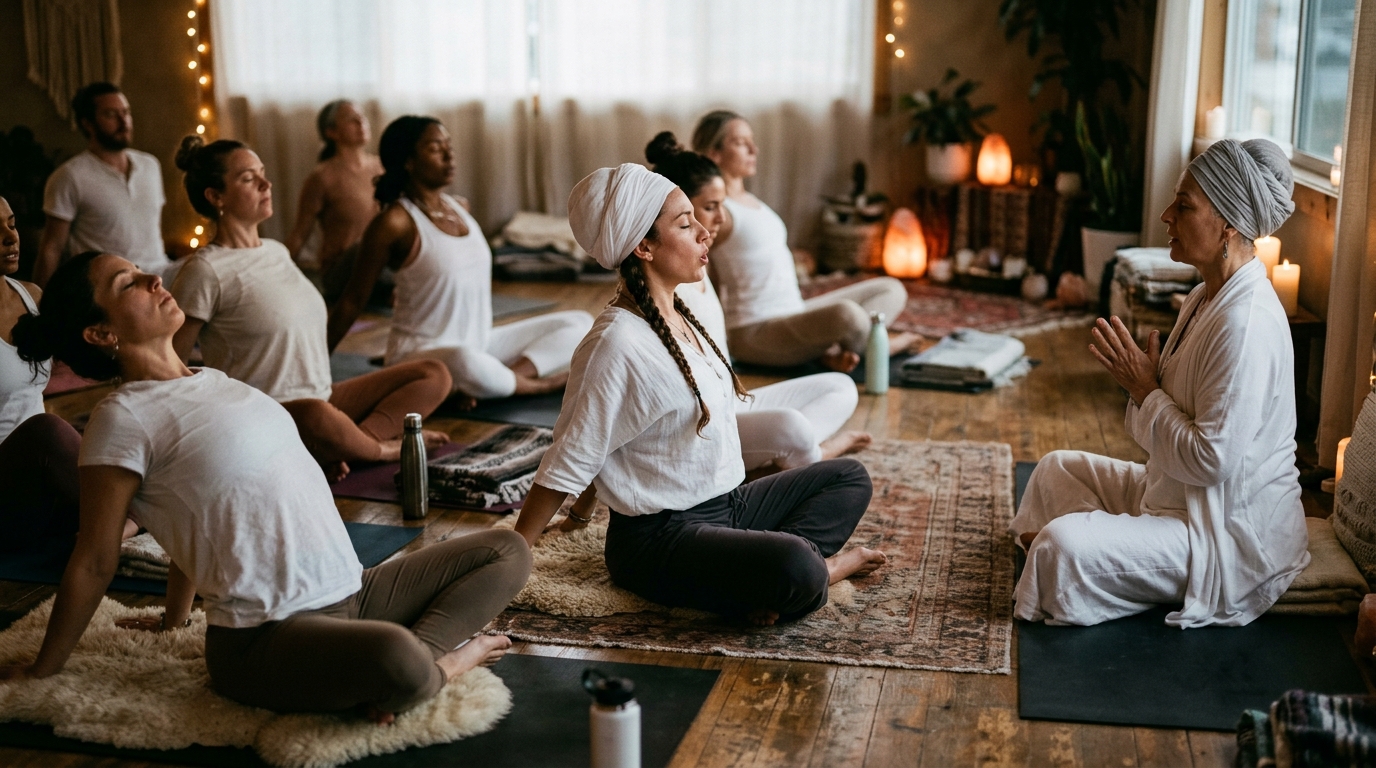
How Kundalini Yoga Differs From Other Yoga and Meditation Styles
If you have tried other forms of yoga, you need to understand that kundalini yoga is not just a different style. It is a different category of practice entirely. The distinction matters because it determines what you can expect and how you should prepare.
Versus Hatha and Vinyasa yoga: These styles focus primarily on physical postures, alignment, and flow. They build strength, flexibility, and body awareness. They are excellent practices. But they do not, by design, target the energetic system in the systematic way kundalini yoga does. A vinyasa class will make you sweat. A kundalini class will rewire your nervous system.
Versus passive meditation: This is a critical distinction. In passive meditation, you sit and observe. You watch the breath. You notice thoughts. You cultivate witness consciousness. This is valuable, and we do not dismiss it. But kundalini yoga is active. You are not passively observing the mind. You are actively directing energy through breath, movement, and sound. You are doing something specific to produce a specific effect.
The difference is the same as the difference between watching a river and building a dam. Passive meditation observes the current. Kundalini yoga directs it. Both have their place, but they are not the same activity and they do not produce the same results.
Versus other energetic practices: Practices like qigong and tai chi also work with internal energy, and they share some principles with kundalini yoga. The primary difference is that kundalini yoga works specifically with the upward rising of dormant energy through the chakra system, while qigong tends to focus on circulating energy through the meridian system. The frameworks are different, but the underlying metaphysical reality is the same. Consciousness directs energy, and energy follows attention.
Versus manifestation practice alone: Many people in our community practice Neville Goddard’s techniques, SATS, and the Law of Assumption without any physical practice. That works. The Law does not require yoga to function. But kundalini yoga accelerates the process by clearing the physical and energetic resistance that slows manifestation down. It is not required, but it is a powerful complement. Think of it as upgrading the hardware so the software runs faster.

Getting Started With Kundalini Yoga Safely
If you have read this far and you want to begin, here is our practical guidance for starting kundalini yoga in a way that serves you rather than destabilizes you.
1. Set your intention before you begin. Why are you practicing? If the answer is to look good or to have a mystical experience to talk about, check yourself. The right intention is to clear the instrument, to make yourself a more capable vessel for conscious creation. Everything else follows from that.
2. Begin with breath alone. Before you attempt any kriya, spend two weeks doing nothing but long deep breathing and breath of fire for ten minutes a day. This alone will begin to regulate your nervous system and prepare your body for more intensive practice.
3. Learn the basic components. Kundalini yoga is built from six core elements: breath, posture, sound (mantra), mental focus, locks (bhandas), and rhythm. Understand what each one does before you combine them. Our complete guide to kundalini awakening covers the deeper context of what these components activate.
4. Start with short, simple kriyas. Five to fifteen minutes is sufficient for a beginner. Do not push for hour-long sessions. Consistency produces results, not intensity. Fifteen minutes daily for ninety days will change you more than a single three-hour session ever will. To say 90 days is a benchmark is ludicrous, but the principle of sustained practice over time is not. Consistency is the mechanism.
5. Keep a practice journal. Writing is a way of turning your thoughts into something tangible. After each session, note what you felt, what emotions arose, what physical sensations you noticed. Over time, patterns will emerge. You will see the connection between your physical practice and your inner states. This is where the real learning happens.
6. Integrate with consciousness work. The physical practice opens the channels. The mental practice directs the energy. Use the tools we teach in the TrueCosmic Academy to work with what arises. SATS, scripting, and state management are not separate from kundalini yoga. They are the other half of the same technology.
7. Know when to stop. If you feel overwhelmed, stop. If you feel dissociated, ground yourself with food, water, and physical movement. If symptoms persist, seek support from a qualified teacher or mental health professional. There is no spiritual merit in pushing through warning signs. The ego that pushes through is the same ego the practice is designed to dissolve.
Frequently Asked Questions
Is kundalini yoga safe for beginners in 2026?
Kundalini yoga is safe for beginners when approached with respect, proper guidance, and gradual progression. Start with short sessions of ten to fifteen minutes, focus on breathwork before attempting complex kriyas, and work with an experienced teacher. The risks associated with kundalini yoga come from rushing the process, not from the practice itself.
What happens when kundalini energy awakens?
When kundalini energy awakens, it rises from the base of the spine through the central channel, clearing energetic blockages at each chakra. Practitioners typically experience heightened awareness, emotional release, physical sensations of heat or vibration, and an expanded sense of connection to Consciousness. The process can be intense, which is why preparation matters. Our complete guide to kundalini awakening covers the signs and stages in detail.
How often should I practice kundalini yoga?
Daily practice of fifteen to thirty minutes is more effective than occasional long sessions. Kundalini yoga works through repetition and consistency, not through intensity. A short daily sadhana, practiced with conscious intention, will produce measurable changes in your nervous system and awareness within weeks.
Can kundalini yoga help with manifestation?
Yes, but not in the way most people think. Kundalini yoga does not magically grant wishes. It clears the physical and energetic resistance that blocks your ability to hold the state of the wish fulfilled. By regulating the nervous system and expanding awareness, it makes you a more capable vessel for conscious creation through the Law of Assumption.
What is the difference between kundalini yoga and kundalini awakening?
Kundalini yoga is the physical and energetic practice, the kriyas, breathwork, and mantras, designed to prepare the system and gradually awaken the energy. Kundalini awakening is the event or process of the energy actually rising. You can practice kundalini yoga for years without a full awakening, and awakening can also occur spontaneously without any yoga practice. The practice is meant to make the awakening safe and controlled.
Why do people wear white in kundalini yoga?
Yogi Bhajan introduced the tradition of wearing white to expand the energetic field and protect the practitioner’s aura during practice. The white fabric is said to reflect light outward, increasing the radius of the electromagnetic field. While this is a tradition rather than a requirement, many practitioners find it helps maintain focus and energetic boundaries during intense practice.
Can I practice kundalini yoga at home?
You can practice kundalini yoga at home once you have learned the basic techniques from a qualified teacher. Start with simple kriyas, keep sessions short, and never push through discomfort or dissociation. Home practice is where the consistency happens, but initial guidance from an experienced teacher is essential to ensure you understand the mechanics and safety protocols.

Conclusion
Kundalini yoga is not a trend. It is not a workout. It is not a mystical hobby for people who like wearing white and chanting. It is a precise technology for awakening dormant consciousness energy through the body, and when understood correctly, it is the outer discipline that supports the most important inner work you will ever do.
We do not approach this practice as an end in itself. We approach it as a means of clearing the instrument so that Consciousness can do what Consciousness does: create. The body is the map. The practice is the method. What you arrive at, eventually, is the simple recognition that your awareness was never separate from what it experiences. It was always the one writing the experience.
Practice with intention. Practice with respect. Practice with the understanding that every breath, every posture, and every mantra is clearing the channel through which your assumed states will harden into fact. That is what makes kundalini yoga devastatingly practical. It is not about escaping this reality. It is about becoming the cause of it.
If you are ready to go deeper, explore our Kundalini Awakening Complete Guide for the signs and stages of the awakening process, and join us in the TrueCosmic Academy to integrate the physical practice with the consciousness techniques that make it work. The outer discipline and the inner work are one system. Practice both, and you cannot fail in what you wish to achieve.

Michael Sutherland is the founder of TrueCosmic and a devoted student and practitioner of Neville Goddard teachings. His path to this work was not academic — it was forged in crisis.
Raised as a devout Jehovah Witness and Baptist, Michael walked away from the church at eighteen and spent the next 25 years in what scripture calls the far country — the prodigal son, wandering. He built a life by the world rules, searching without knowing what he was searching for.
When the biggest crisis of his life arrived, he turned back — not to the church, but to scripture itself. Through Neville Goddard teachings he found what the church had never shown him: that the God of scripture is not an external being to be feared and appeased. God is your own awareness. Your own consciousness. Your own imagination. The I AM within.















0 Comments