I was raised in a tradition that told me the only approved texts were the four canonical Gospels. Anything outside of that was heresy. When I eventually read the Gospel of Thomas, I understood immediately why the church had been so nervous about it. It contains no doctrine that requires a mediator. No instructions to go through an institution. Just the living voice pointing directly inward — toward the kingdom that is already within you.
For anyone who has found Neville Goddard, understanding how the Gospel of Thomas teaches conscious manifestation reads like a confirmation. Not a curiosity. A confirmation. The same truth, in older language, making the same uncompromising claim: you are the creative cause of your experience. The kingdom is not coming. It is already here.
The Gospel of Thomas offers one of the most direct and undiluted teachings on how the Gospel of Thomas teaches conscious manifestation through the inner life, the awakened imagination, and the reality of Christ dwelling within every human being. For those already walking the path that Neville Goddard illuminated, this ancient text reads less like a historical curiosity and more like a precise map of the inner world.
Thomas is not a narrative gospel. There is no story of miracles performed for crowds, no birth narrative, no crucifixion drama in the traditional sense. What Thomas preserves is a collection of 114 sayings attributed to the living Jesus. That word “living” matters deeply. The text opens with: “These are the secret sayings that the living Jesus spoke.” Not the historical Jesus. Not the Jesus of doctrine. The living Jesus. The one who is alive in you, now.
That distinction changes everything.
The Kingdom Is Within You, Not Above You
Perhaps the single most important saying in the Gospel of Thomas for the serious student of conscious creation is Saying 3:
“If your leaders say to you, ‘Look, the kingdom is in the sky,’ then the birds of the sky will precede you. If they say to you, ‘It is in the sea,’ then the fish will precede you. Rather, the kingdom is within you and it is outside you.”
This saying directly dismantles the idea that what you are seeking is somewhere outside of you, waiting to be found by the right prayer formula or the right spiritual authority. The kingdom, which is another word for the full creative power of God, is within you and simultaneously expressed as the world around you.
Neville Goddard spent decades teaching this same point. He would say that God became man so that man might become God, and that your imagination is the very Christ the scriptures speak of. Thomas affirms this not as metaphor, but as the central fact of spiritual reality.
The inner state is not preparation for manifestation. The inner state is manifestation, already taking form.
Bringing Forth What Is Within You
Saying 70 in the Gospel of Thomas is one of the most sobering and clarifying statements in all of scripture:
“If you bring forth what is within you, what you have will save you. If you do not have that within you, what you do not have within you will kill you.”
Read that slowly. This is not a threat. It is an honest description of how imagination works. What is held persistently in the inner life, whether it is fear or faith, lack or abundance, unworthiness or confidence, will eventually take physical form. The teaching is not soft. It places full creative responsibility on the individual.
This aligns precisely with what TrueCosmic explores in its article on the spiritual cause behind every natural effect. The outer world is always the harvest of the inner life. The natural effect has a spiritual cause. Thomas understood this completely.
Most people walk through life unaware that they are constantly bringing forth something from within themselves. They bring forth anxiety, and they harvest circumstances that confirm the anxiety. They bring forth doubt, and they harvest failure that confirms the doubt. The teaching of Thomas is not to judge these people, but to wake them up to what they are actually doing.
Making the Two One: The Core of How the Gospel of Thomas Teaches Conscious Manifestation
Saying 22 is where Thomas gives his clearest instruction on the mechanics of inner transformation:
“When you make the two one, and when you make the inside like the outside and the outside like the inside, and the above like the below, and when you make the male and the female one and the same… then you will enter the kingdom.”
Understanding how the Gospel of Thomas teaches conscious manifestation becomes clearest here. The two that must become one are your present outer reality and your desired inner reality. As long as they remain separated, as long as you feel one thing on the inside and see something contradictory on the outside, you remain in the divided state. The kingdom is entered when the inside and the outside are in agreement.
This is exactly what Neville called “living in the end.” You do not hope for a desired state. You inhabit it. You feel it from the inside as though it is already real. You make the inside like the outside by assuming the feeling of the wish fulfilled.
TrueCosmic’s piece on removing the mountains in your life speaks directly to this point. The mountain in your outer world only persists because the inner state that created it remains unchanged. When you make the two one, the mountain has no ground to stand on.

The Single Eye and the Light Within
The user of these teachings will recognize the concept of the single eye immediately. In Saying 61, the Gospel of Thomas records Jesus saying: “If one is whole, one will be filled with light, but if one is divided, one will be filled with darkness.”
This is the same truth expressed in the canonical gospels when Jesus speaks of the eye being single and the whole body full of light. But Thomas strips it of its vagueness and places it in the context of inner unity. To be whole is to be undivided. To be undivided is to hold a single inner state without contradiction, without the double-minded oscillation between faith and fear.
Neville called this the state of “being in the wish fulfilled.” Thomas calls it being whole, filled with light. They are pointing at exactly the same condition.
Saying 24 deepens this further: “There is light within a man of light, and he lights up the whole world. If he does not shine, he is darkness.”
This is not a passive statement. It is an active one. The light within a person of awakened imagination lights up the whole world. Your inner state is not contained inside your skull. It radiates outward and reshapes the world you perceive. Thomas is describing conscious creation from the inside out.
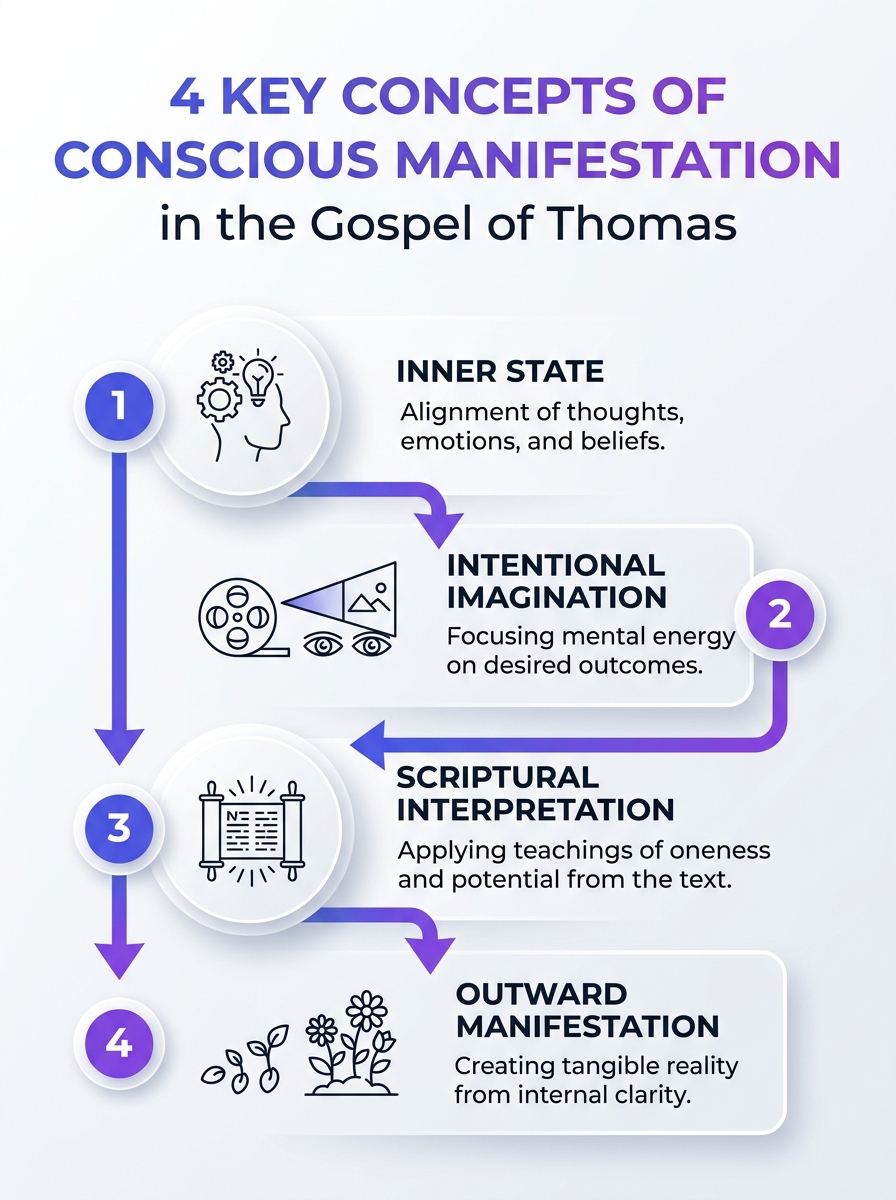
This infographic explains four key concepts of conscious manifestation as taught in the Gospel of Thomas. It highlights practical takeaways for applying ancient wisdom today.
To learn more about Neville Goddard’s life and complete body of work, read our definitive guide: Neville Goddard — The Complete Guide.
Christ in You: The Creative Power Thomas Points To
There is a passage in Paul’s letters that Thomas and Neville both illuminate from different angles. Paul writes in Corinthians: “Do you not realize that Jesus Christ is in you?” It is not a rhetorical question. It is a direct challenge.
Thomas makes this same point through Saying 77:
“I am the light that is over all things. I am all: from me all came forth, and to me all attained. Split a piece of wood; I am there. Lift up the stone, and you will find me there.”
This Christ is not absent. This Christ is not in a building or a book or a historical event. This Christ is the creative power that underlies all form, present in every particle of the physical world, and most immediately accessible as the imagination within you.
The teaching at Christ in You makes this plain: Christ in you is your hope of glory. It is your power to imagine and therefore to create. When you test this by actually assuming the feeling of your desire and watching the outer world rearrange itself to match that inner assumption, you move from doctrine to direct experience. You move from belief to knowledge.
Thomas would call this finding the kingdom. Neville would call it proving the law. They are describing the same moment of realization.
Seeing Beyond the Surface: Fourfold Vision and the Gospel of Thomas
William Blake, who was deeply influenced by the same mystical tradition that Thomas preserves, warned against what he called “single vision and Newton’s sleep.” Single vision is the state of seeing only the physical surface of things, the literal, the material, the fixed.
Thomas challenges this kind of seeing throughout the collection of sayings. In Saying 113, when the disciples ask when the kingdom will come, Jesus answers:
“It will not come by watching for it. It will not be said, ‘Look, here!’ or ‘Look, there!’ Rather, the Father’s kingdom is spread out upon the earth, and people do not see it.”
The kingdom is not coming. It is already here. What is absent is the perception to see it. The student of Neville’s teachings will recognize this immediately. Imagination does not create something out of nothing in some distant future. It reveals what is already real on a level that the physical senses cannot detect.
The article on fourfold vision explores this beautifully. To move from single vision to the fourfold state is to begin seeing imagination as the primary reality, and physical form as its shadow or echo. Thomas teaches exactly this. The physical world is the report, not the cause.
The Moment of Imagination That Satan Cannot Find
Blake wrote that “there is a moment in every day that Satan cannot find, nor can his watch fiends find it. But the industrious find this moment, and when it once is found, it renovates every moment of the day if rightly placed.”
This connects directly to Thomas Saying 3’s insistence that the kingdom is already within you. The moment Blake describes is the moment of pure imagination, the state akin to sleep that Neville called the hypnagogic state, where the surface mind quiets and the deeper creative power can be directed consciously.
Thomas does not describe this state in technical terms, but his sayings consistently point toward an inner turning. Saying 50 records Jesus saying: “If they ask you, ‘What is the evidence of your Father in you?’ say to them, ‘It is motion and rest.'” Motion and rest. The active imagination moving in directed vision, then resting in the certainty of the done deed.
This is the practice. It is not complicated. It is not distant. It is the daily discipline of the industrious person Blake described, the one who finds that still, directed moment and uses it to renovate the outer life.
The teaching at every natural effect has a spiritual cause explains why this moment matters so much. We forget our imaginal acts. Then, when the outer world produces the harvest of those acts, we deny our own authorship. Thomas is asking us to wake up to this cycle and take it in hand deliberately.
Stripping Away the False Self to See Clearly
Saying 37 in the Gospel of Thomas records one of its more startling exchanges. The disciples ask when they will see Jesus, and the answer given is this:
“When you strip without being ashamed, and you take your clothes and put them under your feet like little children and tread on them, then you will see the son of the living one, and you will not be afraid.”
The clothing here represents the false self, the accumulated identity built from external opinion, past conditioning, and the habitual inner states that have hardened into personality. To strip these away is to return to the unconditioned state of the child, the one who imagines freely and fully without apology.
Neville spoke often about the need to die to the old state before a new state can be born. This is not a physical death. It is the willingness to stop defending the old self-concept and to put on the new one instead. Thomas frames this stripping away as the precondition for actually seeing Christ, which in this context means the full recognition of your own creative power.

The Gospel, Paul, and the Revelation Within
Paul insisted that the gospel he taught was received not from men, not through any human tradition, but through direct revelation. Thomas preserves a similar quality of knowing. These are not instructions handed down through institutional channels. They are the record of a direct encounter with the Christ within.
The teaching at the gospel as Paul understood it makes clear that the churches have often taught a Christ that exists entirely outside the individual. But both Paul and Thomas, read carefully and without the filter of tradition, point in the same direction: inward.
There is no intermediary between you and the creative power that underlies existence. This is not arrogance. It is the most humbling recognition possible. Because it means that everything in your life, without exception, is the product of your own inner life, your own sustained imaginal states, your own harvest.
It also means that everything can change. Right now. From the inside.
Conclusion
The question of how the Gospel of Thomas teaches conscious manifestation is not an academic one. It is a practical and deeply personal one. Thomas does not give you a theological system to argue about. He gives you a mirror.
Every saying points back to the same essential truth: you are the creative cause of your experience. The Christ within you is not a doctrine. It is an active, living power that is imagining constantly. The only question is whether you are directing that imagination deliberately or simply running on habit and reaction.
Saying 70 leaves no room for passivity: bring forth what is within you, or what is within you will consume you. Saying 3 leaves no room for spiritual postponement: the kingdom is already here, already within you. Saying 22 gives you the method: make the inside and the outside one, feel the reality of your desire until it is the only reality your inner world knows.
This is ancient wisdom. It is also the most immediately practical guidance available. For those already walking this path through the teachings of Neville Goddard, the Gospel of Thomas is not a new discovery. It is the confirmation, written in the oldest possible language, that what you know to be true has always been true.
The kingdom is spread upon the earth. Open your imagination, and you will see it.
For those who want to continue exploring these ideas from the inside out, the work at TrueCosmic offers a consistent and scripturally grounded companion for this journey.
No matter what the outer circumstances are reporting right now, they are not the final word. They are the harvest of a previous inner state. And inner states can change. Right now. In this moment. By choosing what you imagine, what you feel as real, what you assume to be true about yourself and the world.
That is not a promise made by a distant God in a future you have to earn. That is the immediate, present, unconditional nature of the kingdom that is already within you. Thomas knew it. Neville proved it. Now it is yours to use.
Frequently Asked Questions
Is the Gospel of Thomas considered scripture, and why does it matter for understanding imagination and manifestation?
The Gospel of Thomas was excluded from the canonical Bible during the early formation of Christian orthodoxy, largely because its teachings place authority inside the individual rather than within the institutional church. For students of Neville Goddard, this makes it arguably more relevant, not less. Its sayings preserve a direct and unfiltered teaching on the inner Christ, the creative imagination, and the kingdom within that aligns precisely with what Neville spent his lifetime explaining.
What does Thomas Saying 70 mean when it says “if you do not have that within you, what you do not have within you will kill you”?
This saying is Thomas’s most direct statement on the consequences of an undirected inner life. If you do not consciously bring forth a vision, a feeling, a sustained imaginal state from within yourself, then what you do carry unconsciously, fear, doubt, unworthiness, will shape your life by default. The teaching is not about punishment. It is about the unavoidable reality that the inner life always expresses itself outwardly, whether you direct it or not.
How does the Gospel of Thomas relate to Neville Goddard’s teaching that imagination creates reality?
Thomas and Neville are addressing the same reality from different angles. Thomas preserves the sayings of the living Jesus, who points consistently to the kingdom within and the need to bring forth what is inside. Neville identified that inner kingdom as the human imagination and spent decades demonstrating, through scripture and personal experiment, that assuming the feeling of a desired state causes that state to materialize in the physical world. Thomas Saying 22, which instructs us to make the inside like the outside, is a precise description of what Neville called living in the end.
What is the practical daily application of what the Gospel of Thomas teaches about the inner life?
The most direct application is the one Neville described repeatedly: find a quiet moment, preferably in the drowsy state before sleep, and construct an inner scene that implies your desire is already fulfilled. Hold that scene with feeling until it feels natural. Then release it. Thomas Saying 113 reminds us that the kingdom does not arrive with fanfare or observable signs. It is already spread upon the earth. Your daily practice is not to create it but to align your inner state with it, to make the two one, until the outer world reflects what the inner world already holds.

Michael Sutherland is the founder of Truecosmic, a global platform dedicated to Neville Goddard’s teachings and the Law of Assumption. Passionate about empowering individuals through conscious creation, Michael blends esoteric wisdom with practical insight to help people transform their lives from within.
Michael Sutherland is the founder of TrueCosmic and a devoted student and practitioner of Neville Goddard teachings. His path to this work was not academic — it was forged in crisis.
Raised as a devout Jehovah Witness and Baptist, Michael walked away from the church at eighteen and spent the next 25 years in what scripture calls the far country — the prodigal son, wandering. He built a life by the world rules, searching without knowing what he was searching for.
When the biggest crisis of his life arrived, he turned back — not to the church, but to scripture itself. Through Neville Goddard teachings he found what the church had never shown him: that the God of scripture is not an external being to be feared and appeased. God is your own awareness. Your own consciousness. Your own imagination. The I AM within.












0 Comments