
The SATS technique Neville Goddard developed and taught throughout his career is not, as many people assume, a relaxation exercise or a passive wind-down ritual. It is the most direct route to the subconscious mind available to any human being — and the neuroscience behind it is more remarkable than most manifestation teachers will tell you. Research into sleep onset confirms that a healthy adult typically enters the transitional pre-sleep state within 10 to 20 minutes of lying down; and it is precisely within that narrow biological window — not during wakefulness, not during deep sleep — that your subconscious mind opens its gates and accepts new impressions as literal fact. Neville Goddard understood this. He built an entire method around it. And once you genuinely understand what is happening in your brain during the State Akin to Sleep, you will never again treat SATS as a casual option.
This is the most complete practical guide to SATS Neville Goddard you will find anywhere. Whether you are entirely new to SATS manifestation or you have been practising for months without the results you expected, everything you need is here — the definition, the neuroscience, the step-by-step method, the most common mistakes, and the advanced refinements that separate practitioners who get results from those who simply fall asleep.

Key Takeaways
- What is SATS? SATS stands for State Akin to Sleep — the hypnagogic threshold Neville Goddard identified as the most receptive state of consciousness for impressing a desired reality onto the subconscious mind.
- Why does SATS work? During the hypnagogic state, the brain shifts into theta brainwave activity (roughly 4–7 Hz), dramatically lowering the critical factor of the conscious mind and allowing imaginal scenes to be received as real experience by the subconscious.
- How do you do SATS? You lie still, allow your body to relax toward sleep, enter the drowsy threshold state, then play a short imaginal scene that implies your desire is already fulfilled — looping it gently until you drift off.
- How often should you practise? Every single night. SATS is a nightly practice, not a technique you deploy once and assess. Consistency over weeks and months is what produces results.
- What is the biggest mistake? Overcomplicating the scene and trying to control the exact route by which your desire arrives — a form of subconscious micromanagement that blocks the very receptivity you are trying to cultivate.
- Where can you go deeper? Explore Mastering the State Akin to Sleep and the full Neville Teachings library for extended practice guidance.
What Is SATS? The Complete Definition
SATS — State Akin to Sleep — is a term Neville Goddard used repeatedly in his lectures and writings to describe a very specific condition of consciousness. It is not sleep itself. It is not fully waking awareness. It is the liminal threshold between the two — that drowsy, dreamy, half-awake state you pass through every single night on your way to sleep.
Neville taught that this state has a quality no other waking state possesses: in it, the analytical, doubting, critical function of the conscious mind quietens almost entirely. The guard at the gate of your subconscious steps aside. And what you plant in that receptive soil — through imaginal scene, through feeling, through the sensory texture of an assumed wish already fulfilled — gets absorbed without resistance, without negotiation, without the endless internal argument your waking mind would otherwise generate.
The phrase “akin to sleep” is deliberate. Neville was precise in his language. He was not telling you to fall asleep during the technique. He was telling you to approach sleep, to ride the edge of it, and to use that threshold as your point of creative entry. The State Akin to Sleep is the anteroom to the subconscious — and SATS manifestation is the art of furnishing that anteroom with the reality you choose.
To understand why Neville placed such enormous weight on this state, you need to understand what is actually happening in your brain when you enter it. That is where we go next.

Why the Hypnagogic State Is So Powerful: Theta Brainwaves and Subconscious Receptivity
Your brain does not simply switch off when you fall asleep. It transitions through measurable electrical states — distinct brainwave frequencies that correspond to distinct levels of consciousness. When you are fully awake, your brain is predominantly operating in beta waves (14–30 Hz): active, analytical, critical, argumentative. This is the state in which most people try to do their manifesting — and it is, bluntly, the worst possible state for impressing new beliefs onto the subconscious.
As you relax more deeply, your brain shifts into alpha waves (8–13 Hz): a calmer, more receptive register. Daydreaming happens here. Light meditation happens here. But alpha is still largely accessible to the conscious mind’s editing function.
Then comes the threshold Neville called the State Akin to Sleep. Neuroscience calls it the hypnagogic state — and it is associated with a dramatic shift into theta brainwave activity. Read more about how this brainwave transition specifically affects your SATS practice at Brainwaves for the SATS Technique.
At theta, something extraordinary happens. The brain’s default mode network — the inner critic, the editor, the part of your mind that immediately contests a new belief with counter-evidence — goes quiet. Vivid, involuntary imagery begins to arise. Sensory impressions take on a quality almost indistinguishable from real perception. The subconscious mind, which normally operates beneath a thick layer of conscious resistance, becomes directly accessible.
This is why Neville insisted on the State Akin to Sleep with such consistency across decades of teaching. He was not speaking poetically. He was identifying a neurological window that every human being passes through every single night — a window during which the imagination, if directed with feeling and clarity, can write new facts onto the subconscious as effectively as lived experience.
When you understand this, the entire practice of SATS Neville Goddard reorients itself. You are not doing something esoteric or unusual. You are learning to use a biological state your body enters automatically — and learning to use it with intention rather than letting it pass by unconsciously every night while you simply… fall asleep.
How to Do the SATS Technique: A Complete Step-by-Step Guide
Here is the complete SATS technique step by step, drawn directly from Neville Goddard’s own teachings and refined through everything we know about how the hypnagogic state actually functions. Follow this faithfully, every night, and you will begin to understand what Neville meant when he said: “Your imagination is your own workshop — and the State Akin to Sleep is where you do your finest work.”
Step 1 — Prepare Your Body and Environment
Lie down in a comfortable position, ideally in your bed, approximately 20–30 minutes before you would normally fall asleep. Your room should be dark and quiet. You are not trying to force sleep — you are positioning yourself to approach it.
Do not reach for your phone. Do not review the day’s events. Do not begin planning tomorrow. Your task for the next few minutes is simply to let the physical body settle, let the muscles release, and allow the natural downward drift toward sleep to begin on its own.
Step 2 — Enter a State of Physical Stillness
Neville was specific: the body needs to be still. Not forcibly rigid — genuinely relaxed. Begin by softening your jaw, your hands, your shoulders. Let the weight of your limbs sink into the bed. Breathe slowly and naturally. You are not performing a breathing exercise. You are simply allowing the nervous system to move from activation into rest.
This physical stillness is not incidental to the technique — it is part of it. As the body stills, the brain naturally begins its descent from beta through alpha toward the theta threshold. You are working with biology, not against it.
Step 3 — Recognise the Hypnagogic Threshold
As you relax more deeply, you will notice certain signs that you are approaching the State Akin to Sleep. Your thoughts may become less linear — more imagistic, more fragmentary, almost dream-like in quality. You may see colours or shapes behind closed eyes. Your sense of the physical room may begin to recede slightly. Your limbs may feel heavy or distant.
These are not warnings. They are the signal you have been waiting for. This is the state. You are at the threshold. Now is when the technique begins in earnest.
For a deeper orientation to recognising and sustaining this state, explore Mastering the State Akin to Sleep — a full practical guide dedicated entirely to this skill.
Step 4 — Enter Your Scene
Now you bring your imaginal scene. This is the heart of the how to do SATS question — and it requires precision, but not complexity. Choose one short scene. A single moment in time. Not a long narrative, not a journey — a single frozen moment or a brief loop of action that could only be happening if your desire were already fulfilled.
Make it first-person. You are not watching yourself in the scene from the outside. You are inhabiting it from the inside — seeing what you would see, hearing what you would hear, feeling what you would feel. The sensory quality of the scene is everything. The feeling of reality is the activating ingredient.
Neville often described this as “feeling the wish fulfilled” — and that phrase is precise. You are not merely picturing something. You are feeling the naturalness of already having it, from within the scene, with the emotional texture of lived experience.
Step 5 — Loop the Scene Gently Until You Sleep
Repeat the scene. Not frantically, not with effort — gently, like turning a slow wheel. Play it through once, return to its beginning, play it through again. The repetition is not about forcing anything. It is about keeping your attention on the assumption until sleep claims you and carries it deeper.
If your mind wanders, return without self-criticism. If you lose the scene and find yourself thinking about something else entirely, simply come back. The practice is in the returning, not in the perfection of sustained focus.
And if you fall asleep during the scene — that is, in many cases, exactly as it should be.
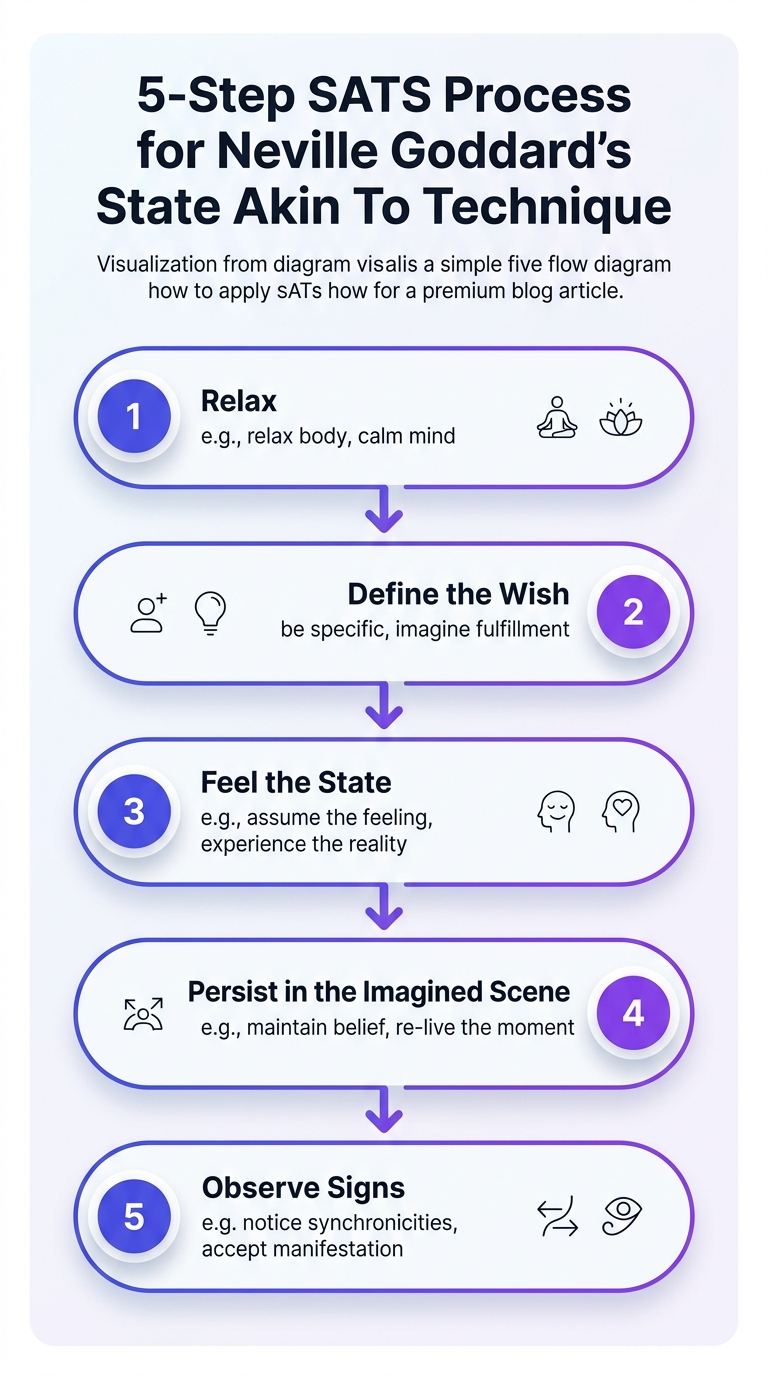
Visual breakdown of the 5-step SATS process in Neville Goddard’s State Akin To Technique. Learn how to apply each step to manifest desired outcomes.
What Scene Should You Use in SATS?
This is one of the most frequently asked questions about SATS manifestation — and the anxiety around it is itself one of the most common obstacles. People spend hours agonising over which scene to choose, whether their scene is “correct,” whether it is detailed enough, whether they are using the right moment. Let me put that anxiety to rest directly.
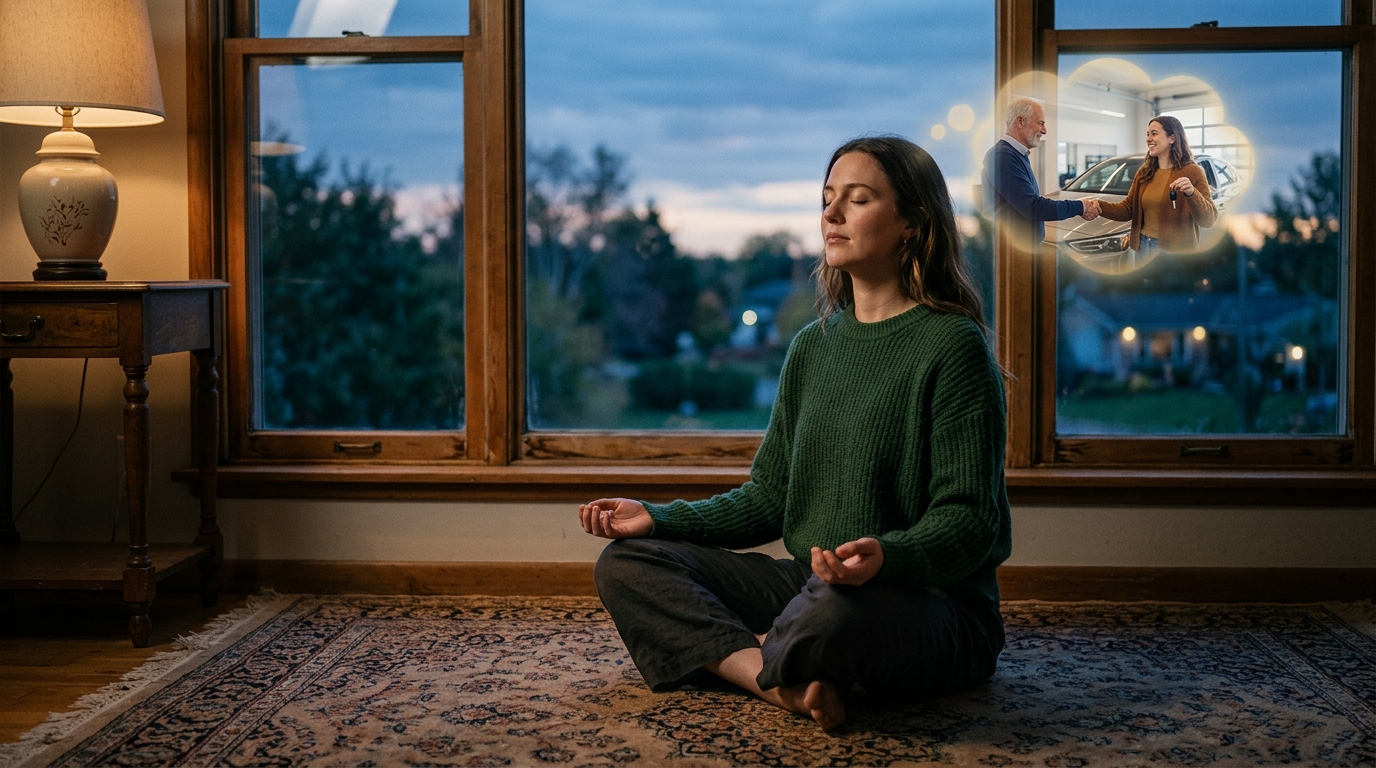
Your scene should be a bridge of incident — a single moment that could only exist after your desire has already manifested. It should not be the moment of getting the thing. It should be a natural, ordinary moment that implies you already have it. The distinction is crucial.
If your desire is a specific person in your life, do not imagine the grand romantic reunion. Imagine a quiet, ordinary Wednesday evening with them — a conversation, a shared meal, the naturalness of their presence in your life. The mundane quality of the scene is actually evidence of its power. Ordinary implies permanent. Ordinary implies already established.
If your desire is financial abundance, do not imagine the moment a large cheque arrives. Imagine looking at your bank account with the quiet satisfaction of someone who has always had enough. Or imagine a small, revealing detail — choosing something you previously would have hesitated over, without a second thought. Small, specific, ordinary moments carry more subconscious weight than dramatic fantasies.
If your desire is improved health, imagine a scene in which you are moving freely, perhaps doing something physical you love, with the easy body-confidence of someone who takes their health for granted.
The scene does not need to be long. Ten seconds of genuine imaginal living, from the inside, with the feeling of reality, is worth more than twenty minutes of strained pictorial imagination from a distance.
Keep it simple. Keep it sensory. Keep it first-person. And above all — keep it post-fulfilment. The scene must imply the desire is already done.
Common SATS Mistakes and How to Fix Them
In my experience working with people on this practice, there are patterns that appear again and again — predictable failure modes that have nothing to do with lack of talent or spiritual capacity, and everything to do with misunderstanding what the technique actually asks of you.
Mistake 1 — Overcomplicating the Scene
Perhaps the single most common error. You spend so much energy deciding on the perfect scene, building it with elaborate detail, adding characters and dialogue and backstory, that by the time you actually try to enter the hypnagogic state, the scene has become a production you are trying to stage rather than a living moment you are inhabiting. Simplify. One moment. One room. One feeling.
Mistake 2 — Trying to Control the Route
This is a subtler mistake, and in some ways the more damaging one. You choose your scene correctly — you are living in the end, you feel the wish fulfilled — but underneath the scene, you are mentally running a parallel programme: monitoring how the desire might arrive, speculating about which specific path reality will take, worrying about whether the mechanism you can currently see is adequate to produce the outcome you want.
This is the micromanagement mistake adapted directly to SATS. You are not responsible for choosing the route by which your desire arrives. Your subconscious mind — operating through laws and mechanisms far beyond what your waking intellect can map — will determine the bridge of incident. Your only job is to furnish the end state with feeling and then release the how entirely.
When you find yourself, mid-scene, thinking “but how will this actually happen?” — that is the critical factor reasserting itself. Return gently to the feeling of the scene. The how is not your business.
Mistake 3 — Falling Fully Asleep Before Entering the Scene
This happens to almost everyone in the early days of practice. You lie down with the intention of entering the State Akin to Sleep, you relax, and then you simply… wake up the next morning. You fell fully asleep before you had the chance to place your scene.
The solution is timing. Do not wait until you are so exhausted that the threshold state is barely accessible before unconsciousness takes over completely. Practise earlier in the evening, when you have enough alertness to ride the edge rather than tumble over it. As the practice matures, you will develop a finer sensitivity to the threshold — you will learn to recognise it, stabilise within it, and work within it before sleep claims you.
Mistake 4 — Using the Scene to Beg Rather Than to Possess
Watch the emotional quality of your scene carefully. If you are imagining receiving your desire with an edge of desperation or longing, you are not living in the end — you are living in the wanting. The scene must carry the emotional register of already having: ease, satisfaction, naturalness, gratitude that has settled into normality. The difference in feeling between “I want this” and “I have this” is the entire difference between the technique working and not working.
Mistake 5 — Monitoring for Results
Every morning after a SATS session, some people begin scanning their external circumstances for evidence that it worked. Nothing has changed yet, so they conclude the technique failed — and they bring that conclusion of failure into the next night’s session. This monitoring habit actively undermines the work. SATS requires you to persist in the assumption of the end even when outward circumstances appear unchanged. You are impressing a new fact; the reflection of that fact in the external world follows according to its own timing.
How Often Should You Practise SATS?
Every night. Without exception. Without conditions. Without waiting for the “perfect” session or the ideal emotional state or the night when everything aligns correctly.
This is where most manifestation teaching fails the student completely. Most platforms present the Law as a trick — a shortcut, a technique you deploy once or twice and then assess for results. The SATS technique Neville Goddard developed is nothing like that. It is a nightly practice, in the same way that brushing your teeth is a nightly practice — not because any single instance is transformative in isolation, but because the cumulative effect of consistent repetition reshapes the underlying structure.
Your subconscious mind did not arrive at its current set of beliefs overnight. It was conditioned over years — through repeated exposure to the same impressions, the same emotional experiences, the same internal narratives, until they calcified into the assumptions that now quietly govern your external circumstances. Replacing those assumptions requires the same process in reverse: repeated, consistent, emotionally engaged impression of the new assumption, night after night, until it becomes the subconscious default.
There will be nights when you barely enter the state. There will be nights when the scene feels flat and unconvincing. There will be nights when you fall asleep almost immediately. Practise anyway. The value is in the practice itself — in the daily reaffirmation that this assumption is the one you are choosing to live from. One extraordinary session will not accomplish what three months of faithful nightly practice will accomplish.
Consistency over intensity. Daily practice over perfect performance. This is not a trick. It is a way of living.
If you want the full depth of Neville’s teachings on the Law of Assumption and its consistent application, the Neville Goddard Fundamentals Crash Course walks you through the principles in a structured, sequential format.

SATS for Specific Desires: Practical Variations
The mechanics of the SATS technique step by step remain constant regardless of the specific desire you are working with. What changes is the content of the imaginal scene — the specific moment you choose to inhabit. Here are practical scene suggestions for the most common categories of desire.
SATS for a Specific Person (SP)
Choose a scene that captures the natural, settled quality of having this person present in your life in the way you desire. An ordinary exchange — a text message, a conversation, a shared domestic moment. The naturalness of their presence, not the drama of an event. Feel how easy it is to have them there. That ease is the feeling you are after.
Avoid scenes of reunion or breakthrough — these carry the energetic signature of something that has been absent and is now returning, which reinforces the assumption of absence. Instead, inhabit a scene where the relationship is so established that the moment in question is completely unremarkable.
SATS for Money and Financial Abundance
A brief, ordinary moment of financial ease. Checking a figure without anxiety. Making a purchase that previously would have caused hesitation, and feeling only lightness. The specific content matters less than the emotional register: abundance is normal, sufficiency is assumed, financial worry is a distant memory.
You might also try what Neville called the “congratulatory scene” — a friend or family member offering you genuine congratulations on your financial success, their warmth and delight confirming what has already manifested.
SATS for Health
Inhabit a scene of physical freedom and ease. Moving your body in a way that only makes sense if you are well. Waking up and noticing the simple, grateful absence of pain or limitation. The body you are imagining from is the body that is already healed — and the imagination must be first-person, sensory, lived. You are not picturing a healthy body. You are inhabiting one.
SATS for Career and Creative Success
A brief scene that implies the role, the recognition, or the outcome is already established. Receiving congratulations on a project. Sitting at a desk that belongs to someone in the position you want. A colleague referring to your work with the casual authority of someone who has seen it succeed. Keep it ordinary. Keep it brief. Keep it lived from the inside.
SATS and the Bible: What Scripture Says About the Sleep State
Neville Goddard was not a New Age teacher in the conventional sense. He was a deeply scriptural one — and his teaching on the State Akin to Sleep was never separate from his biblical interpretation. He read the Bible as a psychological document, a map of consciousness rather than a historical record, and he found the SATS principle woven throughout it with precision that he found impossible to ignore.
In the book of Job, chapter 33, the scripture reads: “In a dream, in a vision of the night, when deep sleep falls upon men, in slumberings upon the bed; then he openeth the ears of men, and sealeth their instruction.” Neville returned to this passage repeatedly. The sleep state is the moment of divine instruction — the moment when what is being sealed into consciousness bypasses all resistance and becomes fact.
Consider also Genesis: God causes a deep sleep to fall upon Adam before performing the great creative act. It is in the sleep state that the new creation is made. This, for Neville, was not incidental. It was the template. The deep sleep is always the precondition for the creative act.
And in the Psalms: “He giveth his beloved sleep.” Neville saw this not as a simple comfort — but as the revelation that the sleep state itself is the gift, the vehicle through which the beloved (consciousness, imagination, God-in-you) does its finest work.
The SATS technique Neville Goddard drew from was not invented. It was recovered — from these passages, from the mystical tradition, from his own lived experience of the sleep-state as the doorway to creative power. If you want to explore how this scriptural dimension runs through all of Neville’s work, the resource Neville Goddard: Live in the End offers that connection in full.
SATS vs Visualisation: The Critical Difference
People conflate these two practices constantly — and the conflation is costly, because they are genuinely different in both mechanism and result.
Ordinary visualisation, as most people practise it, happens in a waking, alert state. You close your eyes, you picture something desired, and you try to sustain the image. The problem is that in full waking consciousness — beta and high-alpha brainwave activity — the critical faculty of your mind is fully operational. As fast as you build the imaginal picture, your subconscious counter-narrative is running beneath it: “This isn’t real. You don’t have this. You’re pretending.” The impression reaches the threshold of the subconscious and bounces off the glass.
SATS bypasses that glass entirely. Because you are approaching the theta threshold of the hypnagogic state, the critical faculty is quietened before you place the scene. The impression does not have to fight its way through resistance — it enters a subconscious mind that is genuinely, neurologically open to receiving it as fact.
This is why Neville consistently preferred SATS over daytime visualisation. Not because daytime imagination is worthless — he also taught living in the end as an all-day practice of sustained assumption — but because the hypnagogic state provides a quality of receptivity that no amount of waking-state effort can replicate.
There is also the matter of feeling. Waking-state visualisation can be vivid but emotionally flat. In the hypnagogic state, sensory and emotional experience takes on a quality much closer to real perception. The feeling of the wish fulfilled comes more naturally, more authentically, more powerfully — because the brain is already operating in the register where imagination and reality feel essentially the same.
The practice of SATS is also explored with specific attention to the brainwave dimension in the resource on brainwaves for the SATS technique — which I encourage you to read alongside this guide.
What to Do When SATS Isn’t Working
Perhaps you have been practising SATS Neville Goddard for weeks. You lie down faithfully each night, you enter the state, you run your scene — and yet nothing in your outer world appears to have shifted. This experience is more common than you might think, and it is not evidence that the technique is ineffective. It is usually evidence of one of a small number of identifiable problems.
Your Scene Still Carries the Feeling of Want
This is the most frequent root cause. Examine the emotional texture of your scene honestly. When you inhabit the moment — is there underneath it a quiet desperation? A longing? An edge of “please let this be true”? If so, you are not living in the end. You are living in the wanting of the end. The subconscious receives feeling as its primary input, not imagery — and if the feeling beneath the scene is lack, lack is what gets impressed.
You Are Not Actually Reaching the Threshold State
Perhaps you are relaxed, but not hypnagogic. There is a quality to the State Akin to Sleep that is distinct from ordinary relaxation — the slight loosening of mental coherence, the spontaneous imagery, the sense of the room receding. If you are not recognising these signs, you may be placing your scene in alpha or even waking beta consciousness, which reduces its subconscious penetration dramatically. Practise arriving at the threshold more reliably — and do so earlier in the evening, when exhaustion has not already made the state too fleeting to work within.
You Have Not Been Consistent Enough
A month of nightly practice is, in most cases, a beginning — not a sufficient test. The assumption you are trying to establish may be working against decades of conditioned counter-belief. Three months of faithful nightly practice, without monitoring and without revision of the technique based on outward results, gives you a genuine foundation from which to assess. Do not abandon the practice because the bridge of incident has not yet appeared in the form you expected.
You Are Attached to a Specific Bridge
You know what you want. But somewhere, beneath the scene, you have also decided exactly how it must arrive — which person must act, which circumstance must change, which mechanism reality must use. This attachment to the bridge is itself a form of resistance. Release the how entirely. Live in the end. Trust the subconscious — which operates with access to an infinitely larger field of possibility than your waking intellect — to engineer the route.
The Neville Goddard 3 Nights Technique is a powerful complementary practice when you feel your assumption needs to be hardened and stabilised more rapidly. It works directly with this challenge.
Advanced SATS Practice
Once the foundational technique is established — once you can reliably enter the hypnagogic state, sustain your scene within it, and maintain the feeling of the wish fulfilled without the intrusion of waking doubt — there are refinements that deepen the practice considerably.
The Congratulatory Scene
Neville Goddard specifically recommended this advanced variation: instead of inhabiting a scene of your own experience of the fulfilled desire, you imagine a loved one — someone whose joy at your success would be genuine and warm — offering you their congratulations. You see their face, you hear their words, you feel the warmth of their celebration of you. The congratulatory scene works because it forces the imagination to assume the fact of the fulfilment absolutely; there is no ambiguity in a congratulation. Someone can only congratulate you on what has already happened.
Multiple Scenes for a Single Desire
If you have been working with one scene consistently and wish to deepen the impression, you may rotate between two or three scenes on different nights — all of which imply the same fulfilled reality from different angles. This is not the same as doubting your scene or abandoning it in favour of something more exciting. It is a way of building a richer, more three-dimensional assumption in the subconscious — approaching the same fact from several angles until it feels entirely self-evident.
The Waking SATS Bridge
This is where SATS and Neville’s teaching on living in the end converge most powerfully. During the day, whenever you find a quiet moment — a few minutes before a meeting, a pause between tasks, the few minutes after waking in the morning before full consciousness reasserts itself — use it as a micro-SATS session. Settle briefly into the feeling of the wish fulfilled. Return to your scene for thirty seconds. The morning hypnopompic state (the threshold between sleep and waking) offers a quality of receptivity nearly identical to the hypnagogic state at night. Use it deliberately.
Deepening the Feeling Deliberately
In your most advanced practice, before you bring the scene at all, spend several minutes simply inhabiting the feeling of the desired state — without any specific imagery. Pure feeling, pure assumption: what it feels like in your body to already be the person who has this. Build the emotional register first; then allow the scene to arise naturally within it. This sequence — feeling before imagery — often produces a quality of subconscious impression that is markedly more powerful than imagery alone.
For a comprehensive curriculum on applying all of Neville’s core principles — including SATS, revision, the Law of Assumption, and the Promise — explore the full Neville Goddard Fundamentals Crash Course in the TrueCosmic Academy.
Neville’s written works are also an indispensable companion to any serious SATS practice. The Law and the Promise and The Power of Awareness both address the sleep-state practice directly and provide the philosophical foundation that makes the mechanics genuinely comprehensible. And if you want Neville’s voice itself — his cadence, his certainty, his lived experience of these principles — the Imagination Creates Reality audiobook is one of the finest places to begin.

Frequently Asked Questions
What exactly is the SATS technique Neville Goddard taught?
The SATS technique Neville Goddard taught involves entering the hypnagogic state — the drowsy threshold between waking and sleep — and using that state to impress a vivid, feeling-rich imaginal scene onto the subconscious mind. The scene depicts your desired outcome as already real and already normal, and is repeated gently until you drift into sleep.
How long does it take for SATS to work?
There is no fixed timeline — and any source that gives you one is guessing. Some practitioners notice outer shifts within days; others require months of consistent nightly practice before the subconscious assumption displaces the old conditioning sufficiently to reshape circumstances. The only reliable answer is: consistent daily practice over time, without monitoring or deadline-setting, produces results. One or two sessions does not constitute a sufficient test.
Can I do the SATS technique during the day, or does it have to be at night?
The technique is most powerful at night, when sleep naturally provides access to the hypnagogic threshold. However, the morning hypnopompic state (waking up) offers nearly identical receptivity — and brief daytime practices during genuine moments of drowsiness can reinforce the nightly impression. The night session is primary; daytime sessions are supplementary.
What is the difference between State Akin to Sleep and actual sleep?
The State Akin to Sleep is the hypnagogic threshold — the transitional state between full wakefulness and sleep onset. You retain enough awareness to direct your imagination deliberately while benefiting from the dramatically reduced critical resistance that characterises this state. Actual sleep is unconscious; the SATS practice happens in the liminal zone immediately before it.
What should I do if I keep falling asleep before I can do my SATS scene?
Adjust your timing. Practice earlier in the evening when you have more residual alertness, giving you a wider window in which to ride the hypnagogic threshold before full sleep takes over. As your practice matures, you will develop greater sensitivity to the threshold state and be able to sustain it longer before unconsciousness arrives.
Is SATS the same as visualisation?
No. Ordinary visualisation typically happens in full waking consciousness, where the subconscious critical factor is active and resistant to new impressions. SATS specifically targets the hypnagogic threshold, where theta brainwave activity dramatically reduces that resistance and allows imaginal scenes to be received as experiential fact. The neurological mechanism is entirely different.
How do I know what scene to use in my SATS practice?
Choose a brief, first-person, sensory scene that could only be happening after your desire is already fulfilled — a natural, ordinary moment that implies the outcome as already established. Avoid scenes of receiving or achieving; instead inhabit scenes of already having. The simpler and more ordinary the scene feels, the more powerfully it registers as established fact in the subconscious.
Conclusion
The SATS technique Neville Goddard developed across decades of teaching is not a trick. It is not a shortcut. It is not a technique you try once, assess, and discard. It is a nightly practice — a deliberate, consistent, faithful use of a biological state you enter every single night of your life, and have been entering every night of your life since birth, mostly without realising the creative power it contains.
No matter what you are facing — housed within you lies the solution to every problem and the fulfilment of every desire. The State Akin to Sleep is not where you beg for what you want. It is where you assume the reality of what is already yours in imagination — and hold that assumption with sufficient consistency and feeling that the subconscious, which governs the outer circumstances of your life far more completely than your waking mind ever will, begins to reflect it back.
The law, lived. That is all SATS is asking of you. Not theory. Not inspiration. The daily practice of returning, night after night, to the assumption of the end — and trusting the vast creative machinery of your own deeper consciousness to engineer the bridge.
Begin tonight. Not perfectly. Just begin.
For the complete guide to the Law of Assumption, see our definitive resource: The Law of Assumption — The Complete Guide.
To learn more about Neville Goddard’s life and complete body of work, read our definitive guide: Neville Goddard — The Complete Guide.
For the complete guide to reading scripture as a consciousness map, see: Esoteric Bible Interpretation — The Complete Guide.
Related reading: Kundalini Awakening — Complete Guide.
This is where most teaching gets it wrong. Most platforms sell instant manifestation — say the words once, feel the relief, and watch reality rearrange itself overnight. That isn’t the Law. It’s a practice, not a trick. Think of a concert pianist: even the greatest hands hit bum notes in rehearsal. What separates the people who occasionally manifest from those who live it isn’t talent or luck — it’s consistency and devotion, practiced when no one is watching. If it isn’t working yet, that’s never the Law’s fault. It’s always the application. Examine the practice, not the principle.

Michael Sutherland is the founder of Truecosmic, a global platform dedicated to Neville Goddard’s teachings and the Law of Assumption. Passionate about empowering individuals through conscious creation, Michael blends esoteric wisdom with practical insight to help people transform their lives from within.












0 Comments