

A self fulfilling prophecy is not simply a prediction that happens to come true. It is an expectation that helps shape behaviour or events until the outcome appears to confirm the original belief.
I came to this idea the long way round. When I faced the biggest crisis of my life and turned to Neville Goddard, my rational mind pushed back hard against anything that sounded like wishful thinking. What helped me was seeing that the self fulfilling prophecy is something sociologists and psychologists have studied for decades. It does not prove the Law of Assumption, and I will be careful about that below. But it shows, from the outside, the same pattern Neville described from the inside: what you assume shapes what you notice, what you do and how others respond to you, until the assumption starts to look like fact.
Key Takeaways

- A prediction is self-fulfilling only when it helps bring about the outcome.
- The pathway runs through attention, interpretation, decisions and responses from other people.
- Teacher expectations can affect student interactions, but they do not determine every pupil’s achievement.
- Placebo and nocebo effects concern measured experiences and responses, not a power to create any chosen health outcome.
- Psychology supports expectation effects in particular situations. It does not prove that thinking about an outcome guarantees it.
- Daily practice can help change habitual responses. That is why the Law of Assumption is a practice, not a trick.
What a self fulfilling prophecy means
In 1948, sociologist Robert K. Merton introduced the term in his article The Self-Fulfilling Prophecy, published in The Antioch Review. He described a process in which an initially mistaken definition of a situation prompts behaviour that makes the mistaken belief appear true.
The distinction matters: if someone predicts rain and it rains, that is not a self fulfilling prophecy unless the prediction helped cause the rain. The expectation must influence a decision, an action or another person’s response.
Merton connected this idea with the Thomas theorem, associated with sociologists W. I. Thomas and Dorothy S. Thomas: situations people define as real can have real consequences. The belief does not have to describe reality accurately at the start; its effects on what people do can still be real.
Merton’s example was a bank run. If depositors believe a bank is insolvent and withdraw their money in large numbers, those withdrawals can weaken the bank and help create the failure they feared. The belief does not magically change the bank’s finances. The depositors’ coordinated decisions provide the causal link.
How an assumption becomes a feedback loop

A self fulfilling prophecy usually develops through a sequence. An expectation influences what a person notices or how they interpret an event; that interpretation shapes a choice or behaviour; the behaviour changes the situation or draws a response from someone else; and that response is then taken as confirmation.
For example, a person who expects rejection may enter a conversation already guarded. They give short replies, avoid asking questions and leave early; the other person responds with less warmth, and the resulting distance seems to prove that rejection was inevitable.
The expectation has not caused the other person’s every thought or action. It has helped shape an interaction in which both people’s behaviour matters. That is why identifying the actual behaviour and response is more useful than treating an assumption as a force that acts on its own.
Psychologists distinguish between a self-imposed prophecy and an other-imposed prophecy. In the first, a person’s own expectation shapes their behaviour; in the second, someone else’s expectation changes how they treat that person, which can influence the person’s later response or performance.
These routes can overlap. A manager who expects a new employee to struggle may give them less coaching and fewer challenging tasks; the employee then has fewer chances to demonstrate skill, and the manager may read the result as confirmation of the original judgement.
Not every difficult outcome follows this pattern. A person can anticipate a problem accurately, and an outcome can arise from circumstances that their expectation did not change. To call it a self fulfilling prophecy, look for the link between the prior belief and what happened next.
Teacher expectations, the Pygmalion effect and the Golem effect

The Pygmalion effect refers to the possibility that high expectations can influence another person’s performance through the way they are treated. Robert Rosenthal and Lenore Jacobson’s Pygmalion in the Classroom (1968) is a documented example of research into teacher expectations.
The proposed pathway is practical and interpersonal. A teacher’s expectations may influence the attention, encouragement, feedback and learning opportunities a pupil receives, which can in turn affect participation and performance.
The corresponding possibility that low expectations contribute to poorer outcomes is commonly called the Golem effect. When pupils receive different levels of encouragement or opportunity because of assumptions about their ability, unequal treatment can help produce apparent differences that are then used to reinforce a stereotype.
This is one way social expectations can become self-sustaining. A pupil who receives less demanding work may have less opportunity to practise, while the weaker performance that follows can be mistaken for evidence that the lower expectation was right.
In the study, teachers were told that certain pupils, identified by a test, were likely to show unusual intellectual growth. Those pupils had actually been selected at random. Rosenthal and Jacobson compared pupils’ test performance before and after the school year and reported larger gains among the identified pupils, particularly in the lower grades. The design is notable because teachers’ expectations were introduced before the outcomes were measured.
The findings have been debated, including questions about the analysis and how reliably similar effects appear in other settings. Teacher expectations can influence pupils’ opportunities and performance, but the effects vary and do not determine achievement. The study is best read as evidence that expectations can matter under some conditions, not that a teacher’s belief can guarantee a result.
Teacher expectations must also be distinguished from stereotype threat. Stereotype threat describes how awareness of a negative stereotype about a group can affect a person’s performance in a situation where that stereotype is relevant; it does not simply mean that a teacher’s expectation changes how the teacher treats a pupil.
Bank runs and the careful case of placebo effects
A bank run shows how a shared assumption can affect an external situation. When many depositors withdraw money because they believe a bank is failing, the collective action can put pressure on the bank and contribute to the feared outcome. This is a social and economic mechanism: decisions change the conditions people are responding to. Panic buying works the same way. When shoppers assume a product is about to run out and rush to stock up, the shelves empty, and the assumption appears to have been right all along.
Placebo and nocebo effects involve a different kind of pathway. In clinical research, treatment expectations and the surrounding context can be associated with changes in reported symptoms or other measured responses; the placebo effect is not evidence that expectation cures disease or creates any chosen physical result.
A person’s experience can also reflect the treatment itself, their prior experience and the circumstances in which care is given.
Nocebo effects describe harmful or unpleasant responses associated with negative expectations and treatment context. Neither term means that belief alone controls health; careful studies compare measured responses and account for other influences rather than treating every reported change as proof of a single cause.
The contrast is useful. A bank run can alter an external situation through coordinated decisions, while expectancy in a clinical setting may influence experience or response. Both show possible consequences of expectations, but neither establishes that thought alone can dictate events.
What the evidence shows, and what it does not

A self fulfilling prophecy is different from confirmation bias. A prophecy involves an expectation helping to change behaviour or events; confirmation bias is the tendency to notice, interpret or favour information that supports a belief. The two can occur together, but noticing confirming evidence does not by itself show that the belief caused the outcome.
To assess a prediction, ask: did it change a decision, action or response before the outcome occurred? Then ask what evidence could count against the prediction, including examples where the expected result did not happen.
It also helps to separate a plausible mechanism from proof of cause. If someone expects rejection and then withdraws from others, there is a visible route through which the expectation may affect social contact. If they experience rejection without changing their behaviour, the original expectation may have described the situation rather than helped create it.
Expectations operate alongside prior ability, resources, social conditions and chance. Unequal opportunities can sustain differences in outcome, so expectations can be one cause among several, even when they have contributed to a feedback loop.
When judging evidence, trace the proposed chain rather than looking only at the expectation and the final outcome. Was the expectation recorded before the interaction? Did researchers observe a change in feedback, practice or avoidance, or only a difference in final performance? Random assignment can strengthen a causal case, while an observed association may reflect other differences between people. Replication across settings also helps show whether a finding applies beyond one context. Without evidence for the pathway, a pattern is not proof that the expectation produced the outcome.
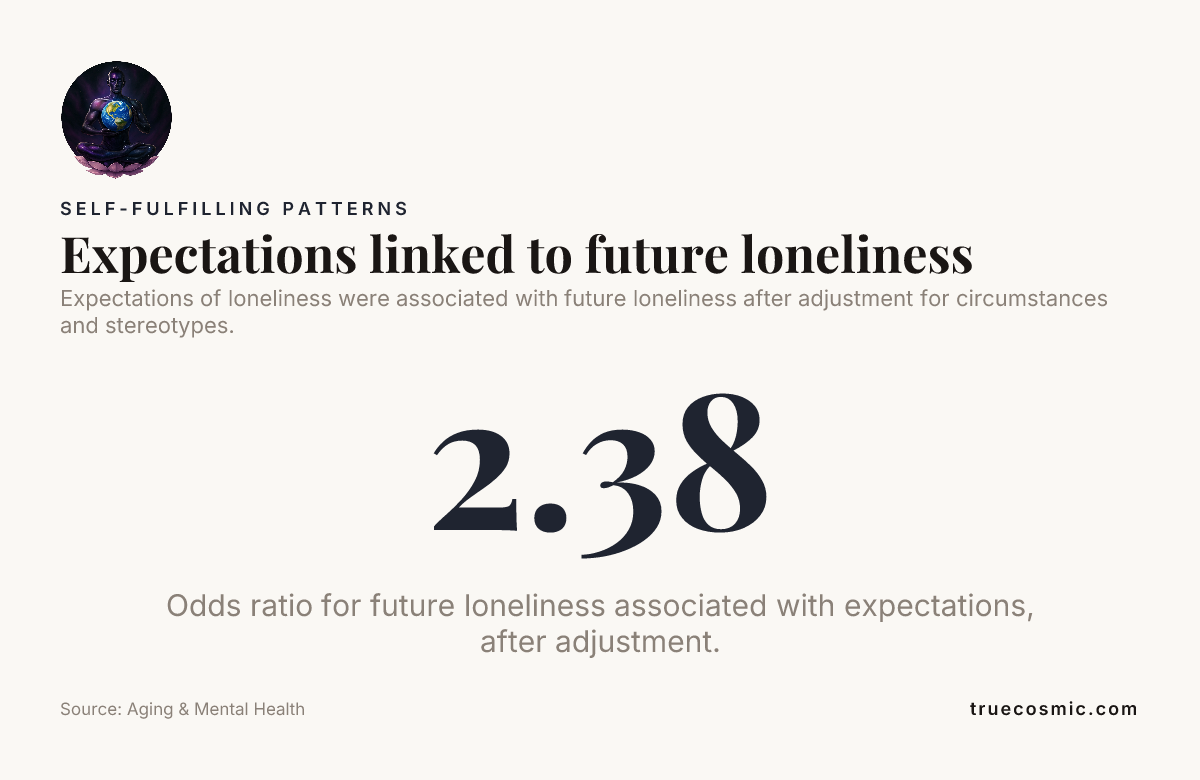
Expectations of loneliness were associated with future loneliness after adjustment for circumstances and stereotypes.
Source: Aging & Mental Health
The psychological evidence supports expectation effects in particular contexts. It does not show that science proves manifestation, that positive thought guarantees a chosen outcome, or that every assumption becomes fact. If you want the fuller picture of what research does and does not support, I have set it out in Is Manifestation Real? and in our guide to the neuroscience of manifestation.
The Law of Assumption viewed from the outside

Neville Goddard’s Law of Assumption is a spiritual teaching that living from an assumed state shapes experience. Psychology offers a narrower, observable comparison: expectations can influence attention, behaviour and social responses, and those pathways may help bring about some outcomes. You can read more about that overlap in The Psychology of Manifestation.
Practising an assumption may help you notice relevant possibilities, make different choices and act more consistently with the end you have assumed. If you assume you can contribute meaningfully at work, for instance, you prepare for meetings, speak up and take on tasks that give others a chance to respond to your contribution. Neville went further than psychology does: he taught that the assumption itself, persisted in, hardens into fact. That is a spiritual claim, not a scientific finding, and I present it as such. Where the two meet is in your self-concept, which is why I keep returning to Neville’s teaching on self-concept.
Readers exploring Goddard’s teaching can also consult Neville Goddard: The Power of Awareness and Neville Goddard: The Law and the Promise.
Here is the part most people miss. An archer does not hit the gold by wishing at the target. She hits it because she has drawn the bow thousands of times when nobody was watching, until the draw, the breath and the release are simply who she is. The Law works the same way. It is a practice, not a trick. One evening of imagining is a single arrow; a self fulfilling prophecy in your favour is built by returning to the same assumption every day until it is the place you live from.
Practise consistently without micromanaging the outcome
There are two types of student in this work. One tries a technique once, waits for immediate proof and stops when events do not shift; the other practises the chosen assumption daily by bringing it into attention, decisions and behaviour. The first type collects techniques. The second type changes.
Consistency can help rehearse habits and make a more useful response easier to choose. It does not guarantee an outcome, because other people’s choices, resources and circumstances remain part of what happens.
A short daily practice can keep the work grounded:
- Name the assumption. Choose a clear, constructive statement of the end, as if it were already true of you, rather than a demand that another person must behave in a particular way.
- Notice the actions it supports today. Ask what you would do differently if you took the assumption seriously.
- Choose one practical action. Make it something within your control, such as preparing carefully, asking a clear question or following through on a commitment.
- Review what happened. Record your action and the response without treating one result as final proof that the assumption is true or false.
The most common mistake I see is micromanaging how the outcome must arrive. Fixating on a particular person, timing or chain of events narrows attention and turns each detail into a supposed sign. I learned this with my friend Beth. We had lost contact for about two years, and I imagined talking with her on the phone. In my mind it would be a WhatsApp call. Within a week I updated my phone and added Facebook Messenger, an app I never use, and two days later Beth called me on Messenger. If I had insisted on WhatsApp, I would have been watching the wrong door.
Neville warned that when an assumption hardens into fact, the circumstances seem so natural that it is easy to say it would have happened anyway (see Believe It In). That is the rational mind closing the loop, and it is exactly when you need to hold your ground and keep practising.
If you notice a negative self fulfilling prophecy taking hold, write down the prediction and the behaviour it prompts. Then choose a different response and look for evidence that could challenge the prediction, including moments when the expected outcome did not occur. If you want structured help with this, our Academy course The Assumed Self: Subconscious Reprogramming Intensive walks you through it step by step.
Daily practice means rehearsing a more useful way to respond, not wishing passively and not blaming yourself when circumstances remain outside your control.
Famous examples of self-fulfilling prophecies

The story of Oedipus is a classic literary example. An oracle predicts that he will kill his father and marry his mother. His parents’ attempt to avert the prediction separates him from his birth family; later, Oedipus’s own effort to escape it helps lead him into the encounters that fulfil it. The story shows how actions taken in response to a prediction can become part of the chain of events.
In Shakespeare’s Macbeth, the witches’ prediction that Macbeth will be king feeds his ambition, and his decision to murder Duncan helps bring about his rise to power. The prediction does not compel him, and other people’s choices also shape events. These stories illustrate a possible mechanism for a self fulfilling prophecy; they are not scientific evidence that every prediction brings itself about.
Conclusion: making the self fulfilling prophecy work for you
A self fulfilling prophecy forms when an expectation helps shape behaviour or social responses until an outcome appears to confirm it. Merton’s bank example, teacher-expectancy research and carefully interpreted placebo findings illustrate different routes, each with limits.
The Law of Assumption asks you to take that pattern and choose it deliberately: to live from the assumption you want rather than the one you inherited, and to practise it daily rather than test it once.
So whatever you are standing in front of today, know this. The answer to it is not somewhere out there waiting to be found; it is already within you. The same creative power that brought everything you can see into being lives in you now, and it waits on your word. No one can switch it on for you. That part is yours. And once you do, no circumstance gets the final say. Do not be afraid.
Frequently Asked Questions
What is a self fulfilling prophecy in simple terms?
It is a belief about the future that changes how people behave, so that their behaviour helps bring the belief true. The sociologist Robert K. Merton coined the term in 1948.
Can a self fulfilling prophecy have both helpful and harmful effects?
Yes. A supportive expectation can encourage someone to attempt a challenging task, while an unfavourable expectation can narrow the opportunities they receive; neither pattern guarantees a particular result.
How can you tell whether an expectation caused an outcome or simply predicted it?
Look for evidence that the expectation came first and changed a relevant action or response. Where possible, compare the situation with similar cases in which the expectation or the resulting treatment differed.
Is the Law of Assumption the same as a self fulfilling prophecy?
Not quite. A self fulfilling prophecy is a psychological pattern that works through behaviour and other people’s responses. The Law of Assumption is Neville Goddard’s spiritual teaching that a persisted assumption hardens into fact. The first is a useful outside view of the second, not scientific proof of it.

Michael Sutherland is the founder of Truecosmic, a global platform dedicated to Neville Goddard’s teachings and the Law of Assumption. Passionate about empowering individuals through conscious creation, Michael blends esoteric wisdom with practical insight to help people transform their lives from within.
Michael Sutherland is the founder of Truecosmic, a global platform dedicated to Neville Goddard’s teachings and the Law of Assumption. Passionate about empowering individuals through conscious creation, Michael blends esoteric wisdom with practical insight to help people transform their lives from within.
Enter your email and get instant FREE access to your report.
No credit card required. 🔒 Your details are secure. You can unsubscribe at any time.















0 Comments