

The parable of the ten virgins is not a story about ten young women at a wedding. It is a map of what happens inside you every time you assume a new state. The lamp is your imagination, the oil is sustained feeling, and the bridegroom is the moment your assumption hardens into fact. Read this way, Matthew 25 becomes one of the most practical lessons in all of scripture on the difference between visiting the feeling of the wish fulfilled and actually living in it.
I was raised in church, first as a Jehovah’s Witness and then as a Baptist, and the parable of the ten virgins was used on me as a warning. Be ready, or the door will be shut and you will be left outside in the dark. It was one more way of keeping people afraid. It took me twenty-five years in the far country, and then Neville Goddard, to see that the story was never about a God outside me waiting to lock me out. It was describing my own mind.
The parable of the ten virgins: the scene and its inner question
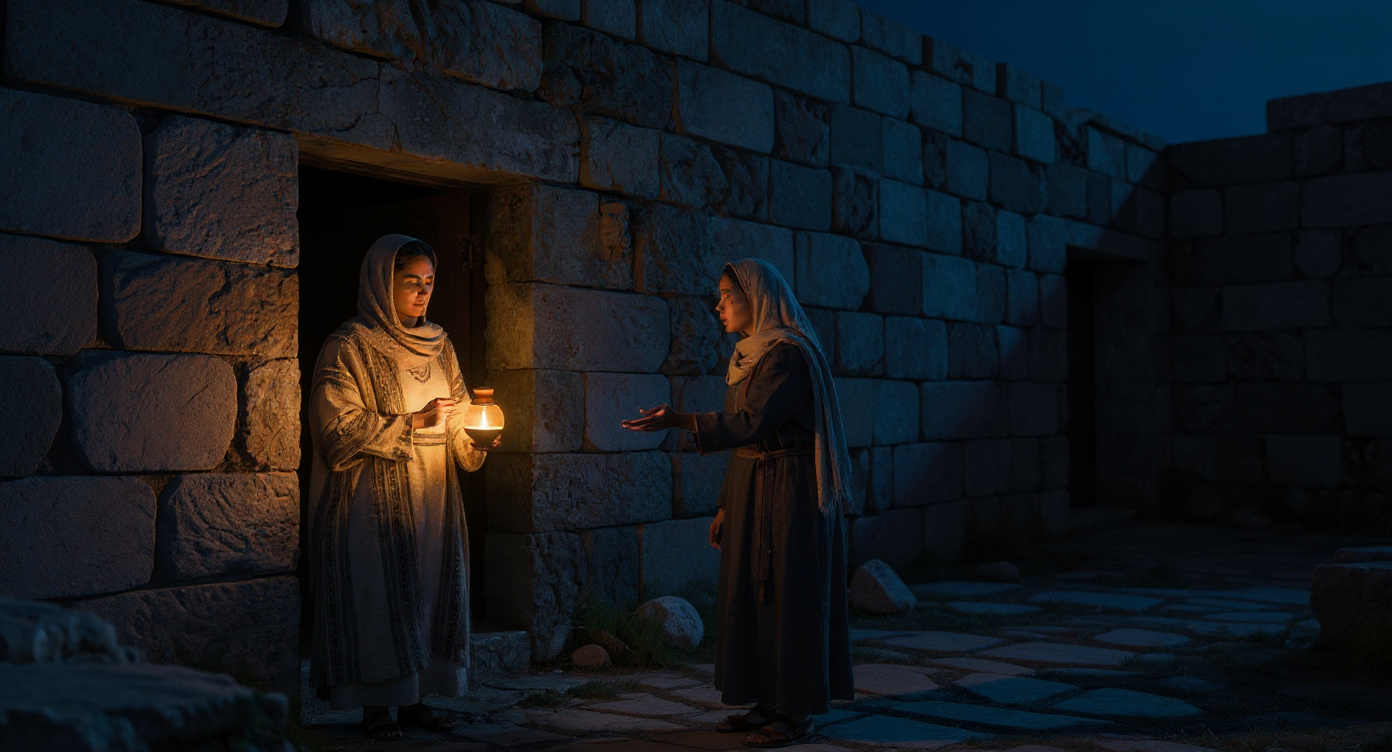
Here is the passage in full, from the King James Version of Matthew 25:1 to 13:
1 Then shall the kingdom of heaven be likened unto ten virgins, which took their lamps, and went forth to meet the bridegroom.
2 And five of them were wise, and five were foolish.
3 They that were foolish took their lamps, and took no oil with them:
4 But the wise took oil in their vessels with their lamps.
5 While the bridegroom tarried, they all slumbered and slept.
6 And at midnight there was a cry made, Behold, the bridegroom cometh; go ye out to meet him.
7 Then all those virgins arose, and trimmed their lamps.
8 And the foolish said unto the wise, Give us of your oil; for our lamps are gone out.
9 But the wise answered, saying, Not so; lest there be not enough for us and you: but go ye rather to them that sell, and buy for yourselves.
10 And while they went to buy, the bridegroom came; and they that were ready went in with him to the marriage: and the door was shut.
11 Afterward came also the other virgins, saying, Lord, Lord, open to us.
12 But he answered and said, Verily I say unto you, I know you not.
13 Watch therefore, for ye know neither the day nor the hour wherein the Son of man cometh.
Notice how the parable of the ten virgins opens: “the kingdom of heaven be likened unto.” The Jesus of scripture is not describing a future event in the sky. He is telling you what the kingdom of heaven is like, and he says elsewhere that the kingdom is within you. So every figure in this story is a part of you. All ten virgins are you. The wise and the foolish are two ways you can relate to an assumption you have chosen.
The lamp, the oil and the bridegroom
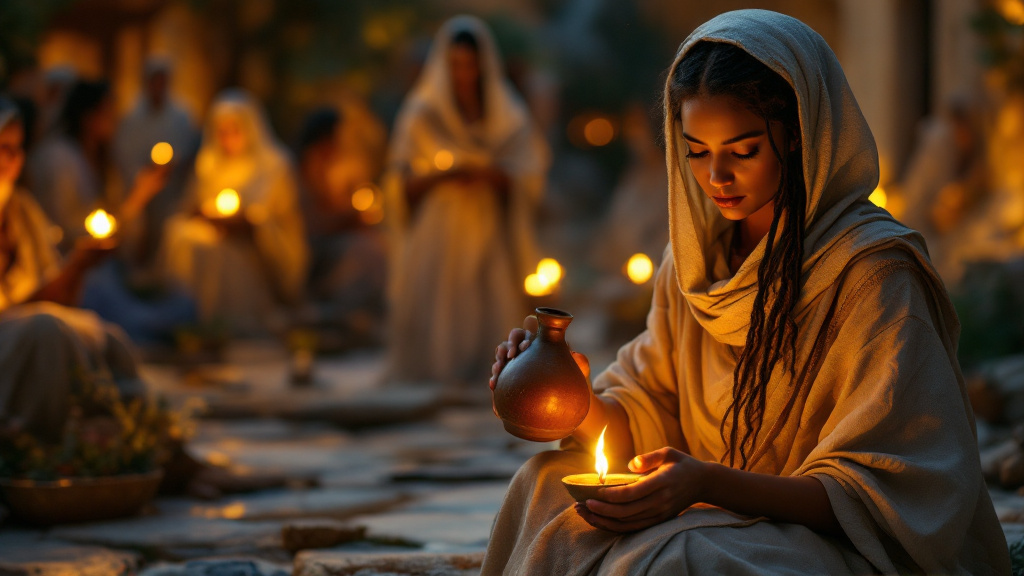
In the parable of the ten virgins, the lamp is imagination: the inward capacity to form a scene and give it direction. Every one of the ten has a lamp. Everyone imagines. What you imagine is not an idle picture; it is the shape of the state you are entertaining.
The oil is sustained feeling, specifically the feeling of the wish fulfilled. A lamp without oil gives a brief flare and then goes dark. An imagined scene without feeling behaves exactly the same way. Neville made feeling the centre of his teaching for this reason, and his little book Feeling Is the Secret is the best companion to this parable you will find.
The bridegroom represents the fulfilment of your assumption. His arrival is the moment the state you have accepted within becomes present as fact. The marriage is the union of you with that state, so complete that you no longer feel you are imagining it. You simply are it.
These symbols work together. The lamp gives the assumption form, the oil keeps it alive, and the bridegroom marks its fulfilment. This is the parable of the ten virgins meaning at its centre: readiness is a living relationship with the state you have chosen.
The wise and foolish virgins: visiting a state versus living in it
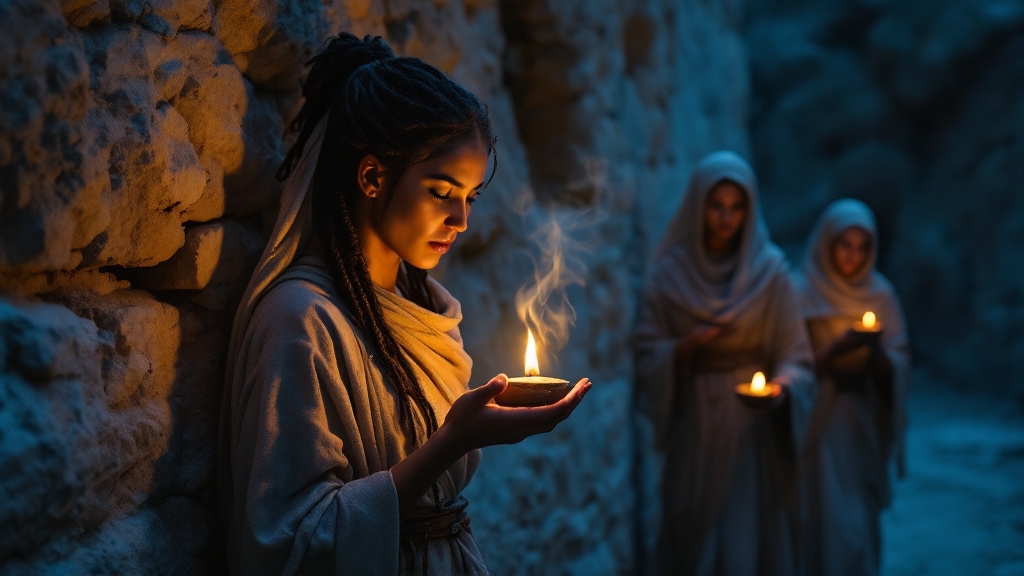
In the parable of the ten virgins, the wise and foolish do not differ in whether they fall asleep. Verse 5 is clear: “they all slumbered and slept.” The story finds no fault in that shared sleep. Their difference is the oil they carry into the delay.
The wise keep oil with their lamps because they sustain the feeling of the fulfilled assumption. They do not picture an outcome once and then abandon it. They make that inward state a place they live from.
The foolish bring lamps but no reserve. They visit the state for an evening, enjoy the glow, then wake up the next morning and return to the old assumption. When the moment calls for readiness, the feeling has run out. I think of the old story of Esau and Jacob here. Esau is the man of the senses, who trades his birthright for a bowl of stew because he is hungry right now. Jacob is the inner man, who holds on to the blessing until the outer world gives way. The foolish virgins are Esau with a lamp: they let the evidence of the moment decide what they believe.
Readiness is continuity of assumption, not anxious vigilance. You do not need to strain every waking moment to keep a scene alive. You need to return to the chosen state until it feels natural, especially when old impressions invite you back into the former story. Our guide on why Law of Assumption persistence fails goes deeper into this.
While the bridegroom tarried: when nothing seems to happen
“While the bridegroom tarried.” Those four words hold the whole test of the parable of the ten virgins. If the bridegroom came the moment the lamps were lit, everyone would look wise. The delay is what reveals who has oil.
I know that delay well. Growing up in a poor neighbourhood, I declared that I would own my own home at twenty-one. For most of my friends, owning property was not on anyone’s list, and some of them visited me once after I said it and never came round again. Then the house I was due to buy fell through because I was in a chain, and the whole process had to start again. That was my midnight. Everything outside said the lamp had gone out.
I kept the oil. I got a house a year later, and it was far better than the one I had planned: bigger, in a better area, and cheaper. If I had insisted on my original route, I would have been mourning a house I was never meant to have. The bridegroom tarried, and when he came he brought more than I had asked for.
This is why I say the Law is a practice, not a trick. Think of a martial artist. A black belt is not someone who learned a clever move once. It is someone who has repeated the basics thousands of times, through boredom and bruises, until the right response comes without thought. Keeping your lamp trimmed is the same. When it seems not to work, the Law has not failed; the practice simply is not finished.
“Buy for yourselves”: why no one can lend you a state
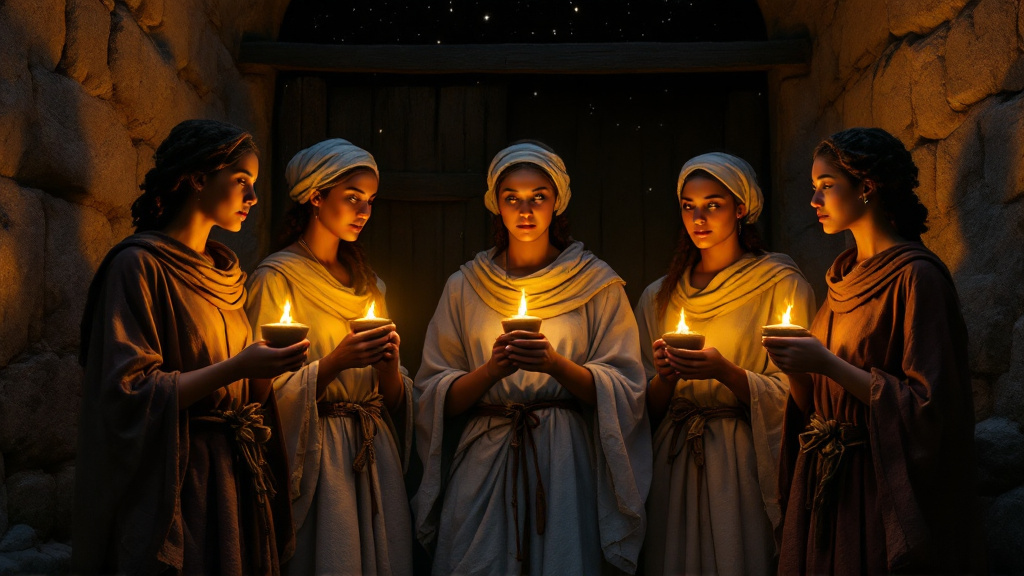
At first glance the wise virgins look selfish. Why not share? But in the parable of the ten virgins the refusal is not unkindness. It is simply true. No one can lend you their state of consciousness.
Another person can encourage you, support you and share what has helped them. A coach, a teacher or a friend who believes in you is a gift. But no one can occupy your assumption for you. You have to go to “them that sell” and buy it yourself, and the price is your own attention, paid daily.
This was the most liberating part of the parable of the ten virgins for me. In the church I was taught that someone else had to stand between me and God: a pastor, an elder, a saviour in the sky. Here the story says the opposite. There is no intermediary. The oil cannot be borrowed because it is already yours to produce. Your own I AM is the source, and it answers to no one but you.
The foolish ask for oil only after the midnight cry. The request exposes the difference between hearing about an assumption and inhabiting it. You can read every book Neville wrote and still have an empty vessel if you never sit down and feel the end.
What “watch” means and how to keep your lamp trimmed nightly

“Watch therefore” means persist in the chosen assumption. The day and hour are unknown, so readiness cannot be postponed until a visible sign appears. You do not get to see the bridegroom on the road first and then fill your lamp.
Keep your lamp trimmed with a simple nightly practice:
- Relax before sleep. Let your body settle and allow the day’s activity to recede. You are preparing to attend to an inner scene, not to force an outcome through effort.
- Choose one short scene that implies fulfilment. Something you would experience if it were already done, such as a friend congratulating you or holding the keys in your hand.
- Imagine from the first person. See the scene through your own eyes, as if you are present in it now. Keep it brief enough to loop gently.
- Let the scene evoke its feeling. Notice the relief, gratitude or quiet certainty that belongs to the fulfilled state. That feeling is the oil. It matters far more than vivid pictures.
- Fall asleep in it. If your attention wanders, return gently, without criticising yourself. Each return trims the lamp.
Do not measure the practice by how vivid the scene looks. Notice whether the assumption feels more natural each night. And during the day, when an old impression tells you nothing has changed, do not argue with it and do not check for evidence. Simply return to the state. Persistence is not force; it is the decision to come back.
The closed door and the parable of the talents
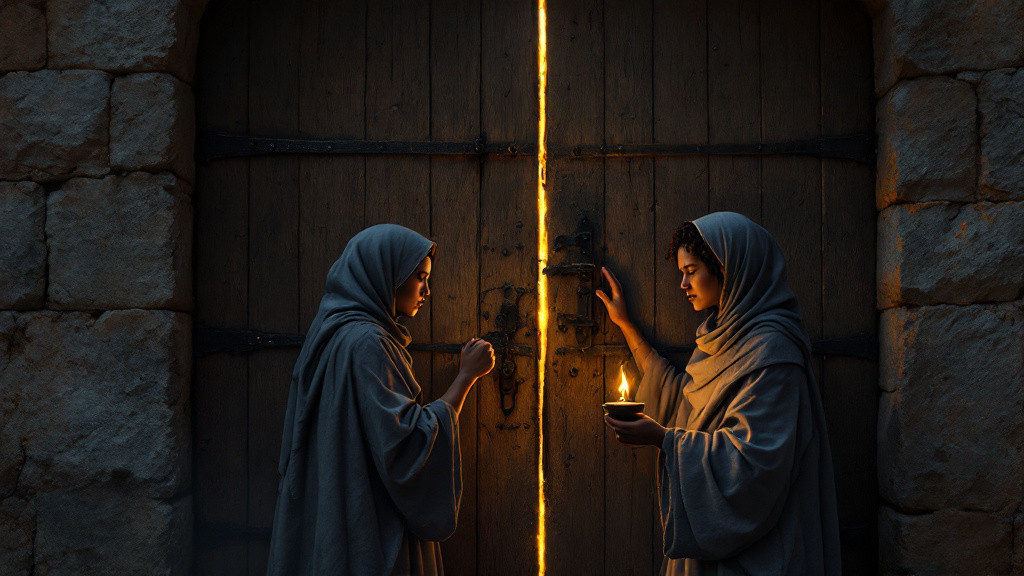
“The door was shut” and “I know you not” are the lines that frightened me as a boy. Read inwardly, the parable of the ten virgins is not issuing a threat but giving a description. A state you only visit never becomes a state you know. The fulfilled assumption does not recognise you, because you were never really there.
And the door is never shut for good. Tonight you can light the lamp again and carry oil this time. Scripture is full of second chances read this way: the prodigal son coming to himself in the far country, and Lazarus called out of the tomb after everyone had given up.
Matthew 25 follows the virgins with the parable of the talents. The two belong together. The virgins teach you to keep the state alive through the delay; the talents teach you to put what you have been given to use rather than bury it out of fear. Readiness first, then faithful use.
If you want to read scripture this way across every book of the Bible, start with the complete Neville Goddard biblical interpretation guide. The Academy course Conscious Mastery: Scripture in Action takes you through it with practice built in, and you can hear Neville teach the stories himself in the TrueCosmic lecture library.
Keep oil in your lamp
The parable of the ten virgins is a precise inner lesson. The lamp is imagination, the oil is sustained feeling, and the bridegroom is the fulfilment of an assumption you have accepted within. The wise are not luckier or more gifted. They simply keep coming back to the feeling until the delay is over.
So whatever you are waiting for tonight, remember this. The answer to what you are facing is not out there in the dark road. It is already burning within you. The same power that formed everything that exists is the very awareness you call I AM, and it waits on your word. You are the one who lights it, and once you do, nothing outside you can put it out. Fear not.
Frequently asked questions
What is the meaning of the parable of the ten virgins?
Read inwardly, the ten virgins are you. The lamp is imagination, the oil is the sustained feeling of the wish fulfilled, and the bridegroom is the fulfilment of your assumption. The wise keep the feeling alive through the delay; the foolish only visit it.
Why did the wise virgins refuse to share their oil?
Because a state of consciousness cannot be lent. Others can encourage you, but only you can occupy and sustain your own assumption. “Buy for yourselves” means paying with your own daily attention.
What does “watch therefore” mean in Matthew 25?
It means persistence. You do not know when the assumption will become fact, so you keep returning to the feeling of it now, instead of waiting for outer evidence before you believe.
Why do all ten virgins fall asleep?
Sleep is not the fault in the story. Everyone has quiet periods when nothing seems to happen. The difference is whether you carry the feeling into that waiting time, and the drowsy state before sleep is the ideal moment to do it.

Michael Sutherland is the founder of Truecosmic, a global platform dedicated to Neville Goddard’s teachings and the Law of Assumption. Passionate about empowering individuals through conscious creation, Michael blends esoteric wisdom with practical insight to help people transform their lives from within.
Enter your email and get instant FREE access to your report.
No credit card required. 🔒 Your details are secure. You can unsubscribe at any time.















0 Comments