

If you have ever come across the phrase feeling is the secret Neville Goddard, and wondered what it actually means in practice — let me tell you, you are about to discover one of the most quietly powerful ideas in all of consciousness teaching.
In 2017, working with my first mentor — a hypnotherapist and Buddhist practitioner — I had my first transcendent experience during deep meditation. My third eye opened. A tingling sensation at the crown of my head began that I would not fully understand for another year.
That threshold state — the drowsy, hypnagogic borderland between waking and sleeping that Neville called the state akin to sleep — was where that experience began. Not in full waking consciousness. Not in analytical thought. In the feeling space. The place where the subconscious mind drops its guard and becomes completely receptive to whatever emotional reality you bring to it.
Feeling is the secret because the subconscious does not understand words. It does not respond to affirmations repeated without conviction. It responds to the felt sense of something being real. That is what Neville spent his life teaching. And it is what I experienced firsthand before I had the language to name it.
I should add something important here that rarely gets said clearly. What I experienced in 2018 was what Neville called the Promise — the full Kundalini awakening, the complete unfolding of scripture within the body and consciousness. And this is not something you can manufacture through technique. It cannot be scheduled. No amount of perfect practice will make it arrive on your timetable. It comes when it comes — in this lifetime or the next — and no one can determine that.
The feeling work Neville teaches — the subject of this entire article — is the Law. The practical, daily application of inner feeling to reshape your assumptions and your outer world. That is available to you right now. The Promise is what the Law prepares the ground for. They are not the same thing, and conflating them leads to frustration that is entirely unnecessary.
And here is something worth knowing about individuals in a hypnagogic state — the drowsy threshold between waking and sleep that Neville calls the State Akin to Sleep — they are far more likely to access creative solutions and breakthrough realisations than those in an ordinary waking state. That is not a coincidence. That is Neville Goddard’s entire method, confirmed. The relationship between feeling and manifestation is not poetic metaphor. It is the actual mechanism by which your subconscious mind receives its instructions — and Feeling Is the Secret is the manual that explains it all.

Key Takeaways
- What is the core premise of Feeling Is the Secret? Neville Goddard teaches that feeling — not thought alone — is the language the subconscious mind understands. Whatever feeling you impress upon the subconscious, it reproduces in your outer world.
- How many chapters does the book have? Four: Prayer, Sleep, Mood, and Health. Each one builds on the last and gives you a specific domain of daily practice.
- Why does Neville place feeling above visualisation? Because a mental image without an accompanying feeling is just daydreaming. The feeling of the wish fulfilled is what signals the subconscious that the desire is real now.
- What is SATS? The State Akin to Sleep — the drowsy, hypnagogic state just before you drift off — is the primary access point Neville recommends for planting a new assumption into the subconscious.
- Can this book be used daily? Absolutely. In fact, Neville wrote it to be used as a daily manual, not a one-time philosophical read. Our dedicated course on the book walks you through exactly how to do that, step by step.
- Is feeling and manifestation connected to mood? Critically so. Chapter Three of the book deals entirely with mood as a sustained feeling-state — and why your habitual emotional tone is shaping your reality right now, whether you intend it to or not.
- Where can I find more Neville Goddard materials? Explore the full Neville Teachings library at TrueCosmic for books, PDFs, and courses that go deeper.
What Is “Feeling Is the Secret” by Neville Goddard?
Perhaps you are wondering what makes this particular book stand apart from the dozens of other Neville Goddard lectures and texts…
It is small. Deceptively small. You can read the entire thing in an afternoon. But the ideas packed inside it have genuinely changed the direction of people’s lives — not because the writing is long, but because it is precise.
Feeling Is the Secret is one of Neville Goddard’s earliest published works, and it reads like a compact operating manual for the subconscious mind. There are no wasted words. No filler. Every sentence is pointing you toward a single, radical conclusion: your feelings — not your actions, not your affirmations alone, not your vision boards — are the actual creative force shaping your life.
In Neville’s framework, the subconscious mind does not understand language the way the conscious mind does. It understands feeling. It responds to the emotional tone you carry most consistently. And whatever impression you make upon it — especially during those critical moments before sleep — it goes to work reproducing in the outer world.
That is the premise. And once you truly grasp it, the four chapters of the book begin to look less like spiritual philosophy and more like practical engineering.
You can access the Feeling Is the Secret digital resource here if you want to dive directly into the text alongside this guide.
The Core Premise: Feeling and Manifestation as One Language
Let me be very direct with you here, because this is where most people misunderstand Neville entirely…
They read his teachings. They understand them intellectually. They visualise. They repeat affirmations. And then they wonder why nothing seems to shift in their 3D world. The answer, almost every single time, comes back to this: they are thinking about their desire, not feeling it as done.
Neville was absolutely clear — the subconscious mind is the builder. The conscious mind is the architect. But the subconscious does not take orders in the form of words or pictures. It takes orders in the form of feeling. Specifically, the feeling that corresponds to a wish already fulfilled.
This is what Neville means when he says feeling is the secret. Not excitement. Not desperation. Not the thrill of wanting something. The quiet, settled, naturalised feeling of already having it. The feeling of the wish fulfilled — as if it happened, as if it is done, as if the thing you desire is simply your current reality.
The connection between feeling and manifestation in Neville’s system is not symbolic. It is mechanistic. The feeling impresses the subconscious. The subconscious creates the conditions. The outer world rearranges. This is the law of assumption in its most concentrated form.
And that is exactly what all four chapters of this book are teaching you to do — in four different arenas of your daily life.
The Four Chapters of Feeling Is the Secret Neville Goddard — And What Each One Teaches
This is where the book becomes genuinely extraordinary. Because Neville did not just give you a philosophical statement and leave you to figure out the rest. He structured the entire book as a domain-by-domain guide to applying feeling as a creative force. Let’s move through each chapter…
Chapter One — Prayer
Neville’s definition of prayer will almost certainly surprise you. He has absolutely nothing to say about petition, repetition, or religious ritual. For Neville, prayer is the art of feeling the wish fulfilled.
Prayer, in this chapter, is not asking God for something. It is becoming the version of yourself who already has it. It is entering into the feeling of the answered prayer — and holding that feeling with conviction and clarity.
He draws a distinction here that is critical: the conscious mind (which Neville calls the male principle) must impregnate the subconscious (the female principle) with the desired feeling. The subconscious then gestates and births the desire into physical reality. Prayer, then, is the act of successful impregnation — the moment the feeling truly lands.
The practical exercise from this chapter: Before you do anything else — before your day begins — spend a few quiet minutes entering into the feeling of your desire as already real. Not thinking about it. Feeling it. Breathe it in. Let it settle. That is your prayer.
Chapter Two — Sleep
This is the chapter that has drawn the most attention — and for good reason. Neville teaches here that the moments just before you fall asleep are the most powerful creative window available to you every single day.
He calls this the State Akin to Sleep — or SATS. As the body relaxes and the critical, analytical conscious mind begins to dissolve, the subconscious becomes unusually receptive. Whatever feeling or scene you hold in that threshold state is impressed deeply and directly onto the subconscious, without the usual resistance or scepticism of the waking mind.
Neville’s instruction is simple but requires real practice: as you drift toward sleep each night, construct a short, simple mental scene that would occur if your desire were already fulfilled. Make it vivid. Make it sensory. And most importantly — make it felt. Then let sleep take you from inside that feeling.
The practical exercise: Choose one desire. Construct a single scene — no more than fifteen seconds long — that implies it is done. Perhaps a friend shaking your hand and congratulating you. Perhaps you holding the object in your hands. Enter that scene as you lie down tonight, feel the reality of it, and allow yourself to drift off from within it. Do this every night without exception.
This is also explored in depth through the 1948 Classroom Series, where Neville covers the sleep technique in remarkable detail across multiple sessions.
Chapter Three — Mood
Perhaps the most underestimated chapter in the entire book… Neville’s teaching on mood cuts to something deeply uncomfortable for most people — because it means your habitual emotional state is not a consequence of your life. It is the cause of it.
Your mood is not just how you happen to feel today. It is a sustained feeling-state that you carry like a signature. And because the subconscious is constantly receiving impressions from that mood — it is constantly building circumstances to match it. Bad mood as a default? The subconscious reads that as instruction. Anxious, defeated, resigned — these are not just emotional experiences. They are creative commands.
Neville’s prescription is not toxic positivity. He is not asking you to pretend everything is fine. He is asking you to deliberately choose and sustain the mood that corresponds to your desired state — to live from the feeling of the wish fulfilled as your dominant emotional frequency throughout the day.
The practical exercise: At three or four points across your day — morning, midday, evening, and just before sleep — pause for sixty seconds and deliberately recall the feeling of your wish as fulfilled. Not to “do a technique.” Simply to re-tune your mood. To reset your dominant signal. Over days and weeks, this consistent practice rewires the habitual emotional tone you broadcast to the subconscious.
Chapter Four — Health and the Body
The final chapter extends Neville’s feeling-based framework directly into the body and health. His teaching here is consistent with everything that came before: the body is an outer projection of inner states. The subconscious governs bodily function. And the feelings you hold — consciously or by default — become the template the subconscious uses to build and maintain the physical form.
Neville does not make this chapter a medical claim. He makes it a spiritual one — and a practical one. He teaches that if you wish to experience a different physical condition, you must first feel it as true on the inside. The body follows the subconscious. The subconscious follows feeling.
The practical exercise from this chapter: Using SATS tonight, enter into the feeling of your body as you wish it to be — not just what it looks like, but how it feels to inhabit it. Energised. Whole. Capable. Let that feeling be the last thing you carry into sleep. And then release all attachment to how it comes.


Why Neville Goddard Placed Feeling Above Visualisation and Affirmation
This is one of the most important distinctions in all of Neville’s work — and feeling is the secret Neville Goddard is the text that makes it most explicit.
Visualisation without feeling is simply imagination tourism. You are visiting a mental image of what you want, but you are doing it as an observer — standing outside the experience, looking at it from a distance. The subconscious is not moved by images it does not believe are real. It is moved by conviction. And conviction is not intellectual. It is felt.
Affirmations alone face the same problem. If you repeat “I am wealthy” while your inner feeling is screaming “I am struggling” — the subconscious hears the feeling, not the words. Every time. Words are surface. Feeling is the depth.
Neville’s genius was in identifying that feeling is the point of contact between the conscious and the subconscious — the actual medium of transfer. So visualisation in service of feeling is extraordinarily powerful. A scene held vividly enough to generate genuine feeling is no longer daydreaming. It is creation.
This is also why feeling and manifestation are inseparable in Neville’s teaching. You cannot manifest something you only think about. You must feel it. You must feel it as natural. You must feel it as settled and done — even while the outer world has not yet caught up.
If you want to go deeper on this distinction, the Power of Awareness is Neville’s companion volume and it extends this same argument across awareness itself as the creative medium.
Feeling Is the Secret Neville Goddard and the SATS Connection
SATS — the State Akin to Sleep — is perhaps Neville Goddard’s single most practised technique. And it is rooted entirely in the principle this book is named after.
The reason SATS works is precisely because of what it does to the gate between the conscious and subconscious mind. In ordinary waking consciousness, the analytical mind acts as a kind of bouncer — screening everything that tries to get through to the subconscious and rejecting anything that conflicts with existing belief. That is why you can repeat affirmations for months without results. The bouncer keeps turning them away.
But in the hypnagogic state — that drowsy, liminal threshold between waking and sleep — the bouncer relaxes. The analytical mind softens. And whatever you are feeling in that moment passes directly into the subconscious, largely unfiltered.
This is why Neville was so emphatic about what you carry into sleep. He was not offering a spiritual metaphor. He was describing a precise window of access that most people waste every single night by falling asleep in anxiety, resentment, or scattered thought.
The SATS method in practice:
- Choose your desire — one clear, specific thing you wish to experience.
- Construct a short scene (fifteen to thirty seconds) that implies it is already real.
- Lie down. Relax your body completely. Allow yourself to enter that drowsy, drifting state.
- In that state — play your scene. Not watch it. Be in it. Feel the handshake. Hear the congratulations. Sense the physical reality of the fulfilled desire.
- Allow sleep to take you from inside that feeling. Let the last impression on the subconscious tonight be the feeling of your wish as real.
Become excessively persistent and even obsessive in this practice and I promise you magical things will take place in your life…
Explore the full Manifesting Mastery resources if you want structured support building this practice into something truly consistent.
The Feeling of the Wish Fulfilled: How to Apply It in Daily Practice
Here is where so many people get stuck. They understand SATS. They understand the sleep technique. But the waking hours? That is where the assumptions they are trying to override tend to flood back in…
Neville’s answer — drawn from the Mood chapter especially — is that daily practice is not about doing one technique once and waiting. It is about living from the end throughout the day, as consistently as you can manage.
What does that actually look like?
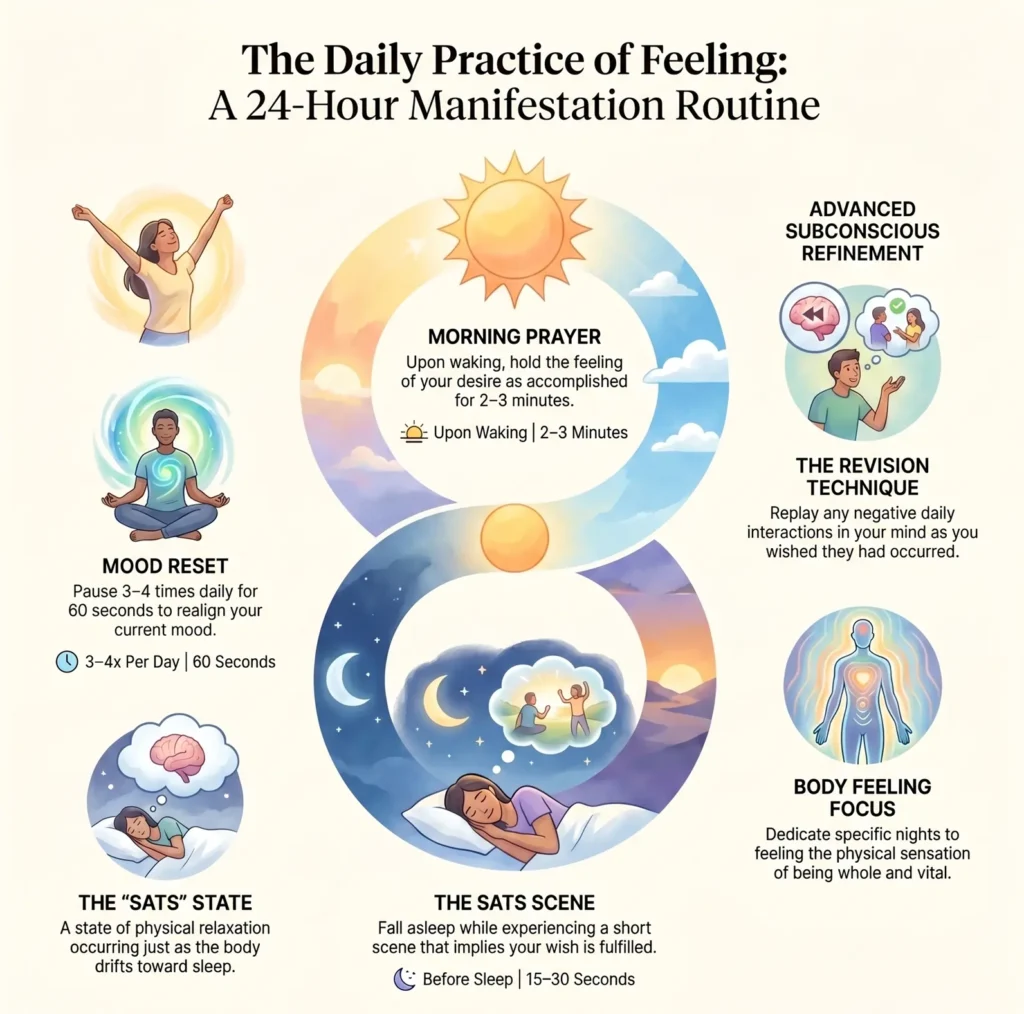
Morning: Before you check your phone, before the day’s demands arrive — spend two or three minutes in the feeling of your wish as already fulfilled. Not visualising. Just feeling. Let that be the first signal you send to the subconscious today.
During the day: When old assumptions try to reassert themselves (and they will), catch them. You do not need to fight them. Simply redirect. Ask yourself: “How would I feel right now if my desire were already real?” Then step into that feeling — even for thirty seconds. That is enough to shift the signal.
Before sleep: SATS. Every night. Non-negotiable.
When doubt arises: Do not spiral into trying to “fix” the doubt with logic. Instead, return to the feeling. The feeling is the argument. The feeling is the evidence. We are custom to living by the evidence of our senses — but Neville is asking you to trust the inner sense of feeling as more real than the outer 3D evidence in front of you.
This is precisely why reading Neville’s The Law and the Promise alongside this book is so valuable — it is filled with testimonials of people who applied exactly this process and saw their outer worlds shift, sometimes dramatically.
Feeling and Manifestation: Practical Exercises Drawn Directly From the Book
Let me pull these together for you clearly, because the book’s exercises are scattered across the chapters and it helps to see them as a unified daily system…
Exercise 1 — The Morning Prayer (Chapter One)
Upon waking, before engaging with the physical day, close your eyes and enter into the feeling of your desire as already accomplished. Do not construct a scene. Simply feel it. Breathe it. Hold it for two to three minutes. This sets the subconscious tone for the day.
Exercise 2 — The SATS Scene (Chapter Two)
Each night, as your body relaxes toward sleep, enter a pre-constructed scene of fifteen to thirty seconds that implies your desire is real. Be in the scene, not watching it. Feel it physically. Drift off from within it.
Exercise 3 — The Mood Reset (Chapter Three)
At three or four points throughout your day, pause for sixty seconds. Ask: “What mood am I currently sustaining?” If it does not correspond to the wish fulfilled — shift it deliberately. Recall the feeling of having what you want. Hold it for sixty seconds. Then return to your day.
Exercise 4 — The Body Feeling (Chapter Four)
During your SATS practice, choose specific nights to focus exclusively on the body. Enter the feeling of the physical experience you desire — not the image of your body, but the sensation of living in it as healthy, whole, and vital. Let that sensory feeling be what you carry into sleep.
Exercise 5 — The Revision Technique (Supplementary)
This one is not in the four chapters explicitly, but Neville teaches it extensively and it connects directly to feeling. At the end of each day, revisit any moment that felt wrong — any interaction, result, or circumstance you did not want to experience. In your imagination, revise it. Replay it as you wished it had gone. Feel the revised version. This clears the subconscious of negative impressions before sleep.
Explore the full explanation of this practice at Neville Goddard’s Revision Technique.
How to Use Feeling Is the Secret Neville Goddard as a Daily Manual
Here is something I want you to really sit with… This book is not meant to be read once and placed on a shelf. Neville wrote it as a manual. And like any manual, its value multiplies with use — not with admiration.
The practitioners who get the most from feeling is the secret Neville Goddard are those who return to it regularly. Not to learn something new on every re-read, but to remind the conscious mind of what the subconscious needs. Because the conscious mind forgets. It gets pulled back into the 3D illusion of outer circumstances. It begins to trust the evidence of the senses again. And then the assumptions start to drift…
A practical daily manual approach might look like this:
- Read one chapter (they are short — ten minutes each) at the start of your week.
- Apply only the exercise from that chapter for the next seven days, with complete focus.
- At the end of the week, notice — not just in your outer world, but in your inner world — whether your feeling-state has shifted.
- Move to the next chapter. Carry the previous exercise forward.
- After completing all four chapters, return to Chapter One. The spiral deepens each time.
This is also why the TrueCosmic course built around this book structures the material as a living practice rather than a lecture series. The principles only become wisdom through experience — not through reading alone.
If you want to go further still, the Neville Goddard Imagination Creates Reality audiobook gives you a powerful audio experience of these same principles — ideal for reinforcing the feeling-based approach during commutes, workouts, or any time your eyes are occupied but your subconscious is listening.

Feeling Is the Secret Neville Goddard: The Broader Teaching Context
This book does not exist in isolation. It is part of a larger, extraordinarily coherent body of work…
The same principles that underpin Feeling Is the Secret run through every lecture, every book, and every recorded talk Neville ever produced. The 7 keys to Neville Goddard’s fundamentals maps out exactly how this fits into the wider system — and if you are new to his teaching, that is an essential read alongside this one.
For those ready to go deep, Prayer: The Art of Believing is essentially an extended exploration of Chapter One of this book. Neville spends an entire volume on what prayer as feeling truly means — and it is extraordinary reading.
And if you want to understand the biblical dimension of Neville’s teaching — because his work is deeply scriptural, though unconventionally so — the complete Neville Goddard biblical interpretation guide will open dimensions of this teaching you may not have encountered yet.
The relationship between feeling and manifestation is the thread that runs through all of it. This book just happens to be the place where Neville states it most plainly and practically.
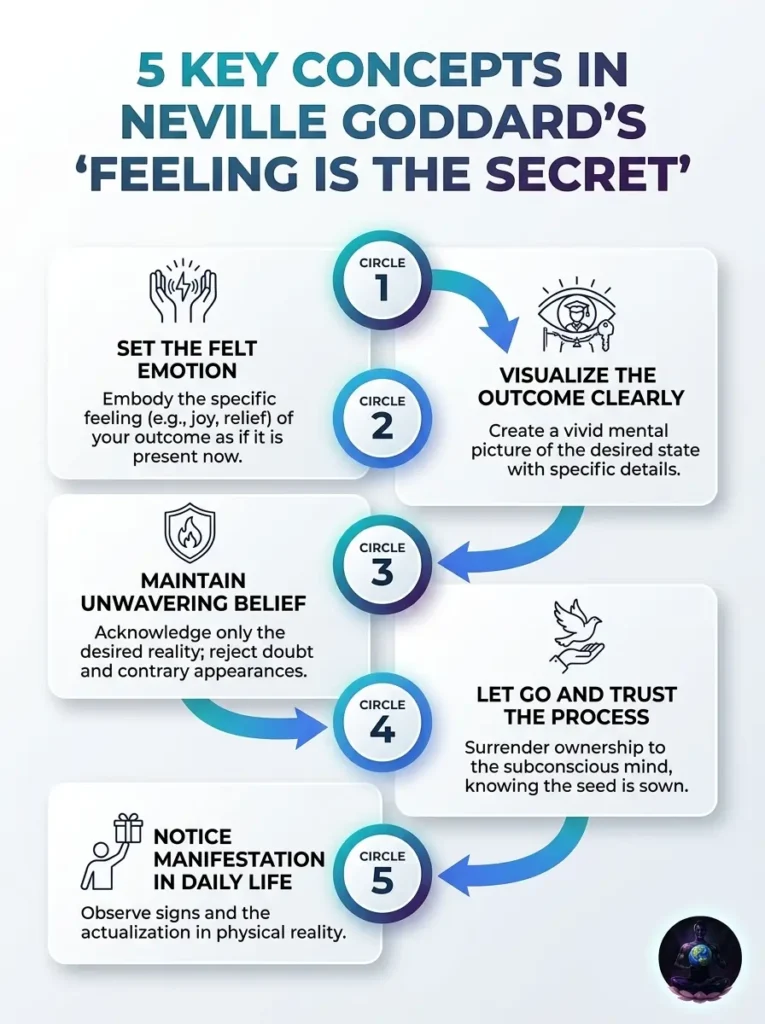
A concise visual guide to Neville Goddard’s Feeling is the Secret. This infographic highlights five core concepts — belief, imagination, feeling, attention, and realization — and how they influence reality.
To go from understanding to practice, the Feeling is The Secret Masterclass at TrueCosmic Academy provides the structured daily exercises to make this technique a lived habit.
For the complete guide to the Law of Assumption, see our definitive resource: The Law of Assumption — The Complete Guide.
For the complete step-by-step guide to the SATS technique, see: The SATS Technique — Neville Goddard’s Complete Guide.
For the complete guide to Kundalini awakening signs, stages, and scripture, see: Kundalini Awakening — The Complete Guide.
To learn more about Neville Goddard’s life and complete body of work, read our definitive guide: Neville Goddard — The Complete Guide.
Conclusion
Let me bring this home for you clearly…
Feeling is the secret Neville Goddard identified — and it is still the secret most people overlook, even those who have been studying this material for years. Not because they do not understand it intellectually. But because understanding and applying are two entirely different things.
The four chapters of this book — Prayer, Sleep, Mood, and Health — are not philosophical categories. They are the four arenas of daily life where you have the opportunity, every single day, to impress the subconscious with a new feeling. A new assumption. A new instruction about what your reality is.
The feeling of the wish fulfilled is not a technique you do once before bed. It is a way of being. A sustained inner posture. And when you begin to live from that posture — consistently, persistently, with real feeling behind it — the outer world has no choice but to rearrange itself to match.
The connection between feeling and manifestation is not theoretical. It is the most practical truth Neville ever taught. And this small, precise, extraordinary book is still, in 2026, the clearest single explanation of how it works that exists in print.
Start with the Feeling Is the Secret digital resource. Apply one exercise from one chapter tonight. And discover, through your own experience, what Neville knew all along…
Real spirituality is learned through experience. Not through reading about it. Let’s begin.
Frequently Asked Questions
Q: What does “feeling is the secret” mean in Neville Goddard’s teaching?
A: In Neville Goddard’s system, feeling is the secret because it is the specific language the subconscious mind understands and responds to. Unlike the conscious mind, which processes words and images, the subconscious receives its creative instructions through feeling — particularly the feeling that a desired experience is already real and present.
Q: How do I actually generate the feeling of the wish fulfilled if I don’t believe it yet?
A: Neville recommends using a short, sensory mental scene — something that implies the desire is done, like hearing a congratulation or holding the result in your hands — and allowing the imagination to generate the corresponding feeling naturally. You are not trying to force belief; you are using imagination as the feeling-generator, especially during the drowsy SATS state before sleep where the analytical mind is quieter and feeling comes more easily.
Q: Is “Feeling Is the Secret” still worth reading if I have already studied Neville Goddard?
A: Absolutely — in fact, many experienced practitioners of feeling is the secret Neville Goddard’s teachings return to this book most often precisely because it is the most compressed and practical statement of his entire method. It works best as a cyclical manual rather than a one-time read, deepening with each pass.
Q: What is the difference between feeling and emotion in Neville Goddard’s framework?
A: Neville makes a subtle but important distinction — emotion in the reactive sense (excitement, anxiety, longing) is not the same as the deliberate, settled feeling of the wish fulfilled. The latter is calm, naturalised, and carries the tone of completion rather than desire. It is less like excitement and more like the quiet confidence of someone who already knows the outcome.
Q: How long does it take for the SATS technique from “Feeling Is the Secret” to work?
A: There is no single timeline — results vary depending on the consistency of practice, the depth of feeling accessed, and the degree to which contradictory assumptions are present. What Neville is consistent about is this: the practice must be nightly, the feeling must be genuine (not forced), and persistence is the engine. Some people applying feeling is the secret Neville Goddard’s SATS method report shifts within days; others find it takes several weeks of consistent practice before the outer world begins to reflect the inner change.


Michael Sutherland is the founder of Truecosmic, a global platform dedicated to Neville Goddard’s teachings and the Law of Assumption. Passionate about empowering individuals through conscious creation, Michael blends esoteric wisdom with practical insight to help people transform their lives from within.
Enter your email and get instant FREE access to your report.
No credit card required. 🔒 Your details are secure. You can unsubscribe at any time.














0 Comments