
You can love the law of assumption persistence in theory, and still quit when your life does not show the change you expected. Even in 2026, thousands of people keep sharing Neville Goddard techniques online, but the part that decides the outcome is not the idea, it is the return. One popular summary post has 7,500 likes, yet most people do not persist long enough to harden their assumption into fact.

Key Takeaways
| What to stop | Stop switching identities, stop waiting for a feeling, stop treating one session as “done”. |
| What persistence is | Persistence is return, not intensity, you come back to the assumed self again and again. |
| Outer evidence | Do not let what you see cancel what you assume, the 3D world is old film playing on the screen. |
| Bridge of incidents | You persist in the inner state, you do not obsess the bridge of incidents details. |
| Start with inner identity | We use identity over technique, your self-concept sets your emotional reality. |
| Read more |
What It Feels Like When You Practice, Then Quit
You start by doing the steps. You pick a scene, you repeat it, you try to feel grateful, you try to live as if it is already done. For a while, you even get quiet inside. Then you look at your life, you see the same situation, and you lose trust.
Here is the common moment where law of assumption persistence fails. You do a session, you want proof immediately, and when the proof does not arrive fast, you treat the whole practice like it was wrong. You then switch to a new method, a new identity, a new coach voice, or a new plan.
That cycle is not a mystery. It is a pattern of replacing the assumption instead of returning to it. We see it again and again, in 2026 and beyond, because the brain hates uncertainty. Your mind wants a “receipt” before it commits.
The 3D world is a reflection, not a final truth. If you treat the reflection as the judge, your assumption will never harden.
The Real Reasons Law of Assumption Persistence Fails, Most of the Time
The law of assumption persistence fails for a few simple reasons. These are not random mistakes. They are predictable human habits.
1. You switch identities too often
One day you decide “I am the person who has it.” The next day you decide “I am the person who is still waiting.” That is identity switching, and it resets the inner world you are building.
When you keep switching, you create internal conflict. The assumed self does not get time to feel normal. So it never becomes the standard.
2. You wait for the feeling to arrive before believing
You think the feeling is proof. So you wait for certainty to rise, then you try to act from certainty.
This is backwards. We use feeling as a training tool, not a gate you must pass. If you wait for the emotional wave to show up first, you will always be late.
3. You treat one session as enough
Some people do a scene once, twice, then they want reality to change instantly. That is like pressing a button once and expecting the furnace to be hot for hours.
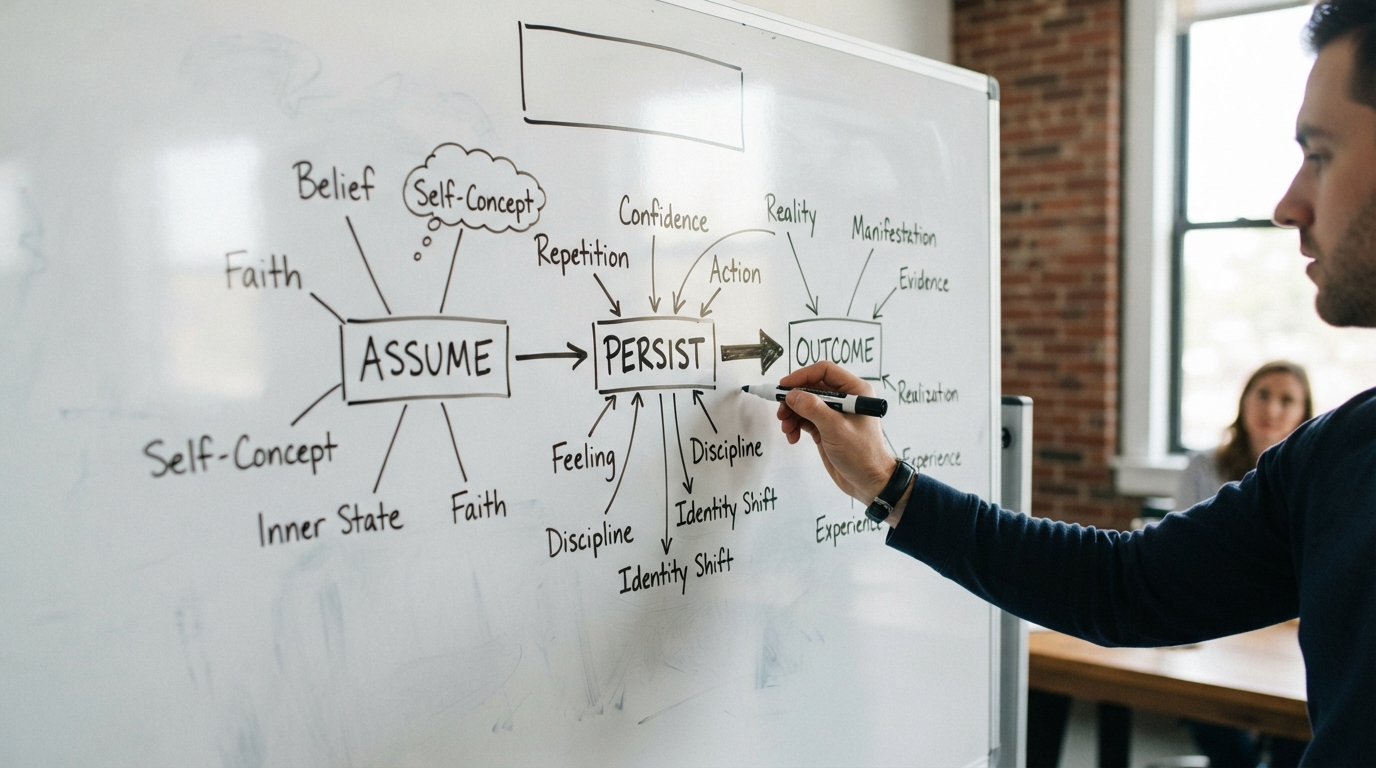
Assumptions harden through return. A single session is a seed. Persistence is watering.
4. Outer evidence overrides the inner assumption
Your senses will keep reporting the old state. Your phone keeps showing the old message thread. Your bank balance keeps looking the same. Your calendar keeps repeating the same emptiness.
Then you do the fatal thing. You let what you see become the new “assumption.” You say, “Since it is still here, I must be wrong.”
Your reasonable mind and outer senses may deny it, but we promise you this, if you will persist, you will receive your assumption.
For a deeper look at the identity angle, see self concept manifestation, identity over technique.


Stop Treating Persistence Like a Feeling, It Is a Skill
Many people confuse persistence with intensity. They think persistence means you must feel strong every day. You must be emotionally fired up. You must never get discouraged.
No. The law of assumption persistence is not about constant adrenaline. It is about returning to the same inner fact, even when your mood changes.
Here is a line we use often because it is true: the work is internal. You change the inner state, and the outer world rearranges to match. We are not chasing a vibe. We are training your psychological map of consciousness.
Think of it like this. Your assumption is a new groove. You keep running on it until it becomes automatic. If you stop and switch grooves every time life mirrors something uncomfortable, you never deepen the channel.
Persistence means “I return”, not “I force”
- You return to the wished-for identity after you feel doubt.
- You return to the same scene after you drift.
- You return to the same assumption after you see outer evidence.
Decisions act as waves of probability until your focused imagination collapses them into a physical experience. The collapse is not one dramatic moment. It is the result of consistent return to the assumed state.
If you want the identity-first explanation, we also cover it in law of assumption guaranteed to manifest your desire.
Persistence as Training, Like a Sourdough Starter or a Blacksmith
Let us kill one wrong picture. Persistence is not a single dramatic burst of effort. Persistence is like a sourdough starter.
When you keep feeding a sourdough starter, you do not wait for it to “feel alive” each time. You feed it because feeding is what it is. The growth is steady. It becomes unstoppable over time.
It is also like blacksmith work. You do not strike once and call it done. You heat, you shape, you strike, you cool, you repeat. The metal changes because the process repeats.
This is exactly what the law of assumption persistence does. It repeatedly hardens your inner world. It shapes your assumption into a stable expectation.
A simple “starter” style rhythm you can actually keep
- Pick one assumed self. Not ten. One.
- Pick one inner reality. One proof you live from.
- Practice daily. Short return beats long quitting.
- Refuse identity swap. If you slip, you return quickly.
When you keep returning, your imagination becomes the observer that keeps selecting the same outcome. That is how living in the end becomes normal for you.
The Bridge of Incidents Neville Goddard Manifestation, and Why Worry Breaks Persistence
The bridge of incidents is real in how it works. But most people do not fail because they do not understand the bridge. They fail because they worry about it.
Worry is a second story. Worry says, “Something must happen first, and it is not happening. I do not have it.” That second story competes with your original assumption.
So you keep checking the outer world for the exact path. You try to map each event like it owes you a schedule. Then your mind gets stuck in “not yet” evidence.
What to do instead
- Persist in the assumed self, you do not negotiate with the old reality.
- Let the bridge happen without your mental obsession.
- Track less, feel more, but always return to belief.
The Bible framing helps some people here, because it is about inner state. We do not treat scripture as a museum piece. We use it as a precise psychological map of consciousness. The “outer events” are the screen, the state is the source.
If you want this approach explained with the “state of consciousness” angle, read how to interpret the Bible using state of consciousness.
How to Practice Persistence Without Overthinking, SATS Included
Now we give you a practical method, not a motivational lecture. We do not ask you to “believe harder” in a vague way. We ask you to build a stable inner state you return to.
If you use SATS, we keep it simple. State Akin To Sleep helps you impress the assumption, but it is not a magic spell that ends the job. Persistence is still required after you wake up.
State Akin To Sleep is a tool for quieting the surface mind. You feel the wish fulfilled because you are giving your imaginative power a clear instruction. Then you keep living from the assumed identity.
If you need a clear explanation of why this state works, read state akin to sleep, what it is, why you should do this.
Persistence practice plan, a short daily loop
- Choose the assumption. Example: “I am already the kind of person who has this.”
- Live the attitude. Stand, speak, and decide like that person today.
- Do your short SATS scene. Keep it consistent, do not keep changing it.
- Return when life distracts you. If you spiral, come back within minutes, not days.
- Act from the inner state. Small actions match the assumption, big fantasies do not.
For health and healing, we also teach this state focus in SATS manifestation for health using state akin to sleep.
Why Your Inner World Overrides Your Outer World, Even When It Looks Wrong
The current reality is not the truth. It is the past settled into its present shape. That is why the first days of persistence can feel like nothing is changing.
The outer world is still playing old film. You are not waiting for a new movie. You are training the mind that chooses the next frame.
Whatever contradicting behavior you are focused on, all of it is old film playing on the screen. Persistence is what tells your mind to stop treating the screen as the boss.
When you decide on a specific outcome, you are using your imaginative power to collapse the quantum wave of possibilities. But you do not collapse once and walk away. You keep selecting the same imagined certainty until it becomes a lived fact.
One warning, stop asking the wrong questions
Questions shape the inner state. If you ask questions that keep your mind in lack, your assumption will weaken.
We go deeper on this with six questions you must not ask when manifesting goals.

What About Jesus, Other Esoteric Teachers, and the Bible?
We do not require you to accept one teacher to practice the law of assumption persistence. But if you study older esoteric teachings, you see the same principle in different clothes.
Some students treat the biblical figure as “just history”. We do not. We treat the biblical record as a psychological code. The Christ is the human imagination, and the God of scripture is your imagination.
Other esoteric teachers in the past also pointed to inner state and assumption, not surface tricks. That is why we rotate in multiple references when we teach this, we do not lock you into one personality cult.
For a Bible-focused framework, read the law of assumption in the Bible, Neville’s complete biblical framework, and also what Neville Goddard saw that most missed.
Conclusion, Persist and Return to Yourself
The real reason your law of assumption persistence fails is not that you lack talent. It is that you stop the return. You switch identities, you wait for the feeling, you treat one session as enough, and you let outer evidence override the inner assumption.
Reframe persistence as a skill built through return, like a sourdough starter or a blacksmith repeatedly shaping heated metal. When you practice the same assumed self, and you return fast after doubt, you strengthen the bridge between inner state and outer manifestation. The law of assumption persistence is not a lucky event. It is the result of repeated inner choosing.
No matter what you are facing in 2026, the solution is already inside you, you do not need to beg for it, you need to activate it. When you stop outsourcing your identity to what the screen says, and you keep returning to what you assume, your assumption becomes your world.
Frequently Asked Questions
Why does my law of assumption persistence not work even when I do SATS?
If your law of assumption persistence does not work with SATS, it is usually because you return to a different identity after you wake up. SATS can help you impress the assumption, but outer evidence or identity switching will still weaken the result. Persist in the same assumed self, and refuse the “new proof” story.
How long does the law of assumption persistence take to show results?
There is no universal number, because law of assumption persistence depends on how consistently you return to the assumption. In practice, many people report results stabilizing after a steady weekly rhythm of 5 to 10 hours of focused effort, but the key is not the clock, it is the return to the inner state. If you quit early, you delay the hardening into fact.
What does persistence actually mean in practice, day to day?
Persistence means you keep returning to the same inner fact even when emotions change. You keep the same assumed identity, you repeat the same scene if you use it, and you come back quickly after doubt. Your law of assumption persistence shows up in your repeat decisions, not your rare emotional moments.
How do I stop letting outer evidence override my inner assumption?
You stop treating the outer world as the final authority. The 3D world is past consciousness settled into its present shape, so it will lag behind your inner shift. When you see “old film,” you redirect attention to the end state, you feel it as real, and you persist.
Is the bridge of incidents important, and do I need to worry about it?
The bridge of incidents matters because it is how inner state becomes outer events. But you do not need to worry about the details or demand a specific timeline. Your job is to persist in the assumption, then let incidents arrange themselves.
What are the most common mistakes that break law of assumption persistence?
The biggest breaks are identity switching, waiting for feeling to arrive before believing, treating one session as enough, and letting outer evidence override the inner assumption. If you keep those four habits, your law of assumption persistence will keep failing. Fix the return pattern, and the assumption hardens.

Michael Sutherland is the founder of TrueCosmic and a devoted student and practitioner of Neville Goddard teachings. His path to this work was not academic — it was forged in crisis.
Raised as a devout Jehovah Witness and Baptist, Michael walked away from the church at eighteen and spent the next 25 years in what scripture calls the far country — the prodigal son, wandering. He built a life by the world rules, searching without knowing what he was searching for.
When the biggest crisis of his life arrived, he turned back — not to the church, but to scripture itself. Through Neville Goddard teachings he found what the church had never shown him: that the God of scripture is not an external being to be feared and appeased. God is your own awareness. Your own consciousness. Your own imagination. The I AM within.
















0 Comments