Only 24% of Americans now take the Bible as the literal word of God, a record low that signals a profound shift in how humanity approaches scripture. This decline in literalism opens the door to a deeper, more esoteric understanding of Bible Allegory, where the text is recognized not as a historical record but as a precise psychological map of consciousness. The God of scripture is your imagination, and the Christ is the human imagination, operating within you right now.

Key Takeaways
| Key Insight | Explanation |
|---|---|
| The Bible Is Allegory | Scripture encodes inner states of consciousness rather than external historical events. |
| Dark Sayings | Psalm 78:2 declares that wisdom is spoken in “dark sayings,” meaning hidden psychological truths. |
| God of Scripture | God is not an external deity but human imagination, the creative power within. |
| Christ Is Within | The Christ is the human imagination, the I AM presence that shapes your reality. |
| Characters as States | Biblical figures like Moses, David, and Jesus represent faculties of the human mind. |
| Practical Application | Allegorical interpretation is a tool for conscious creation and self-transformation. |
Related resources: Explore our complete guide to esoteric Bible interpretation and our esoteric Bible dictionary for deeper study.
What Is an Allegory in the Bible? The Definition of Hidden Truth
When we ask “what is an allegory in the Bible,” we are really asking whether scripture operates on more than one level. The allegory definition Bible scholars use refers to a narrative whose surface story conceals a deeper spiritual or psychological meaning. This is not speculation; it is what scripture itself declares.
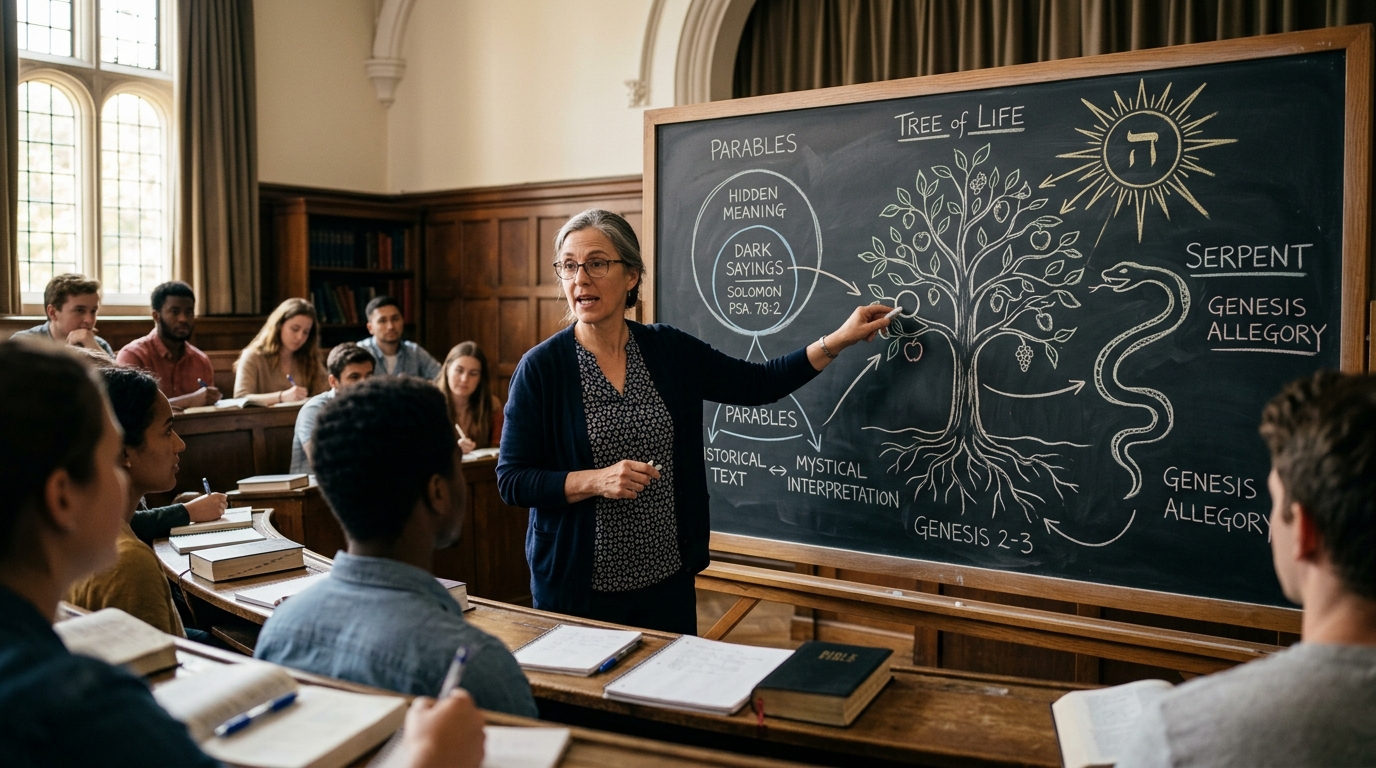
Psalm 78:2 states: “I will open my mouth in a parable: I will utter dark sayings of old.” The word “parable” here is the Hebrew mashal, which means a prophetic riddle or symbolic saying. These dark sayings are the encoded language of consciousness, hidden from those who read only with the literal eye.
The Bible is an allegory in the sense that every character, every battle, every journey, and every miracle represents an operation occurring within your own mind. When you understand the allegory meaning in the Bible, you realize that the entire text is a manual for the soul, a master-to-student transmission about the nature of consciousness itself.
Consider what does allegory mean in the Bible practically. It means that the Exodus is not about a group of people leaving a physical country. It is about consciousness leaving the bondage of limited beliefs. The Promised Land is not a piece of geography; it is a state of consciousness, an inner state of fulfilled desire.
The Bible Is Allegory: Scripture as a Map of Consciousness
The bible is allegory, and this is a precise metaphysical claim, not a spiritual metaphor. Consciousness is the only reality. The physical world, everything you can see, touch, hear and experience, is a projection of consciousness. Scripture encodes this truth in symbolic language.
When we say the bible is allegory, we mean that every geographic location in scripture corresponds to a state of mind. Jerusalem means “peace” or “vision of peace.” Egypt represents bondage to the senses. Babylon represents confusion and the conditioned mind. These are not poetic flourishes; they are precise psychological designations.
The bible as allegory reveals that places like Canaan, Bethlehem, and Nazareth are states of consciousness you enter through imagination. Bethlehem means “house of bread,” representing the substance of consciousness. Nazareth means “the branch,” representing growth and unfolding awareness. Every name in scripture carries an inner meaning.
Imagining creates reality. The world, and all within it, is man’s conditioned consciousness objectified. When you read the Bible as allegory, you begin to see that every story is your story. Every character is a faculty of your own mind, playing out its role on the inner stage of consciousness.
Dark Sayings and the Allegory Meaning in the Bible
The concept of “dark sayings” is central to understanding allegory in bible interpretation. These are not sayings that are evil or negative. They are sayings encrypted in symbolic language, hidden from the rational intellect and revealed only to the awakened imagination.
Proverbs 1:6 speaks of understanding “the words of the wise, and their dark sayings.” This is an explicit acknowledgment that scripture contains a hidden layer of meaning. The allegory in bible study is the process of decoding these dark sayings, of moving past the literal narrative to the psychological truth beneath.
Jesus himself declared in Matthew 13:34 that he spoke only in parables to the multitudes. He never spoke to the crowd without using allegorical language. The reason is clear: the truth of consciousness cannot be received by a mind still operating in the 3D world of sensory evidence. It must be encoded in story so that the subconscious mind, the deeper faculty, can receive it.

Feeling is the language the subconscious mind understands. The dark sayings of scripture speak directly to this subconscious faculty through symbolic imagery. When you read allegory in bible passages with your imagination engaged, the subconscious mind accepts the feeling as instruction and begins rearranging your outer experience to match the inner state it has been given.
The allegories in the bible are not optional literary devices. They are the very structure through which divine truth is transmitted. To read scripture literally is to read someone else’s mail. To read it allegorically is to receive the message meant for your own awakening.
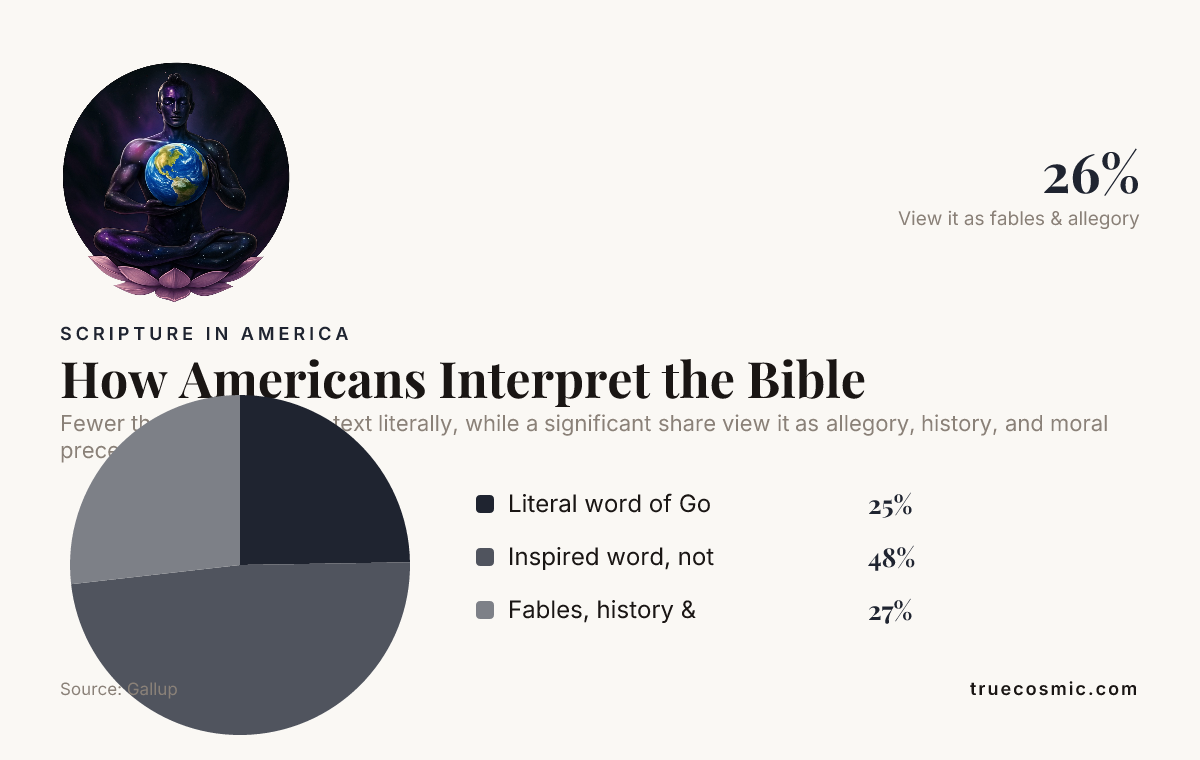
Fewer than 1 in 4 take the text literally, while a significant share view it as allegory, history, and moral precepts.

Allegory in the Bible Examples: Characters as Inner States
When examining allegory in the bible examples, we find that every character represents a specific state of consciousness or a faculty of the human mind. This is not interpretation imposed on the text; it is the text’s own internal logic. Let us examine several allegory examples in the bible to see this clearly.
Moses represents the mind drawn out of the senses. The name Moses means “drawn out,” and his story is the story of consciousness being extracted from the bondage of sensory evidence. When Moses leads the Israelites out of Egypt, it is your own mind leading awareness out of identification with the 3D world.
David represents the beloved state of consciousness, the one who has found favor with I AM. David’s slaying of Goliath is the triumph of imagination over the seemingly impossible. Goliath represents the giant of doubt, the external evidence that says your desire cannot manifest. David represents the inner state that knows it is already done.
Jesus is not a historical figure in the allegorical reading; he is the Christ, the human imagination itself. The name Jesus means “Jehovah saves,” and Jehovah is I AM. When Jesus heals the blind, it is imagination restoring vision to the mind that was blind to its own creative power. When Jesus walks on water, it is imagination rising above the turbulent emotions of the subconscious.
These allegory examples in the bible demonstrate that scripture is a psychological document. Your current circumstances are not obstacles to what you want. They are the Goliath your inner David must face. Change the assumption and the circumstances must change, not because the state of consciousness is cooperating with you, but because the circumstances were always just a reflection of your inner state.
Jesus as Imagination: The Christ Is the Human Imagination
This is the central revelation of the allegory bible: the Christ is the human imagination. This is not blasphemy; this is what scripture itself teaches when read allegorically. Colossians 1:27 declares “Christ in you, the hope of glory.” The Christ is not a person who lived two thousand years ago. The Christ is the creative power of I AM operating within your own consciousness right now.
When Jesus says “I am the way, the truth, and the life,” he is speaking as the principle of imagination itself, not as a historical individual. The “I AM” in scripture is always the name of God operating within the individual. God of scripture is your imagination. When you say “I AM,” you are invoking the creative power that shapes reality.
The four Gospels, when read as allegory, present four aspects of the same inner process. Matthew represents the kingly aspect of imagination, the ruling faculty. Mark represents the servant, the executing power. Luke represents the human side, the feeling nature. John represents the spiritual, the direct knowing. Together they form a complete map of how the Christ, the human imagination, operates within consciousness.
The moment an idea or desire is accepted by the subconscious mind as a fact, the creative process begins. This is the “spiritual pregnancy” that eventually births the manifestation. The virgin birth is not a biological event; it is the birth of a new state of consciousness from the womb of the subconscious mind, conceived by imagination without the aid of external evidence.
For a deeper exploration of these teachings, explore our guide to hidden mystical teachings in the four Gospels and our Neville Goddard Library.

How to Read Allegories in the Bible: Practical Application
Understanding what is allegory in the bible is only the beginning. The real work is applying this understanding to your daily life. Scripture is a practical manual for conscious creation, and its allegories contain precise instructions for manifesting desired outcomes through the Law of Assumption.
The first step in reading allegories in the bible is to abandon the literal-historical lens entirely. Ask not “did this happen?” but “what state of consciousness does this represent?” Every person in scripture is a state you can enter. Every place is a state you can occupy. Every event is an imaginal act you can replicate.
The second step is to cross-reference biblical names with their Hebrew or Greek meanings. The name Abraham means “father of a multitude,” representing the state of consciousness that has accepted abundance. The name Isaac means “laughter,” representing the joy of fulfilled desire. For this work, our curated esoteric Bible dictionary resources provide essential reference material.
The third step is to identify the imaginal act within each story. When Jacob places striped rods before the flocks, he is using imagination to shape the outcome. When Peter walks on water and begins to sink, he demonstrates what happens when consciousness loses focus on the desired state. These are not moral lessons; they are technical instructions for the conscious creator.
The 4D is where we “plant” our desires. Scripture calls this the “invisible” or the “heavenly.” The 3D world is the world of manifestation, the world of sensory evidence. The allegory bible teaches you to work in the 4D realm of imagination, to plant your desires there through feeling, and to let the subconscious mind bring forth the harvest in the 3D world.
Techniques like State Akin to Sleep (SATS) are directly derived from biblical allegory. When you enter the hypnagogic state, you are entering the “deep sleep” that fell upon Adam, the state in which I AM works without interference from the rational mind. Sensations in the hypnagogic state can be so realistic that people who unintentionally enter it often believe they are still in the physical body. This is the state where the subconscious is most receptive to the feeling of the wish fulfilled.
The Neville Goddard teachings provide perhaps the most systematic modern approach to biblical allegory. Neville demonstrated that every story in scripture is about you, operating within you, right now. The bridge of incidents that connects your inner assumption to its outer fulfillment is the same bridge scripture describes when Jacob sees the ladder reaching from earth to heaven.
For those ready to go deeper, our guide to the top Neville Goddard books and our exploration of who inspired Neville Goddard provide essential context for this work.

The Law of Assumption and Biblical Allegory
The Law of Assumption is the practical mechanism through which Bible Allegory becomes lived experience. Scripture does not merely describe states of consciousness; it instructs you in how to shift from one state to another. The Law of Assumption is the operating law, and imagination is its agent.
When we examine the Law of Assumption in the Bible, we find it everywhere. When God tells Abraham to count the stars and says “so shall thy seed be,” God is instructing Abraham to assume the state of already having the promise. Abraham is being told to imagine the end, to feel the reality of the fulfilled desire, and to let the subconscious mind accept that feeling as fact.
When Jesus says “Whatsoever things ye desire, when ye pray, believe that ye receive them, and ye shall have them,” he is giving the precise formula for the Law of Assumption. Prayer in the allegorical sense is not begging an external deity. Prayer is the act of assuming the feeling of the wish fulfilled, of entering the state of consciousness where the desire is already reality.
Everyone Is You Pushed Out (EIYPO) is the biblical principle that every person in your experience reflects your own state of consciousness. When scripture says “as a man thinketh in his heart, so is he,” it is declaring EIYPO. The people around you are not independent agents acting upon you; they are conditioned consciousness objectified, mirrors of your inner state.
Your mental diet, the thoughts and assumptions you entertain throughout the day, is the true scripture you are writing into your subconscious. The Bible is the external record of this inner process. When you discipline your mental diet to align with your desired state, you are doing what scripture calls “walking in the spirit” rather than “walking after the flesh.”
Is the Bible an Allegory? The 2026 Shift in Consciousness
Is the bible allegory? The data from 2026 suggests that humanity is increasingly ready to receive the answer. With only 24% of Americans holding to literalism and a growing plurality recognizing scripture as inspired rather than factual, the collective state of consciousness is shifting toward allegorical understanding.
This shift is not a loss of faith. It is the recovery of faith’s original meaning. Faith, in the allegorical sense, is not belief in external facts. Faith is the substance of things hoped for, the evidence of things not seen. Faith is the feeling of the wish fulfilled, the inner knowing that imagination has already created what the 3D world has not yet shown.
The bible is an allegory, and recognizing this is the first step toward using scripture as it was intended. Not as a history book. Not as a moral rulebook. But as a precise, encoded manual for the conscious creator. Every story is your story. Every promise is your promise. Every character is a state you can occupy.
Neville Goddard spent his life demonstrating that the Bible is allegory, that the Christ is the human imagination, and that the God of scripture is your imagination. His work was never to start a new religion. It was to recover the original meaning of the one that already existed, long before any single teacher claimed it: the same truth found in the Upanishads, in the Gospel of Thomas, in the Kabbalists’ reading of Genesis, and in the Hermetic axiom that the inner world creates the outer one. The Law is a practice, not a trick. Reading scripture allegorically is only the beginning. Living it, returning to that inner state night after night until it hardens into fact, is the work that actually changes a life.
Conclusion
The question “is the bible an allegory” is answered definitively by scripture itself. Psalm 78 declares dark sayings. Proverbs speaks of hidden wisdom. Jesus spoke only in parables. The Bible is allegory by its own declaration, and understanding the allegory meaning in the Bible is the key that unlocks its transformative power.
When you read allegory in bible passages, you are not engaging in literary analysis. You are entering a state of consciousness. You are activating the Christ, the human imagination, within your own mind. You are learning that every story in scripture is a coded instruction for conscious creation, a map showing you how to move from bondage to freedom, from lack to abundance, from illness to wholeness.
The God of scripture is your imagination. The Christ is the human imagination. The Bible is an allegory of your own awakening. Read it not as a record of what happened to others, but as a prophecy of what is happening within you, right now, as you assume the feeling of the state you desire to inhabit. Imagining creates reality, and scripture is the proof.
No matter what you are facing, housed within you lies the solution to every problem and the fulfilment of every desire. The same power that animates and created this entire universe exists in you, at your beck and call. Only you are the operant power. You have to activate it. And when you do, no problem, no circumstance, no situation can stand in its way. Fear not.
For a deeper look at how specific Old Testament figures carry this same symbolic structure, see Old Testament Metaphysical Symbolism.
Frequently Asked Questions
Is the Bible an allegory or literal history?
The Bible is allegory, not literal history. Scripture itself declares in Psalm 78:2 that wisdom is spoken in “dark sayings,” meaning symbolic, hidden truths. When you recognize the Bible as allegory, you understand that its characters represent states of consciousness and its events represent psychological processes within your own mind.
What is an allegory in the Bible?
An allegory in the Bible is a narrative whose surface story conceals a deeper psychological or spiritual meaning. The allegory definition Bible scholars use involves reading characters as faculties of the human mind and places as states of consciousness. This makes the Bible a practical manual for inner transformation rather than a historical record.
What does allegory mean in the Bible practically?
What allegory means in the Bible, practically, is that every story is about your own consciousness. Moses represents the mind drawn out of sensory bondage. Jesus represents the Christ, the human imagination. The Exodus represents your consciousness moving from limitation to freedom. Allegories in the Bible are instructions for conscious creation.
What are some allegory examples in the Bible?
Allegory examples in the Bible include the Exodus (consciousness leaving bondage to the senses), David and Goliath (imagination triumphing over doubt), and the virgin birth (a new state of consciousness conceived by imagination). These allegory in the Bible examples show that every character and event encodes an inner psychological process.
How do I start reading the Bible as allegory in 2026?
Begin by abandoning the literal-historical lens and asking what state of consciousness each character and place represents. Use an esoteric Bible dictionary to decode Hebrew and Greek name meanings. Practice entering the states described through techniques like SATS (State Akin to Sleep), where the subconscious accepts the feeling of the wish fulfilled as reality.
Did Neville Goddard teach that the Bible is allegory?
Yes, Neville Goddard taught that the Bible is allegory in its entirety. He demonstrated that every character, including Jesus, represents an aspect of human imagination. Goddard’s teachings show that the Christ is the human imagination and that the God of scripture is your imagination, making the Bible a psychological manual rather than a historical document.
What is the difference between the Bible as allegory and the Bible as literal?
Reading the Bible as allegory means recognizing that its stories encode states of consciousness and psychological truths. Reading it literally means treating it as a record of external historical events. The allegorical approach reveals the Bible as a manual for conscious creation, where the God of scripture is your imagination operating within you.

Michael Sutherland is the founder of TrueCosmic and a devoted student and practitioner of Neville Goddard teachings. His path to this work was not academic — it was forged in crisis.
Raised as a devout Jehovah Witness and Baptist, Michael walked away from the church at eighteen and spent the next 25 years in what scripture calls the far country — the prodigal son, wandering. He built a life by the world rules, searching without knowing what he was searching for.
When the biggest crisis of his life arrived, he turned back — not to the church, but to scripture itself. Through Neville Goddard teachings he found what the church had never shown him: that the God of scripture is not an external being to be feared and appeased. God is your own awareness. Your own consciousness. Your own imagination. The I AM within.












0 Comments