
What is the secret place of the most high? For most of my early life the answer would have been simple: it was a line in a prayer. In the Baptist church of my upbringing, Psalm 91 was taught as a protection prayer, words you held up against danger the way a soldier holds up a shield.
Today I understand those words very differently. The secret place is not a church, a building or a spot on any map. It is a state within you, and I have found my own way into it, as I will share with you below.
I do not approach Psalm 91 as a record of one man’s escape from arrows and plague. I approach it as a truth folded into an image, so that it could travel for thousands of years without losing its shape. Our work is to unfold it, and what we discover inside is a description of ourselves.
This is not an attack on anyone’s faith. I honour those who pray this psalm as a literal promise of physical protection, but the two readings do not stand as equals: the literal is the first rung, and it gives way to the inner reading, just as the elder serves the younger.
Psalm 91 in brief
The psalm opens with the verse that gives this article its question:
“He that dwelleth in the secret place of the most High shall abide under the shadow of the Almighty.” (Psalm 91:1, KJV)
Then the speaker answers for himself: “I will say of the LORD, He is my refuge and my fortress: my God; in him will I trust.” (Psalm 91:2, KJV)
What follows is one of the most tender images in the whole of the Psalms: “He shall cover thee with his feathers, and under his wings shalt thou trust: his truth shall be thy shield and buckler.” (Psalm 91:4, KJV). The one who dwells there is told that he will not be afraid of “the terror by night; nor for the arrow that flieth by day” (Psalm 91:5, KJV), and then comes the line that so many people have clung to in hard times:
“A thousand shall fall at thy side, and ten thousand at thy right hand; but it shall not come nigh thee.” (Psalm 91:7, KJV)
The psalm promises angels: “For he shall give his angels charge over thee, to keep thee in all thy ways.” (Psalm 91:11, KJV). And near the end the voice changes, and God himself speaks, giving the reason for it all:
“Because he hath set his love upon me, therefore will I deliver him: I will set him on high, because he hath known my name.” (Psalm 91:14, KJV)
Hold on to that last phrase. Everything in the psalm turns on it.
What is the secret place of the most high? The inner reading
Let me be plain: as far as I have found, Neville Goddard never taught on Psalm 91 as such. What follows is TrueCosmic’s own reading, built on foundations Neville laid with great clarity.
The secret place is a state, not a site. Notice the verb: he that dwelleth. The psalm does not speak of someone who visits the secret place in an emergency and leaves again. It speaks of someone who lives there. The secret place is the inner awareness that you are, before you are anything else: before your name, your bank balance, your diagnosis or your reputation.
The most High is not up there. We were taught to picture the most High above the clouds, looking down. But the Jesus of scripture said, “behold, the kingdom of God is within you.” (Luke 17:21, KJV). If the kingdom is within, then the throne is within, and the most High is the highest thing in you: your own awareness of being, the I AM. The psalms say it outright: “I have said, Ye are gods; and all of you are children of the most High.” (Psalm 82:6, KJV), a verse Neville returned to again and again.
Neville put the consequence of this discovery in a single sentence:
“There is no one to whom we can turn after we discover that our own awareness is God.” (Neville, in his lecture “Lesson 5 Remain Faithful to Your Idea”)
If there is no one outside to turn to, then the refuge and the fortress of verse 2 are not outside either. They are the very awareness that is reading these words.
The secret is hidden in plain sight. The Jesus of scripture gave the same instruction in other words: “But thou, when thou prayest, enter into thy closet, and when thou hast shut thy door, pray to thy Father which is in secret; and thy Father which seeth in secret shall reward thee openly.” (Matthew 6:6, KJV). The closet and the secret place are the same room. You enter it by shutting the door on the senses.
“He hath known my name.” Here is the key that unlocks the whole psalm. At the burning bush, Moses asks for the name of the one who sends him, and the answer is “I AM THAT I AM” (Exodus 3:14, KJV). To know the name is to know that I AM is God. The one set on high in verse 14 is the one who has realised what the name means.
Hidden in the Hebrew: what the words of Psalm 91 conceal
In ancient Hebrew every letter carries a sound, a symbol and a number, and the words built from those letters often conceal far more than any translation can carry. I explore that principle in full in the biblical numbers meaning. Psalm 91 is a perfect place to put it to work, because its opening verses are packed with meaning that English quietly flattens.
Four names of God, ending in I AM
In just two verses the psalm uses four different names of God. Verse 1 speaks of the most High, in Hebrew Elyon, and of the Almighty, Shaddai. Verse 2 turns to the LORD, the sacred name Yod He Vau He, and then to “my God”.
Neville taught that God reveals himself to us in exactly this order: first as power, then by name.
“God’s first revelation to Man is Power, Almighty God, El Shaddai. His second revelation is I AM.” (Neville, in his lecture “Faith Hope And Love”)
Scripture says the same: “And I appeared unto Abraham, unto Isaac, and unto Jacob, by the name of God Almighty, but by my name JEHOVAH was I not known to them.” (Exodus 6:3, KJV). And of that name Neville says simply, “The word “Lord” means “I am.”” (Neville, in his lecture “Test Yourselves”)
Here is TrueCosmic’s reading. Psalm 91 makes that whole journey in two verses. Verse 1 describes the shelter of the Almighty from the outside, as power. Then in verse 2 the speaker opens his own mouth: “I will say of the LORD, He is my refuge and my fortress”. The refuge is no longer a power above him. It is I AM. And that is why the psalm closes as it does: “I will set him on high, because he hath known my name.”
“Abide” means to spend the night
The Hebrew verb translated “abide” in verse 1 comes from the root lun, which the standard Hebrew lexicon defines as “to lodge, stop over, pass the night, abide” (Strong’s H3885). So the verse can be read: he that dwelleth in the secret place of the most High shall pass the night under the shadow of the Almighty.
Read that again with my own secret place in mind, the drowsy state at the threshold of sleep. The psalm does not merely allow a night-time reading. Its very verb is a word for spending the night.
“Secret place” means a hiding place
The word translated “secret place”, seter, comes from a root meaning to hide. It is the same idea the Jesus of scripture gave when he spoke of the Father “which is in secret” (Matthew 6:6). The secret place is not secret because it is rare or reserved for a chosen few. It is secret because the senses cannot see it.
A psalm meant to be spoken at night
Psalm 91 was never only read. Jewish tradition ascribes it to Moses, and it is recited in the nightly Bedtime Shema, the prayers said last thing before sleep; the Talmud (Shevu’ot 15b) even records it being called a “song of plagues” (Psalm 91). For centuries, then, these words have been spoken at exactly the threshold where I meet them: the edge of sleep.
Notice, too, where the speaking begins in the psalm itself. Verse 1 describes; verse 2 declares: “I will say of the LORD.” The move from describing a shelter to saying “He is my refuge” is the move from hoping to assuming. What you say within, in the silence before sleep, is the very ground the Law of Assumption is built on.
91, the number of Amen
Even the psalm’s number has been read for meaning. Jewish teachers note that Amen, spelled aleph, mem, nun (1, 40 and 50), adds up to 91, and that this equals the sacred name Yod He Vau He (26) together with Adonai (65) (Ninety-One). TrueCosmic’s reading follows from that. Amen is the word that seals a prayer as settled: so it is. The 91st psalm carries the number of the word that declares the thing already done, which is the posture of the secret place in a single word.
The temptation on the pinnacle
There is a remarkable moment in the Gospels where Psalm 91 is quoted, and of all people, it is the adversary who quotes it. Setting the Jesus of scripture on a pinnacle of the temple, he says, “If thou be the Son of God, cast thyself down: for it is written, He shall give his angels charge concerning thee” (Matthew 4:6, KJV). The answer comes back: “Thou shalt not tempt the Lord thy God.” (Matthew 4:7, KJV)
Neville did comment on this scene, and what he said about it changes how we read the psalm it quotes:
“The conflict recorded in this chapter is taking place in the mind of the individual, although it appears to be happening on the outside.” (Neville, in his lecture “Gods Almighty Power”)
The adversary turns the psalm into a test, a demand for outward proof. That is the literal use of Psalm 91 pushed to its limit: the secret place reduced to a magic formula against danger. The reply refuses that bargain. The secret place is not a dare you put to God. It is the state you rest in, the one from which you no longer need to prove anything to anyone.
The ancient witness: shrines of the Most High
This idea that the true sanctuary lies within the human being is far older than our churches. The mystic Manly P. Hall, in The Secret Teachings of All Ages (1928), describing the inmost room of the tabernacle, writes that “before entering the Holy of Holies, the High Priest removed his earthly finery and entered into the presence of the Lord God of Israel unclothed. There he could be robed only in his own virtues, and his spirituality must adorn him as a garment.”
That is exactly how the secret place is entered. You leave the finery at the door, the titles and the worries, and come in with nothing but the bare awareness that you are.
And in his chapter on the Hiramic legend, Hall speaks of “the Master Builder who through all ages erects living temples of flesh and blood as shrines of the Most High.” Living temples of flesh and blood. Not stone. You are the shrine the psalm was written about.
My secret place
So where is the secret place for me? My secret place is the drowsy state, that hushed threshold between waking and sleep. It is there that every dilemma meets its solution, and a peace abides that nothing in the outer world can disturb. “He that dwelleth in the secret place of the most High shall abide under the shadow of the Almighty.” I no longer recite those words as a prayer for protection. I dwell in them every night.
Those words hold the whole psalm in miniature. All dilemmas are there, because that is where whatever troubles you can be brought. All solutions are there, because in that state the end can be assumed, the problem already resolved. And all peace is there, because the noise of the outer world cannot follow you in.
The Baptist church taught me Psalm 91 as a prayer to say against harm. Neville taught me that the shelter it describes is a place I can actually enter, every night of my life, and rest in until I fall asleep.
That is the heart of the Law of Assumption: you assume the state of the wish fulfilled, and the outer world rearranges itself to match.
The lion and the adder
Verse 13 promises: “Thou shalt tread upon the lion and adder” (Psalm 91:13, KJV). Read literally, it sounds like a promise of protection from wild animals. Read inwardly, the lion is the roaring fear and the adder is the quiet doubt that slips in unnoticed. Both lose their power over the one who dwells in the secret place.
Daniel among the lions shows the same truth, as I explore in the story of Daniel in the lions’ den.
One warning belongs here. People enter the secret place and then try to dictate exactly how deliverance must come: this person must call, this door must open, on this date. That is micromanagement, and it shuts the very intelligence you came to trust. The psalm says he will give his angels charge over you “to keep thee in all thy ways”. All thy ways, not the one way you insisted on. Decide the end, and leave the route open.
How to dwell in the secret place
- Name the storm. Be honest about the thing that frightens you, the terror by night or the arrow by day.
- Leave the finery at the door. Before you do anything else, let go of every label for a few moments. Not the worried parent, not the struggling business owner, just the simple awareness that you are. Rest there.
- Know the name. Remind yourself quietly that the I AM you are resting in is the most High of the psalm. You are not outside the shelter asking to be let in. You are already within it.
- Decide the end, not the route. Ask what it would be like if the matter were already resolved. Choose that outcome clearly, and refuse to plan how it must arrive.
- Enter each night in the drowsy state. As you drift towards sleep, enter one short scene that would only happen if your wish were already fulfilled: a conversation, a phone call, an embrace, a moment of relief. Feel it as done, and let sleep take you while you are still inside it.
This is a practice, not a trick. Think of a beekeeper. He does not tear open the hive every morning to see whether there is honey yet. He moves slowly and calmly, tends the hive on its own rhythm, and trusts the colony to do work he could never do with his own hands. One sweet harvest does not make a beekeeper; years of patient return do. The secret place is tended the same way: not visited once in a crisis, but returned to faithfully, night after night, until you live there.
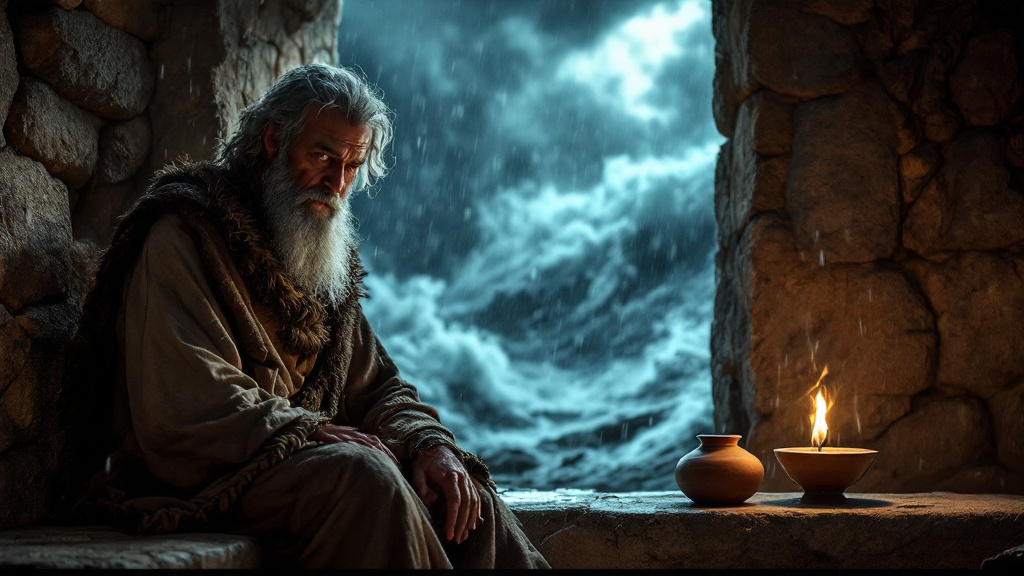
And this is what unwrapping Psalm 91 finally gives you. Picture a still room at the centre of a storm. Outside, the wind tears at everything and the rain drives sideways. And yet at the centre there is a room where not one candle flame moves. Nothing outside can reach it, because it is not made of the same stuff as the storm. That room is in you. It always has been. The power that dwells there has only been sleeping, and the moment you step inside, it wakes.
Keep reading: What Is the Jacob’s Ladder? The Stairway of Consciousness You Climb Every Night and What Is the Ark of the Covenant? The Hidden Temple Within You.
Frequently Asked Questions
What is the secret place of the Most High in Psalm 91?
Read inwardly, the secret place of the Most High is not a building or a church but a state of consciousness: the bare awareness that you are, the I AM. The psalm speaks of the one who “dwelleth” there, which points to a state you live in rather than a place you visit. In TrueCosmic’s reading, the Most High is your own awareness of being.
Is Psalm 91 a prayer of protection?
Many churches teach it that way. In the inner reading, the protection is real, but it comes from the state you dwell in rather than from reciting the words. Notice that in Matthew 4 the adversary quotes this psalm to demand outward proof, and the demand is refused.
Did Neville Goddard teach on Psalm 91?
Not directly, as far as we have found, so the reading in this article is TrueCosmic’s own. It rests on what Neville did teach: that our own awareness is God; that God reveals himself first as El Shaddai, the Almighty of verse 1, and then as I AM, the LORD of verse 2; and that the conflict in the temptation story, where the 91st Psalm is quoted, takes place in the mind of the individual.
Is it heresy to read the secret place as an inner state rather than a promise of physical safety?
Reading scripture for its hidden meaning is ancient; the apostle Paul himself, writing of Abraham’s two sons, said “Which things are an allegory” (Galatians 4:24). The literal reading is where most of us begin, but it gives way to the inner one. Realising that the shelter of the psalm lives within you is the very thing that sets transformation in motion.
How do I enter the secret place?
Shut the door on the senses, as Matthew 6:6 instructs, and rest in the simple awareness that you are. The most natural doorway is the drowsy state just before sleep, when the mind grows quiet. Enter one short scene of your wish fulfilled, feel it as done, and fall asleep inside it.
Conclusion: the secret place is within you
So what is the secret place of the most high? It is not a sanctuary you must travel to or a prayer you must recite correctly. It is the inner room of your own awareness, the I AM that the psalm calls refuge and fortress, and it is open to you every night as you drift towards sleep.
Whatever storm is raging around you now, the shelter you are looking for is not out there. It is already inside you, together with the same power that formed the stars, and that power waits on you and you alone. You are the operant power. It does nothing until you awaken it, but once you do, no storm, no circumstance and no fear can break into the room where you dwell. Fear not.

Michael Sutherland is the founder of Truecosmic, a global platform dedicated to Neville Goddard’s teachings and the Law of Assumption. Passionate about empowering individuals through conscious creation, Michael blends esoteric wisdom with practical insight to help people transform their lives from within.
Enter your email and get instant FREE access to your report.
No credit card required. 🔒 Your details are secure. You can unsubscribe at any time.





0 Comments