
No m
For the complete in-depth treatment of this subject, read The Law of Assumption — Complete Guide.
For the complete guide to Kundalini awakening signs, stages, and scripture, see: Kundalini Awakening — The Complete Guide.
For the complete step-by-step guide to the SATS technique, see: The SATS Technique — Neville Goddard’s Complete Guide.
To learn more about Neville Goddard’s life and complete body of work, read our definitive guide: Neville Goddard — The Complete Guide.
atter what you are facing right now — the relationship that feels broken, the money that is not there, the life that looks nothing like what you imagined — housed within you is the solution. The same power that created this entire universe exists in you, ready to be used. That is not a motivational line. That is the core of what Neville Goddard spent his life teaching.
The Law of Assumption is one of the most powerful and most misunderstood principles in the history of consciousness teaching. Neville Goddard, the Barbadian-American mystic who taught in New York and Los Angeles from the 1930s to the early 1970s, did not discover this law so much as spend a lifetime clarifying what it actually means and how it works.
I came to Neville’s teachings not out of curiosity but out of necessity. I was facing the biggest crisis of my life. What I found in his work did not just give me techniques — it gave me back a sense of God I thought I had lost, and a power I did not know I had. Everything that followed, including a full Kundalini awakening in 2018, confirmed what Neville had been saying all along.
This guide covers everything: what the Law of Assumption really is, how it differs from other manifestation philosophies, the specific techniques Neville taught, and the mistakes that keep people stuck. If you have read Neville’s books and still feel uncertain about how to practise what he taught, this is the article that will change that.
What Is the Law of Assumption?
The Law of Assumption states that whatever you assume to be true — consciously or unconsciously — will harden into the facts of your experience.
Neville Goddard stated it directly:
“An assumption, though false, if persisted in, will harden into fact.”
This is not a metaphor. Neville meant it literally. Your assumptions are not passive thoughts floating through your mind. They are the creative force behind everything that appears in your physical world. The moment you truly assume something — with the feeling of it already being real — you have set a cause in motion that must produce a matching effect in your outer experience.
What makes this different from positive thinking is that Neville was not talking about hoping for something or working toward something. He was talking about the inner state of already having it. Not wanting. Not striving. Already having. The assumption is the creative act itself.
“Assume the feeling of your wish fulfilled and observe the route that your attention follows.”
Most people who try manifestation are operating from a state of wanting — which is a state of lack. The Law of Assumption asks you to move out of that state entirely and into the state of already having. That shift is the whole practice.
Law of Assumption vs Law of Attraction — The Critical Difference
This is one of the most searched questions in the manifestation space, and for good reason — the two teachings sound similar but work on completely different principles.
The Law of Attraction, popularised by Abraham Hicks and The Secret, is built on the idea that you attract experiences that match your vibrational frequency. Like attracts like. Raise your vibration and abundance flows toward you. The model is magnetic.
The Law of Assumption works on a different premise entirely. There is no universe sending things back to you. There is no vibrational matching. There is only consciousness — your consciousness — and the world is its projection.
I practised the Law of Attraction for years before I found Neville. The shift was immediate. The Law of Assumption is not about becoming a better magnet. It is about realising you are the source.
Neville was explicit:
“The world is yourself pushed out. Ask yourself what you want and then give it to yourself. Do not question how it will come about — just go to the end.”
| Law of Attraction | Law of Assumption | |
| Mechanism | Vibrational matching | Consciousness projects reality |
| Focus | Raising your vibration | Changing your self-concept |
| Source | The universe sends to you | You are the source |
| Key concept | Like attracts like | Assumptions harden into fact |
| Originator | Abraham Hicks / New Thought | Neville Goddard |
Neville Goddard’s Core Teaching: Consciousness Is the Only Reality
To understand the Law of Assumption properly, you need to grasp Neville’s foundational claim — one that is more radical than most people realise.
Neville did not teach that your thoughts influence reality. He taught that consciousness is the only reality. The physical world — everything you can see, touch, hear and experience — is a projection of consciousness. It has no existence independent of the observer.
“Imagining creates reality. The world, and all within it, is man’s conditioned consciousness objectified.”
This is a precise metaphysical claim, not a spiritual metaphor. Consciousness comes first. The physical world comes second. This is why assuming something to be true is not wishful thinking — it is the actual mechanism of creation.
Your current circumstances are not obstacles to what you want. They are the projection of your past assumptions. Change the assumption and the circumstances must change — not because the universe is cooperating with you, but because the circumstances were always just a reflection of your inner state.

How the Law of Assumption Works
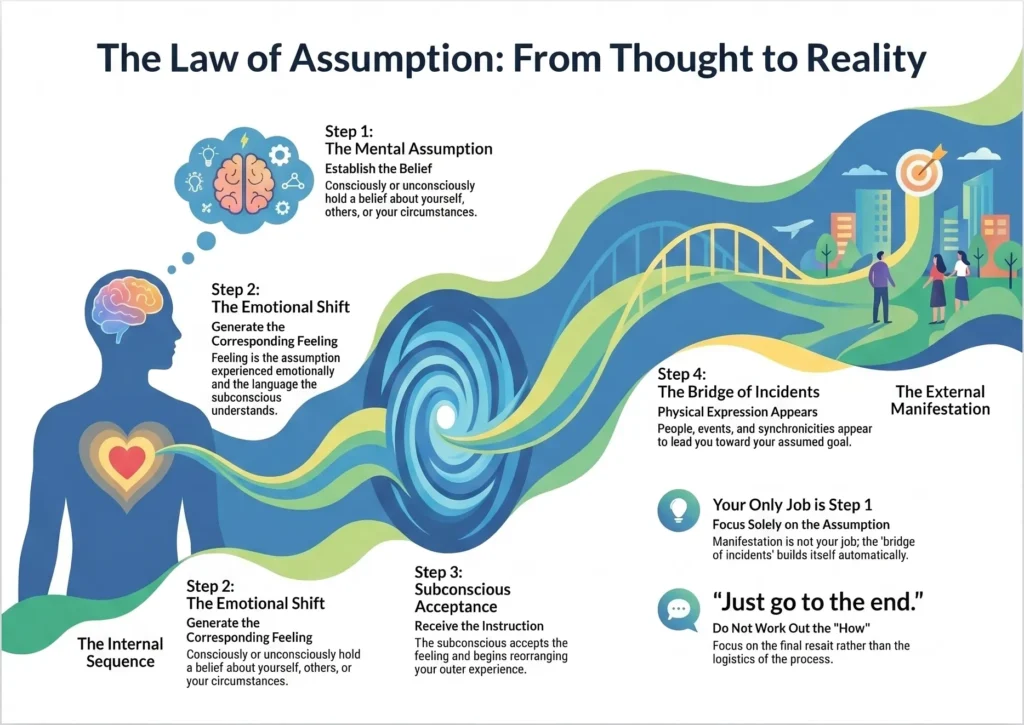
The Law of Assumption operates through a specific sequence:
- Step 1: You hold an assumption — consciously or unconsciously — about yourself, other people, or your circumstances.
- Step 2: That assumption generates a corresponding feeling. The feeling is the assumption experienced emotionally. Feeling is the language the subconscious mind understands.
- Step 3: The subconscious mind accepts the feeling as instruction and begins rearranging your outer experience to match the inner state it has been given.
- Step 4: Outer circumstances shift — through what Neville called the bridge of incidents. People, events, and synchronicities appear in your life that lead toward the physical expression of what you assumed.
The key insight is that step 4 — the physical manifestation — is not your job. Your only job is step 1: the assumption. The bridge of incidents builds itself.
“Do not try to work out the how. Just go to the end. The bridge of incidents will appear.”
The Four Core Techniques
1. State Akin to Sleep (SATS)
The State Akin to Sleep is the foundation of Neville’s entire system. It refers to the drowsy, hypnagogic state between waking and sleeping — the moment just before you drift off. In this state, the analytical mind relaxes and the subconscious becomes highly receptive to new impressions.
Neville taught a precise method:
- Relax completely in your bed at night
- Allow yourself to drift toward sleep without fully losing consciousness
- In this drowsy state, construct a single short scene that implies your wish is fulfilled
- The scene should be one you would experience after your desire has manifested — a handshake, a congratulation, a view from your new home
- Feel the reality of the scene — let it have texture, sound, and emotional weight
- Allow yourself to fall asleep from within that scene
I have written an entire book on this subject with some powerful methods for entering this state quickly and reliably. For the complete guide, visit the TrueCosmic SATS Masterclass.
2. The Revision Technique
Revision is one of Neville’s most transformative and most underused teachings. At the end of each day, instead of accepting events as final, you mentally revise any event that did not go the way you wanted. You replay it in your imagination exactly as you wish it had occurred. You feel the satisfaction of that revised outcome. You let it go.
“Revise the day. Revise every unpleasant experience. It is the wisest thing you can do.”
3. Living in the End
Living in the end means holding the inner state of already having your desire — not just during SATS but throughout your waking day. It is not about pretending in your outer behaviour. It is about maintaining the inner conviction that what you desire is already yours. Neville described this discipline extensively across his own recorded lectures (archived at the Internet Archive).
This is the mental diet Neville referred to constantly. Every time you catch yourself reacting to outer circumstances as though they are fixed and final, you bring yourself back to the end state. Not through force. Through a quiet, persistent return to the assumption.
Think of it the way Neville described a pianist. A beginner hits bum notes. That does not mean the piano is broken or the method does not work. It means the practice is still being built. The concert-level manifester is not someone who got lucky once. They are someone who kept returning to the end, every day, long after the excitement wore off.
4. Inner Conversations
Neville taught that the conversations you hold in your imagination are among the most powerful creative tools available to you. What are the conversations you have with people in your mind? Change your imaginal conversations and you change what those people say to you in the physical world — because the people in your world are also projections of your consciousness.
Practise holding inner conversations that reflect the reality you are assuming. Hear people congratulate you, support you, affirm what you desire to be true.
Law of Assumption Examples
Example 1: Manifesting a Specific Person
The work is not to focus on the other person but to change your own self-concept. Assume you are someone who is deeply loved and wanted. Assume the relationship already exists in the state you desire. The other person’s behaviour will shift to match your new assumption.
Example 2: Career and Financial Manifestation
Assume you are already the person who holds the position you desire. What does that person feel like from the inside? What do they assume about themselves? Inhabit that identity. The circumstances will rearrange to match.
Example 3: Health
Neville taught that the body responds to inner conviction. Assume the feeling of perfect health. Revise any memory of illness. Hold the inner state of vitality and wholeness. The body, as part of the outer world that consciousness projects, responds to the assumption.
The Most Common Mistakes
- Focusing on the how. The moment you start planning how your desire will arrive, you have stepped out of the end and into the problem. Trust the bridge of incidents.
- Checking for signs. If you assume something is true and then look for evidence, you are operating from doubt, not assumption. This is the single most common reason people abandon the practice — they decide not just what they want but exactly how it should arrive, and when reality unfolds through an unexpected route they conclude the method does not work. What they are actually doing is blocking the very intelligence that was already working on their behalf.
- Using the wrong scene. Your SATS scene should imply fulfilment, not desire. A scene of praying implies it has not arrived. A scene of gratitude after it has arrived implies it is done.
- Confusing assumption with affirmation. Repeating words while feeling the opposite is affirmation. Assuming the inner state — the ease, the security, the naturalness — is assumption.
- Giving up before the bridge appears. The bridge of incidents often involves events that look counterproductive. Neville taught students to remain loyal to the assumption even when outer circumstances appear to contradict it.
Law of Assumption and the Bible
One of the most distinctive aspects of Neville Goddard’s teaching is that he grounded the Law of Assumption entirely in scripture — not the literal, historical reading of the Bible, but what he called the psychological and mystical interpretation.
For Neville, every biblical character represents a state of consciousness. Every miracle is a demonstration of what happens when a human being assumes an inner state completely and persists in it.
“The Bible is the greatest book on psychology ever written.”
For a deeper exploration of how Neville read scripture, visit the TrueCosmic Neville Goddard Biblical Interpretation Guide.

Frequently Asked Questions
Q: What is the Law of Assumption in simple terms?
A: The Law of Assumption states that whatever you truly assume to be real — held in the feeling of it being already true — will manifest in your physical experience. Your assumptions are the cause. Your circumstances are the effect.
Q: Is the Law of Assumption the same as the Law of Attraction?
A: No. The Law of Attraction is based on vibrational matching — attracting experiences from outside yourself. The Law of Assumption is based on consciousness projecting reality. Your inner state is the cause of your outer world, not a magnet for it.
Q: Who created the Law of Assumption?
A: Neville Goddard, born in Barbados in 1905 and based in New York and Los Angeles for most of his career, is the primary teacher of the Law of Assumption. He taught it through lectures and books from the 1930s until his death in 1972.
Q: How long does it take for the Law of Assumption to work?
A: Neville taught that the time between an assumption and its physical manifestation depends on how completely and naturally you occupy the assumed state. There is no fixed timeline. Some assumptions manifest within hours. Others take weeks or months. The determining factor is the depth and naturalness of the assumption, not the passage of time.
Q: What is the best Neville Goddard technique for beginners?
A: SATS — the State Akin to Sleep technique — is the most powerful and most accessible entry point to Neville’s system. It bypasses the analytical resistance of the conscious mind and delivers the assumption directly to the subconscious in its most receptive state.
Q: Does the Law of Assumption work for manifesting a specific person?
A: Yes, according to Neville’s teaching. The specific person is not separate from your consciousness. Their behaviour is a reflection of your assumptions about yourself in relation to them. Change your self-concept and the other person’s behaviour changes accordingly.
Q: What is the difference between an assumption and an affirmation?
A: An affirmation is a repeated statement. An assumption is an inner state — a felt sense of something being true. Neville’s work is focused entirely on the inner state, not the words. You can repeat “I am wealthy” a thousand times and remain poor if the inner state of lack persists.
Q: Is the Law of Assumption religious?
A: Neville Goddard drew heavily on the Bible in his teaching, but he interpreted scripture as psychological and mystical text rather than literal history. His teachings are not tied to religious practice or belief. People of any faith or no faith apply the Law of Assumption.
Q: Where can I learn more about Neville Goddard’s teachings?
A: The TrueCosmic Library contains the complete collection of Neville Goddard’s lectures and books. Visit the TrueCosmic Neville Goddard Library to explore his complete works.
Conclusion
The Law of Assumption is not a technique. It is a description of how reality works. Your assumptions are the cause. Your circumstances are the effect. Change what you assume — truly, feelingly, persistently — and the outer world must rearrange itself to match.
Neville Goddard spent forty years teaching one thing: go to the end. Assume the feeling of your wish fulfilled. Persist in that assumption. Do not look for evidence. Do not plan the how. Do not give up because the bridge has not appeared yet. Simply occupy the state of already having — fully, naturally, completely.
Fear not. The power is already in you.
The TrueCosmic Academy offers structured programmes built on Neville’s complete body of work. Explore the TrueCosmic Academy.


Michael Sutherland is the founder of Truecosmic, a global platform dedicated to Neville Goddard’s teachings and the Law of Assumption. Passionate about empowering individuals through conscious creation, Michael blends esoteric wisdom with practical insight to help people transform their lives from within.















0 Comments