
The Gospel of Philip: What It Reveals About the Bridal Chamber, Mary Magdalene, and the True Meaning of Resurrection
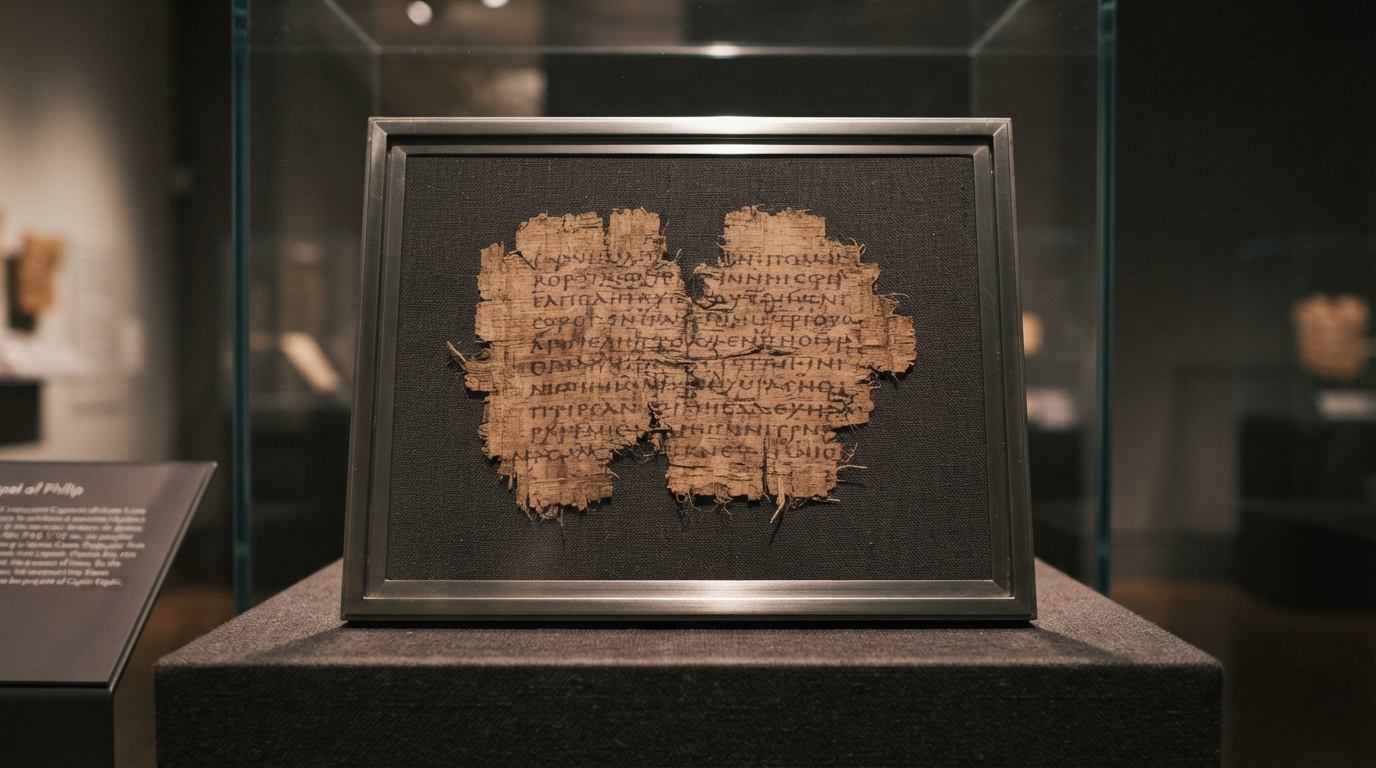
The Gospel of Philip is one of the strangest and most misunderstood texts to survive from the ancient world, and only a single Coptic manuscript of it is known to exist anywhere on earth. Everything scholars know about this gospel comes from that one fragile copy, pulled from a buried jar in the Egyptian desert and nearly lost to history forever.
That scarcity alone should tell you something. This is not a text that was copied a thousand times and studied in every monastery. It is a whisper that almost didn’t survive, and what it whispers is more radical than most churches would ever want printed in a pew Bible.
Key Takeaways
- The Gospel of Philip is a Gnostic text discovered in the Nag Hammadi library in 1945, not a biography of the apostle Philip.
- Most scholars date its composition to the 3rd century, though its ideas likely circulated earlier among Valentinian teachers.
- Its most famous passage calls Mary Magdalene the “companion” of Jesus, a word that has fueled decades of debate.
- The text describes a “bridal chamber” sacrament, the highest of five (sometimes counted as seven) sacred rites it names.
- It rejects a literal, physical resurrection, teaching instead that resurrection is something you must “receive while you are still in this flesh.”
- It was excluded from the biblical canon because its teachings on secret knowledge, sacred union, and the self as divine directly threatened the authority structure the early church was building.
- Read closely, the gospel’s sacraments describe an inner event of consciousness, not an outward ritual. For more on this collection of writings, see our full piece on the Gnostic Gospels.
What Is the Gospel of Philip?
The Gospel of Philip is not a narrative gospel like Matthew or Luke. It tells no story of a birth, a ministry, or a death.
Instead it is a collection of theological reflections, sayings, and sacramental teachings, roughly 127 short passages stitched together without a clear chronological order. Fifteen of these passages contain direct sayings attributed to Jesus, and seven of those echo lines found in the canonical gospels.
Two others closely resemble sayings from the Gospel of Thomas, another Nag Hammadi text built entirely from the words of Jesus with no narrative frame at all. The Gospel of Philip reads more like a private teaching manual for an inner circle than a public proclamation meant for crowds.
The apostle Philip himself is mentioned only once in the entire text, which is one more clue that the title was attached later, likely by a scribe or community that revered him rather than by Philip’s own hand.
The Gospel of Philip’s Place in the Nag Hammadi Library
In 1945, an Egyptian farmer digging near the town of Nag Hammadi struck a sealed clay jar. Inside were thirteen leather-bound codices containing over fifty ancient texts, hidden away sometime in the 4th century, likely to protect them from destruction as orthodoxy tightened its grip on Christian doctrine.
The Gospel of Philip was one of these texts, bound into what is now called Codex II alongside the Gospel of Thomas and the Apocryphon of John. This library is the single richest surviving source of Gnostic Christian writing, and without that accidental discovery, we would likely know almost nothing about the bridal chamber teaching or the companion passage at all.
We’ve written more broadly about this discovery and its contents in our piece on Nag Hammadi, which surveys the wider collection and explains why these texts were buried rather than burned.

Date and Authorship: Why Most Scholars Point to a Valentinian Origin
The Gospel of Philip did not fall from the sky fully formed. It grew out of the teaching schools of Valentinus, a 2nd-century Christian teacher whose followers built an entire theological system around inner knowledge, spiritual pairing, and the fall and return of a divine principle they called Sophia.
The vocabulary inside the Gospel of Philip matches Valentinian thought almost point for point. It speaks constantly in pairs: bridegroom and bride, light and darkness, image and truth, this world and the “eternal realm.”
That pairing language is not decorative. It is the entire argument of the text, and it is why most historians treat this gospel as a product of a Valentinian school, written and copied by teachers who saw themselves as heirs to a hidden strand of the Jesus tradition rather than founders of a new one.
The Bridal Chamber: The Gospel of Philip’s Most Debated Sacrament
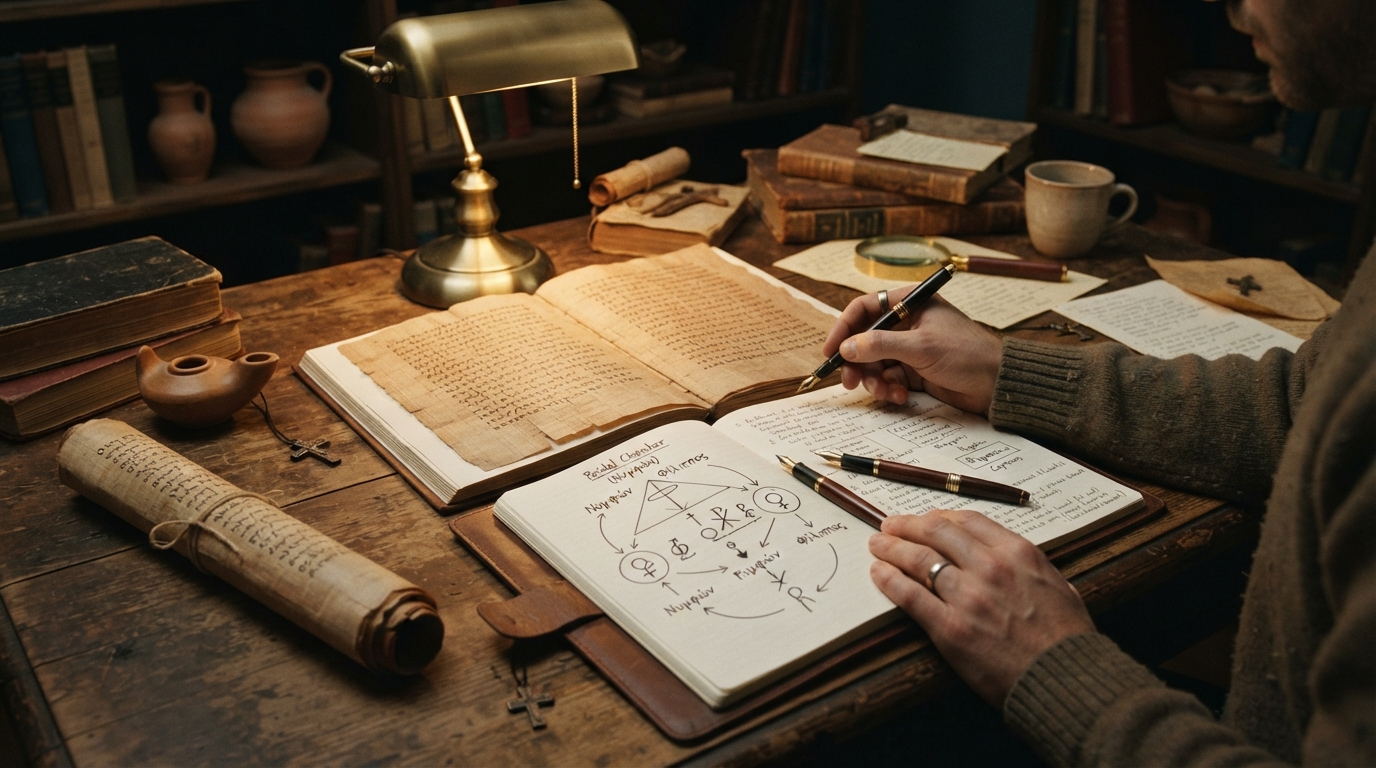
Nothing in this text has generated more speculation than its treatment of the “bridal chamber.” The gospel lists it as the highest of the sacraments it names, above baptism, above anointing, above the eucharist.
Popular retellings have often flattened this into a literal marriage rite or even a sexual ritual performed by Valentinian initiates. The text itself gives almost no ritual instructions at all, which is itself telling.
“Those who have united in the bridal chamber will no longer be separated.”
Read plainly, that line is not describing a wedding ceremony. It is describing a permanent state, a joining that cannot be undone once it happens, and the gospel never once tells us what physical actions, if any, accompanied it.
Mary Magdalene and the “Companion” Passage That Shook Tradition
The most quoted line in the entire Gospel of Philip concerns Mary Magdalene directly. The text calls her the “companion” of Jesus and says he loved her more than the other disciples, kissing her often, which reportedly upset the twelve.
The Coptic manuscript is damaged at exactly the point where the word “kissed” appears, leaving a gap that has been filled in by scholars with everything from “mouth” to “forehead” to “hand.” That single hole in a single decaying page is responsible for an enormous amount of modern speculation about a hidden marriage between the two.
We covered this figure in far more depth in our companion piece on the Gnostic Gospel of Mary Magdalene, which looks at how she is portrayed across several Nag Hammadi texts as a figure of superior spiritual understanding, not simply a romantic partner. In the Gospel of Philip specifically, her closeness to Jesus is used to illustrate the very bridal chamber teaching we just covered: she stands in the text as a living symbol of consciousness reunited with its source, not as evidence of a marriage certificate history forgot to record.
Resurrection Reconsidered: What the Gospel of Philip Actually Teaches
The Gospel of Philip’s teaching on resurrection is its most quietly radical claim, and it has nothing to do with an empty tomb or a future event at the end of time.
“Those who say they will die first and then rise are in error. If they do not first receive the resurrection while they live, when they die they will receive nothing.”
Read that again. The text states plainly that resurrection is something to be received now, in this body, in this life, or not at all.
This is not a text arguing about what happens after physical death. It is a text arguing about what happens inside your own awareness while you are still breathing, and it treats waiting for some later, external event as a fundamental misunderstanding of the entire teaching.
Why the Gospel of Philip Was Excluded From the Bible
The Gospel of Philip was never a serious candidate for inclusion in the canon that church councils assembled in the following centuries. Several reasons made that exclusion inevitable.
- It taught that saving knowledge (gnosis) comes through inner realization, not through obedience to church authority or sacramental gatekeeping.
- Its resurrection teaching directly contradicted the doctrine of a future bodily resurrection that had become central to orthodox belief.
- Its portrayal of Mary Magdalene as a companion of exceptional understanding undercut the male-only apostolic authority structure being formalized in Rome.
- Its Valentinian theology, with its pairs and its emphasis on Sophia, was explicitly condemned by influential bishops like Irenaeus as a heresy to be stamped out.
A text like this could not survive as scripture inside an institution built on the idea that truth flows downward from clergy to congregation. It survived instead in a jar in the desert, buried by people who valued it too much to burn it and too little power to defend it openly.
A Consciousness-Based Reading of the Gospel of Philip
Here is where we part ways with most academic treatments of this text. Scripture read as history is one thing; scripture read as a psychological map of consciousness is another entirely, and the Gospel of Philip only makes sense once you stop asking “what ritual is this describing” and start asking “what state of consciousness is this describing.”
The bridal chamber is not a room. It is the moment your awareness stops experiencing itself as separate from its own source and recognizes that separation was never real to begin with.
The gospel itself hands you the key with its repeated use of mirrors and images. It says that truth did not come into the world naked, but came in symbols and images, and that the world will not receive truth in any other way.
A mirror does not create a second person standing in front of you. It reflects the one person who is already there. The 3D world operates the same way: it is a reflection, not a final truth, and everything you meet in it, including every closed door and every unanswered text message, is old material replaying on a screen rather than a fixed fact about your future.
Read this way, the “image” the gospel keeps returning to is your outer circumstance, and the “truth” is the imagination producing it. Union in the bridal chamber is the instant you stop worshipping the image and turn your attention back to the one producing it, which the gospel elsewhere calls being reunited with your own likeness.
Resurrection, then, is not something that happens to your corpse someday. It is a shift in self-conception you undergo the moment you stop defining yourself by the crystallised past and start defining yourself by the state you have decided to occupy now.
The Bridge of Incidents: Neville Goddard’s Manifestation Framework and the Bridal Chamber
Neville Goddard, writing centuries after this gospel was buried, described a mechanism he called the bridge of incidents. It is the sequence of small, seemingly unrelated events that appear between the moment you assume a new state and the moment that state becomes visible fact.
The bridge of incidents Neville Goddard manifestation teaching describes is not a test of your patience. It is the natural unfolding of a decision you have already made internally, showing up piece by piece as the outer world catches up to the inner shift, and it rarely arrives all at once. It builds the same way a concert pianist builds a flawless performance, through repetition rather than a single lucky night, still hitting bum notes in rehearsal long after the piece is technically mastered, refining the same passage over and over until it finally plays without a flaw in front of an audience. The union described in the bridal chamber works the same way: it is not claimed once and finished, it is returned to and deepened through consistent practice.
The Gospel of Philip’s bridal chamber functions as an ancient description of the exact moment that bridge begins. The union it describes is the instant of assumption itself, the decision inside consciousness that precedes every outer incident that follows it.
Once you assume the state of being already united with your wish fulfilled, you are not waiting for permission from circumstance. You are simply walking the bridge of incidents Neville Goddard manifestation students are taught to expect, watching the small events arrange themselves toward the state you already occupy within.
Reading the Gospel of Philip as a Map, Not a History Book
We must strip away the dogmas of mainstream religion to see the esoteric wisdom beneath a text like this. The Gospel of Philip was never trying to tell you what happened in Galilee two thousand years ago.
It was trying to tell you what happens inside your own imagination the moment you stop identifying with the reflection and remember you are the one producing it. That is a claim no council of bishops could canonize, because it hands ultimate authority back to the individual rather than to the institution.
The gospel’s silence on ritual detail, its damaged manuscript, its single surviving copy, none of that is an accident of poor preservation. It is fitting for a text whose entire message is that the real bridal chamber cannot be photographed, described in a liturgy manual, or performed by a priest on your behalf.
Applying the Gospel of Philip’s Bridal Chamber Teaching Today
You do not need a Coptic manuscript or a Valentinian teacher to test any of this. You need only a state akin to sleep and a willingness to occupy the feeling of your wish fulfilled before evidence appears.
The bridal chamber the gospel describes is available to you the moment you stop treating your current circumstance as final truth. Your current job, your current relationship status, your current bank balance, all of it is the past crystallised into form, not a verdict on what is possible next.
Reject the intermittent efforts and the fast food manifestation myths that promise a new life by tomorrow morning; the Gospel of Philip’s own bridal chamber teaching argues the opposite, that the union deepens through consistent return, not a single dramatic gesture.
Conclusion
The Gospel of Philip is not a lost history book, and it was never meant to be one. It is a Valentinian teaching document, likely composed in the 3rd century and hidden away with the rest of the Nag Hammadi library until a farmer’s shovel brought it back into the light in 1945.
Its bridal chamber, its treatment of Mary Magdalene, and its insistence that resurrection must be received now rather than later all point toward the same conclusion: this text was written for people ready to stop worshipping the reflection and turn back toward the one producing it. Read the Gospel of Philip that way, as a description of an inner union rather than an outer ritual, and it stops being a historical curiosity and starts being exactly what it was written to be, a working instruction manual for the human imagination.
No matter what you are facing — housed within you lies the solution to every problem and the fulfilment of every desire. The same power that animates and created this entire universe exists in you, at your beck and call. Only you are the operant power. You have to activate it. And when you do, no problem, no circumstance, no situation can stand in its way. Fear not.
Frequently Asked Questions
What is the Gospel of Philip actually about?
The Gospel of Philip is a Valentinian Gnostic text made up of sayings and sacramental teachings rather than a narrative story. It centers on inner union, symbolic imagery like mirrors and images, and a sacrament called the bridal chamber, all pointing toward direct spiritual knowledge rather than obedience to church authority.
Why isn’t the Gospel of Philip in the Bible?
The Gospel of Philip was excluded from the canon because its teachings on inner knowledge, its unconventional portrayal of Mary Magdalene, and its rejection of a future bodily resurrection conflicted with the doctrines and authority structures early church councils were establishing. It was labeled heretical by orthodox bishops and never seriously considered for inclusion.
What does the Gospel of Philip say about Mary Magdalene?
The Gospel of Philip calls Mary Magdalene the “companion” of Jesus and states he loved her more than the other disciples, kissing her often to their visible displeasure. The exact word describing where he kissed her is lost to manuscript damage, which is why interpretations of this passage vary so widely.
What is the bridal chamber in the Gospel of Philip?
The bridal chamber is described as the highest sacrament in the Gospel of Philip, representing a permanent inner union rather than a documented wedding ritual. Read symbolically, it describes the moment consciousness recognizes it was never separate from its own source.
Does the Gospel of Philip really deny physical resurrection?
Yes, the Gospel of Philip explicitly states that anyone who does not receive resurrection while still alive will receive nothing when they die. This makes resurrection, in this text, an inner shift in self-conception available now rather than a future physical event.
Is the Gospel of Philip connected to the Gospel of Thomas?
Yes, scholars note that at least two sayings in the Gospel of Philip closely resemble sayings found in the Gospel of Thomas, and both texts were discovered together in the same Nag Hammadi codex in 1945. Both share the same emphasis on inner knowledge over historical narrative.
How reliable is the surviving text of the Gospel of Philip?
Only one Coptic manuscript of the Gospel of Philip is known to exist, and portions of it are damaged, including the famous line about Mary Magdalene. That scarcity means every translation involves some educated reconstruction of the missing words.

Michael Sutherland is the founder of TrueCosmic and a devoted student and practitioner of Neville Goddard teachings. His path to this work was not academic — it was forged in crisis.
Raised as a devout Jehovah Witness and Baptist, Michael walked away from the church at eighteen and spent the next 25 years in what scripture calls the far country — the prodigal son, wandering. He built a life by the world rules, searching without knowing what he was searching for.
When the biggest crisis of his life arrived, he turned back — not to the church, but to scripture itself. Through Neville Goddard teachings he found what the church had never shown him: that the God of scripture is not an external being to be feared and appeased. God is your own awareness. Your own consciousness. Your own imagination. The I AM within.









0 Comments