

Who were the Amalekites? On the page of scripture they are a desert people who attacked Israel on the road out of Egypt, and whose name became a byword for an enemy that must never be forgotten. But I learned what Amalek really means from a much closer battle: my own, in the early days of this practice, when my hands grew heavy and someone else had to hold them up.
That someone was a coach and mentor I worked with every week for more than a year. I will tell you about him shortly, because he played the part of Aaron and Hur in my life, and without that part the story makes no sense.
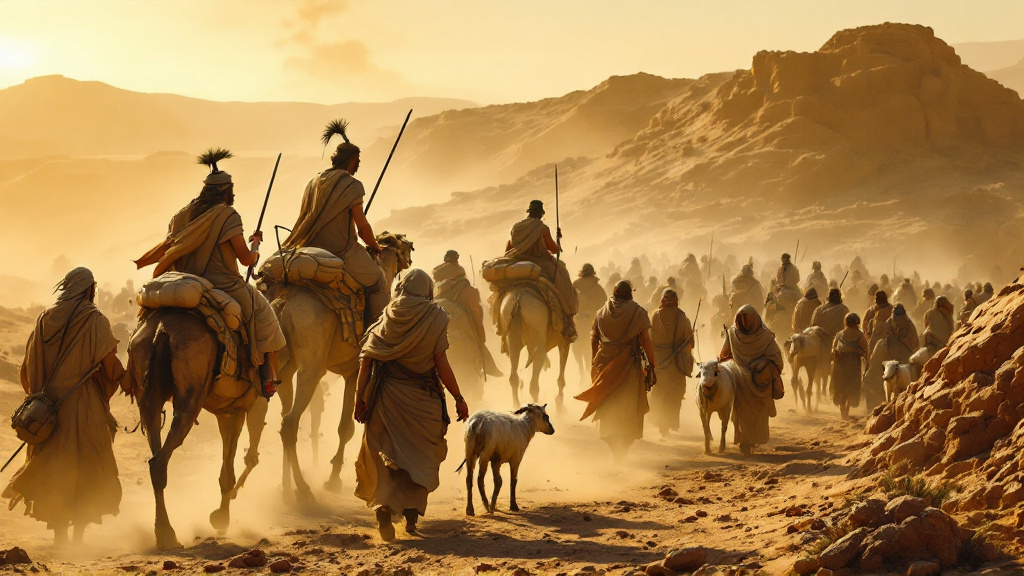
I do not read the battle with Amalek as a page from a military chronicle. I read it as a story that bears meaning, crafted by sages who knew that a truth told as a drama would be carried down the generations long after a plain instruction had been forgotten. Our task is to unwrap it. And what we find inside is not a war in the wilderness long ago, but a portrait of your own mind under pressure, and of a power within you that holds firm when it is properly supported.
I write for those who still hold the Bible as sacred but are tired of the way it was taught to them, or of the hypocrisy they have seen in religious institutions. This is not an attack on anyone’s faith. I honour those who read the Amalekites as a historical nation, yet that literal reading is the first rung and not the last: it gives way to the inner reading, as the elder serves the younger.
Who were the Amalekites in the Bible?
Scripture traces them to a single ancestor, Amalek, a grandson of Esau: “And Timna was concubine to Eliphaz Esau’s son; and she bare to Eliphaz Amalek” (Genesis 36:12, KJV). That detail matters more than it first appears. Esau, in the inner reading, stands for the outer world of the senses, as I explain in the inner meaning of Esau and Jacob. Amalek is his offspring.
When the spies are sent into Canaan, they report that “The Amalekites dwell in the land of the south” (Numbers 13:29, KJV). But the Amalekites are remembered above all for how they fought. Deuteronomy tells Israel never to forget it:
“Remember what Amalek did unto thee by the way, when ye were come forth out of Egypt; How he met thee by the way, and smote the hindmost of thee, even all that were feeble behind thee, when thou wast faint and weary; and he feared not God.” (Deuteronomy 25:17 to 18, KJV)
Amalek appears again in 1 Samuel 15, where Saul is commanded to destroy them and is rejected as king for sparing their king, Agag. For many readers that chapter is among the most troubling in the whole Bible, and it is one more reason why we refuse to read these stories as history, or as a mandate for anything ever done to real people. They describe a war inside us.
The battle at Rephidim: Exodus 17
The first encounter comes immediately after a miracle. In the same chapter, Moses strikes the rock in Horeb and water flows for a thirsty people (Exodus 17:6, KJV). Then, with no pause at all:
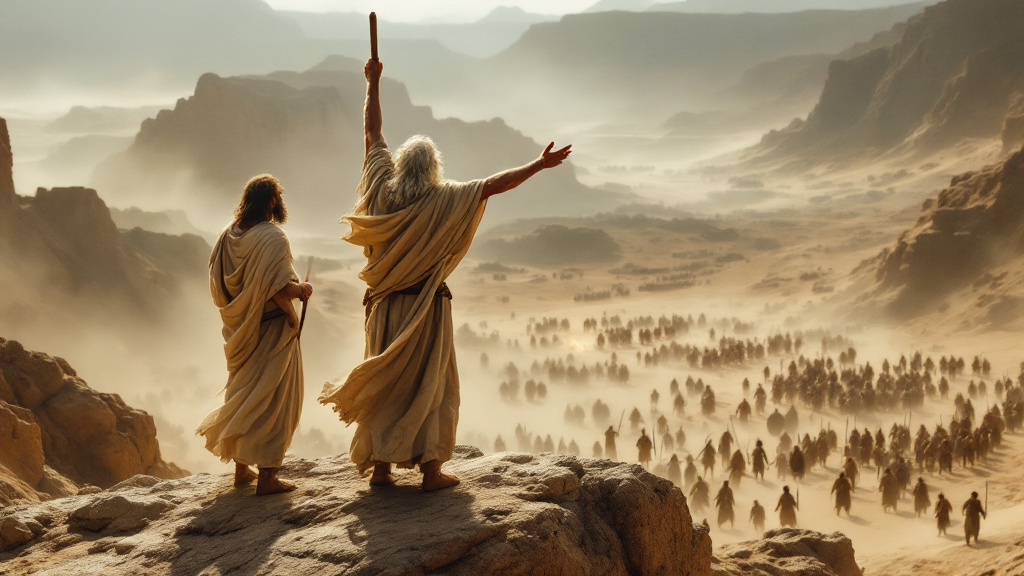
“Then came Amalek, and fought with Israel in Rephidim. And Moses said unto Joshua, Choose us out men, and go out, fight with Amalek: to morrow I will stand on the top of the hill with the rod of God in mine hand.” (Exodus 17:8 to 9, KJV)
Joshua fights in the valley, and “Moses, Aaron, and Hur went up to the top of the hill.” (Exodus 17:10, KJV). What follows is one of the strangest and most beautiful passages in the Old Testament:
“And it came to pass, when Moses held up his hand, that Israel prevailed: and when he let down his hand, Amalek prevailed. But Moses’ hands were heavy; and they took a stone, and put it under him, and he sat thereon; and Aaron and Hur stayed up his hands, the one on the one side, and the other on the other side; and his hands were steady until the going down of the sun. And Joshua discomfited Amalek and his people with the edge of the sword.” (Exodus 17:11 to 13, KJV)
Who were the Amalekites, read from within?
I want to be plain: Neville Goddard did not teach on Amalek in any lecture we hold, so the reading that follows is TrueCosmic’s own. It rests, though, on principles Neville taught constantly, and above all on the Law of Assumption: that the state you hold within is the state you will see without.
Amalek is doubt. Not the honest question that leads to understanding, but the corrosive voice of the senses, the grandson of Esau, insisting that what you see is all there is. Notice how he fights. He does not meet you at the front, where you are strong and resolved. He strikes “the hindmost”, “all that were feeble behind”, when you are “faint and weary”. Doubt waits for the evening, the tired moment, the day when the evidence has gone quiet.
He comes after the breakthrough. Amalek arrives straight after water has poured from the rock. Many of us know this pattern well. A first result appears, a door opens, and almost at once a wave of doubt rises to argue that it was coincidence, or that it cannot last.
The raised hands are the assumption held. Moses does not fight in the valley. He stands on the hill with the rod of God and lifts his hands. As long as they are raised, Israel prevails. When they drop, Amalek prevails. The outcome below depends entirely on what is held above. That is the whole teaching of assumption in one image.
Joshua does the fighting. Moses never tells Joshua how to win the battle. He holds the end and lets the action in the valley take care of itself. Here is the biggest mistake on this path, avoided: micromanaging how the result arrives. Your part is to keep your hands raised. The means will find their own way.
The stone and the sitting. When Moses tires, he is given a stone to sit on. The assumption is not held by strain. It is held from a place of rest.
Until the going down of the sun. The hands are steadied until sunset. In the inner reading, this points to the close of the day, the moment before sleep, when the assumption you hold is carried down into the deep.
Aaron and Hur: the coach who held up my hands
And then there are Aaron and Hur, standing one on each side. This is the part of the story I understand best, because I lived it.
In my early days I had a mentor, a coach, with weekly sessions for over a year. Neville once alluded to this very thing: it is far easier to teach than to apply the principles to yourself, to take your own medicine, especially when the situation carries a huge emotional tariff. Quoting Shakespeare, he put it this way:
“far “easier to teach twenty what were good to be done, than to be one of the twenty to follow mine own teaching.”” (Neville, in his lecture “Order Your Conversations Aright”)
That is where my coach came in. He was not attached to the situation, so he could stay completely objective in his advice. When I faltered, he would remind me that I was giving importance to the 3D. “That’s not what we are practising here, Michael.” No doubt, had the situation been personal to him, it would have proved a great deal more difficult.
Neville told of a man who had exactly this problem. The man called him from Chicago and admitted that “he was too close to the picture. He couldn’t use his imagination because he was too close to it” (Neville, in his lecture “He’s Dreaming Now”). When the situation is your own, your arms grow heavy far sooner. The one who stands beside you, with nothing at stake, can hold them steady.
Scripture honours this kind of support again and again: “Two are better than one; because they have a good reward for their labour. For if they fall, the one will lift up his fellow” (Ecclesiastes 4:9 to 10, KJV). And Paul: “Bear ye one another’s burdens, and so fulfil the law of Christ.” (Galatians 6:2, KJV)
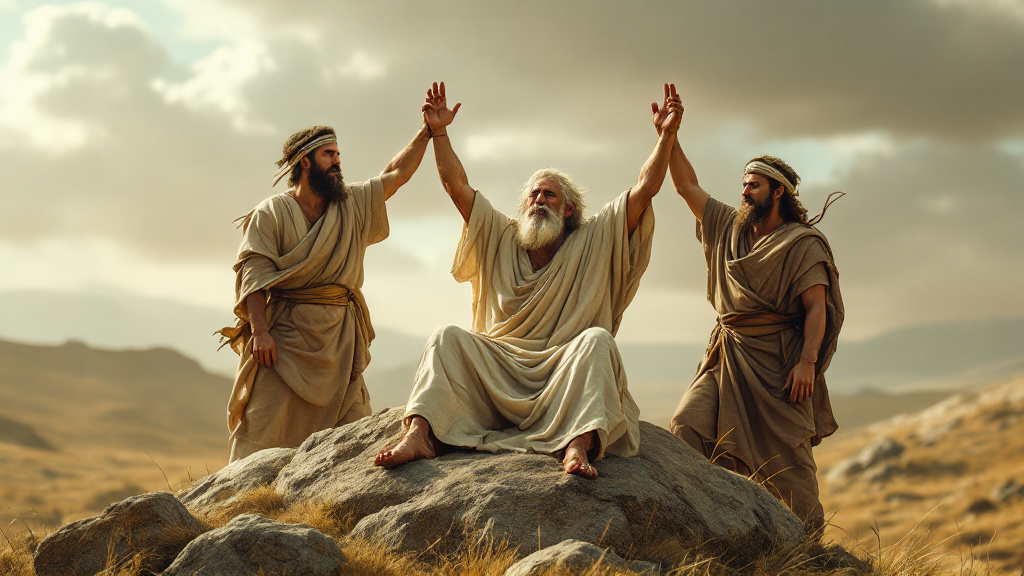
Needing Aaron and Hur is not a weakness. Moses himself needed them. Even the one who holds the rod of God has hands that grow heavy, and the story makes no secret of it.
How to apply the story of Amalek
- Recognise Amalek when he comes. Expect doubt to strike at the back of the line: when you are tired, late in the day, or just after a first result. Name it for what it is, the voice of the senses, not the voice of truth.
- Keep your hands raised. Decide the end you are holding and return to it whenever you notice it slipping. The battle below follows what is held above.
- Find your Aaron and Hur. Choose someone who understands the practice and is not emotionally entangled in your situation, a coach, a mentor or a trusted fellow student, who will remind you what you are practising when you falter.
- Sit on the stone. Hold the assumption from rest, not strain. If you find yourself gripping, sit down inwardly and let the end be done.
- Hold until the sun goes down. Each night, in the drowsy state just before sleep, enter one short scene that implies your wish fulfilled, and feel it as done. Let your raised hands be steadied into sleep.
This is a practice, not a trick. Think of a mountaineer roped to a team. No climber reaches a high summit in a single bound. The ascent is made step by deliberate step, camp by camp, over days, and the rope matters as much as the boots: when one climber slips, the others take the weight until footing is found again. Those who reach the top are not the ones who never stumble; they are the ones who keep climbing, and who never climb alone. The Law asks the same steady devotion of you.

Hands held up until the sun goes down
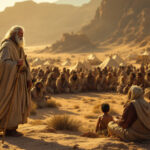
Picture the scene on that hill at Rephidim as the light begins to fade. Moses is seated on a stone, his arms aching. Aaron stands on one side and Hur on the other, holding his hands aloft. Below them the battle turns. Nothing in the valley is being fought by the three on the hill, and yet everything in the valley depends on them.
That is what unwrapping this story reveals. The power that decides the battle is not in the valley at all. It is in the hands held up, in the assumption you keep raised while doubt does its worst at the back of the line. That power has been dormant in you, waiting for you to lift it and keep it lifted. Find the people who will help you hold it, sit on the stone, and keep your hands raised until the sun goes down.
Frequently Asked Questions
Who were the Amalekites?
In scripture the Amalekites were the descendants of Amalek, a grandson of Esau (Genesis 36:12), who dwelt “in the land of the south” (Numbers 13:29). They attacked Israel at Rephidim soon after the Exodus. In TrueCosmic’s inner reading, Amalek represents the doubt born of the senses that attacks you when you are weary.
Why did Israel win when Moses held up his hands?
Exodus 17:11 says that when Moses held up his hand Israel prevailed, and when he let it down Amalek prevailed. Read inwardly, the raised hands are the assumption held in consciousness. The battle in the valley follows what is held on the hill.
What did Amalek do according to Deuteronomy 25?
Deuteronomy 25:18 says Amalek “smote the hindmost” of Israel, “even all that were feeble behind thee, when thou wast faint and weary”. He attacked the stragglers rather than the front line. That is why we read him as the doubt that strikes in your most tired moments.
Is reading the war with Amalek as an inner struggle a departure from true faith?
Reading scripture for its inner meaning is ancient; Paul himself wrote that “the letter killeth, but the spirit giveth life” (2 Corinthians 3:6). The literal account is where we begin, but it gives way to the inner reading. Realising that Amalek, Moses and the battle all live within you is what turns the story into transformation.
Who were Aaron and Hur?
Aaron was the brother of Moses, and Hur was a leader who went up the hill with them at Rephidim; he appears alongside Aaron again in Exodus 24. Together they held up Moses’ hands until sunset. In the inner reading they stand for the support that steadies your assumption when your own strength fails.
Conclusion: who were the Amalekites, and who holds up your hands?
Who were the Amalekites? On the surface, a desert people who struck Israel from behind. Within, they are the doubt that waits for your weariest hour, and the story shows exactly how they are overcome: by hands held up, supported by those who stand beside you, until the sun goes down.
Whatever battle you are fighting today, victory is not waiting somewhere in the valley. It already lives within you, one with the power that brought the whole universe into being, and it answers to you alone. You are the operant power; nothing moves until you lift your hands. But lift them, and keep them lifted, and no Amalek, no weariness and no circumstance can prevail against you. Fear not.

Michael Sutherland is the founder of Truecosmic, a global platform dedicated to Neville Goddard’s teachings and the Law of Assumption. Passionate about empowering individuals through conscious creation, Michael blends esoteric wisdom with practical insight to help people transform their lives from within.
Enter your email and get instant FREE access to your report.
No credit card required. 🔒 Your details are secure. You can unsubscribe at any time.









0 Comments