

Some links on this page are Amazon affiliate links; if you buy through them TrueCosmic may earn a small commission at no extra cost to you.
If I were choosing where to begin among the best meditation books, I would start with Wherever You Go, There You Are for everyday mindfulness, Real Happiness for an organised introduction to meditation, or 10% Happier for a candid, non-mystical personal account. The best choice is the one that makes a daily sit feel clear enough to begin and practical enough to continue.

What Should You Know Before Choosing a Meditation Book?
- Want gentle guidance? Choose a reflective introduction that connects awareness with ordinary life.
- Need clear instructions? Look for a practical guide that explains what to do with attention and distraction.
- Drawn to a tradition? Zen, Vipassana, loving-kindness and mantra meditation each have distinct practices.
- Want a personal story or research context? A memoir or science-focused book can inform your reading without serving as a complete manual.
- Use this test: Does the book help you build a daily sit you can keep?
There is no universal best book for every reader. The best meditation books are the ones that meet your interest and give you a workable way to practise, rather than simply making you want to collect more titles.
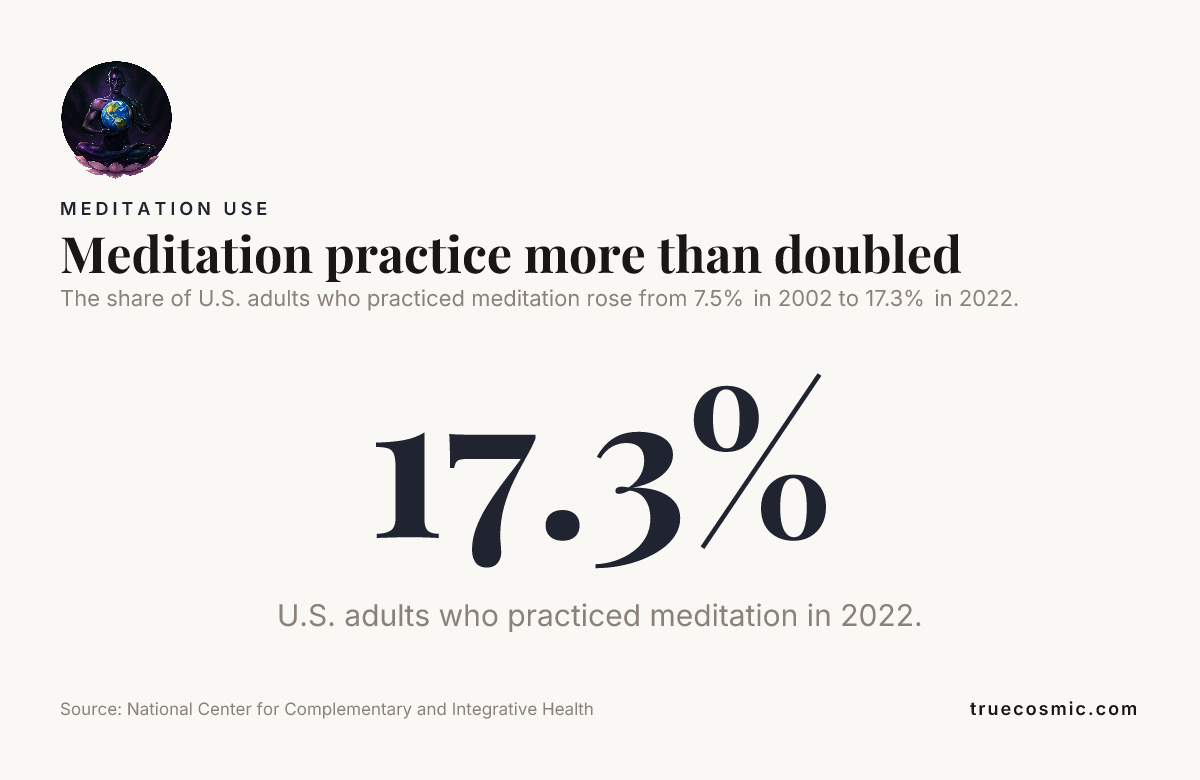
The share of U.S. adults who practised meditation rose from 7.5% in 2002 to 17.3% in 2022.
Source: National Center for Complementary and Integrative Health
What Are the Best Meditation Books for Beginners?
For meditation books for beginners, start by deciding what kind of support you want: a reflective guide to everyday awareness, a structured introduction to meditation, or a personal story that makes the practice feel approachable. These are different doorways, and none is the single right entrance for everyone.
Wherever You Go, There You Are by Jon Kabat-Zinn

Who it suits and the core idea: Choose this gentle, secular introduction if you want to recognise mindfulness in ordinary moments as well as during formal sitting. Its reflective approach invites you to bring attention to what is happening now, whether you are sitting quietly or moving through the day.
One limitation: It is reflective and modular rather than a step-by-step course, so readers who want a fixed schedule may need more explicit instructions. Try: Give one ordinary activity your full attention for a minute, noticing the sensations and movements involved without rushing ahead to the next task.
Real Happiness by Sharon Salzberg

Who it suits and the core idea: This is a useful choice for beginners who want an organised introduction that includes loving-kindness, also called metta. Metta deliberately cultivates goodwill; it is not simply another way of holding attention on the breath.
One limitation: Readers who want to stay with a single technique throughout may find the variety less direct than a one-method guide. Try: Sit quietly and bring to mind someone you care about, then consciously extend goodwill to that person without needing to create a particular feeling.
10% Happier by Dan Harris

Who it suits and the core idea: Pick this memoir and introduction if you are sceptical of mystical language and prefer a candid personal account with a practical framing. It can lower the barrier for a doubtful reader by presenting meditation as something to explore rather than an identity to adopt.
One limitation: It is a memoir and introduction, not a comprehensive meditation manual. Try: Pair a short breath-focused sit with your reading, gently returning attention to the breath whenever you notice it has wandered.
A reflective guide can help you recognise everyday mindfulness; a structured introduction can support a routine; and a personal account can make it easier to start when you are doubtful.
Which Books Give the Clearest Meditation Instructions?
Choose hands-on meditation books if you want clear guidance on sitting, attending to the breath and responding when the mind wanders. Practical instructions are something to test through regular practice, not a promise of immediate calm or a substitute for sitting down.
Mindfulness in Plain English by Bhante Gunaratana

Who it suits and the core idea: This direct guide suits readers looking for Vipassana instruction. In insight practice, you observe how sensations, thoughts and feelings change; attention to the breath can help steady concentration as you learn to notice experience.
One limitation: Its disciplined presentation can feel demanding if you want a light, conversational introduction. Try: Sit with a stable posture and follow the natural breath. When you notice a thought or sensation drawing your attention away, acknowledge that you noticed it and return to the breath.
The Miracle of Mindfulness by Thich Nhat Hanh

Who it suits and the core idea: Choose this concise, poetic guide if you want to connect meditation with daily activities. Mindful walking, eating and other ordinary actions extend attention beyond the cushion, while remaining related to, rather than interchangeable with, seated practice.
One limitation: Its reflective style may leave readers wanting more detailed instruction for a complete seated routine. Try: Walk at an unhurried pace and feel each foot meet the ground, returning attention to the steps when your thoughts move elsewhere.
The terms matter. Breath-focused attention uses the breath as an anchor; mindfulness notices present experience with openness; and insight practice investigates how experience changes.
For formal practice, let posture support alert ease. Sit on a chair or cushion with a stable base and an upright, unforced spine. If a set of instructions feels confusing, return to a simpler anchor rather than treating distraction as failure.
Which Books Introduce Zen and Mantra Meditation?
Tradition-specific books are most useful when you understand what the practice asks of you. Zen emphasises sitting and awareness in the present; mantra meditation gives attention a repeated verbal anchor, so begin with one approach rather than combining unfamiliar methods at once.
Zen Mind, Beginner’s Mind by Shunryu Suzuki

Who it suits and the core idea: This collection of teachings suits readers curious about Zen and its attitude of openness. Its reflections on posture and beginner’s mind point towards meeting practice without assuming you have already understood it.
One limitation: It is a collection of teachings rather than a beginner’s workbook, and its reflections do not provide a complete practice schedule. Try: Sit upright for a brief period, notice the sensations of sitting, and return to that present experience when you catch your attention drifting.
Passage Meditation (first published as Meditation) by Eknath Easwaran

Who it suits and the core idea: Choose this devotional, mantra-centred discipline if you want a sustained practice based on silently repeating a chosen passage or sacred text. This gives attention a verbal anchor, distinct from breath-counting or open monitoring.
One limitation: Its sustained devotional discipline may not suit someone seeking a quick, secular technique. Try: Select a passage that you want to return to, then silently repeat it during a quiet sitting without rushing through the words.
A teacher or guided practice can help when a tradition’s instructions, posture or expectations are unclear. Our page on mantra meditation offers another way into that practice.

Which Books Help You Deepen a Meditation Practice?
If you already have a regular sit, a detailed training framework or a research-oriented account can meet a different need. One gives you more structure for practice; the other helps you think carefully about what research on meditation can and cannot say.
The Mind Illuminated by Culadasa

Who it suits and the core idea: Choose this detailed, staged approach if you want systematic training in concentration and breath meditation. It gives a demanding framework for developing attention and working with distractions, which suits a motivated reader who wants to examine the process closely.
One limitation: Its density and level of detail can overwhelm someone who has not established a basic sit. Try: Work with one instruction during a single sitting instead of trying to master the entire framework at once.
Altered Traits by Daniel Goleman and Richard Davidson

Who it suits and the core idea: This science-focused book suits readers who want context on research into lasting changes associated with meditation. It is an exploration of research and its limits, not a how-to manual that teaches a meditation routine.
One limitation: Reading about studies does not itself train attention, and research findings should not be taken as a promise of a particular result for an individual. Try: After a reading session, sit with a simple breath anchor and notice the difference between learning about a practice and doing it.
A sensible reading path is to learn a simple anchor and return to it regularly, then explore a systematic training method if you want more structure. For a measured overview of meditation and mindfulness, see the NCCIH summary.
Is There a Meditation Book for Sleep and Imaginal Practice?
Mindfulness, Zen, mantra and insight practices have their own instructions and aims. Neville Goddard’s imaginal approach is a distinct spiritual route for readers drawn to the drowsy transition into sleep, not another form of breath attention or Vipassana.
Feeling Is the Secret by Neville Goddard
Who it suits and the core idea: This short spiritual text suits readers interested in the imaginal side of practice. Its teaching concerns the Law of Assumption, sleep, prayer and feeling: in the relaxed state before sleep, you assume the feeling of the wish already fulfilled and let it carry you into sleep.
One limitation: Readers seeking detailed posture guidance or progressive attention training should pair it with a practical meditation guide. Try: Before sleep, settle into a drowsy, relaxed state and hold one short scene that implies the thing is already done, then let yourself fall asleep in that feeling.
TrueCosmic offers Feeling Is the Secret as a free PDF. For more on this route, read our guide to Neville Goddard meditation and explore manifestation meditation step by step. Readers interested in the drowsy transition into sleep can also follow the step-by-step SATS guide.

How Do You Turn the Best Meditation Books Into a Daily Practice?
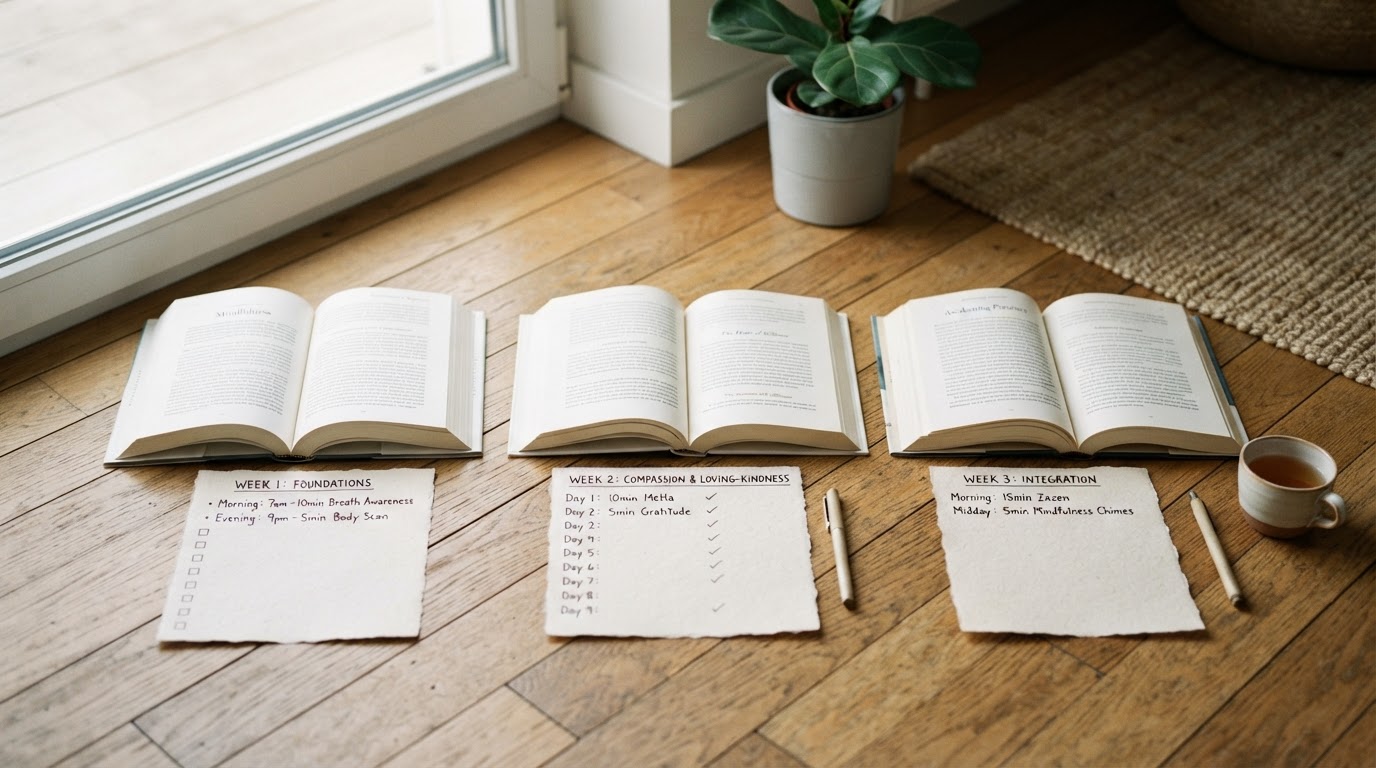
Use one test: does this book help you build a daily sit you can keep? Pick one method and give it a fair, steady trial before switching to another technique or book.
At TrueCosmic, the Law is a practice, not a trick. Depth beats quantity: ten honest minutes every day beats an occasional hour. A potter’s wheel turns every day before a single bowl holds water; repetition develops the steadiness that an occasional burst of effort cannot supply.
Keep the routine simple:
- Choose a regular time and a posture that feels stable and alert.
- Read a small portion of the book, then put it aside for your sit.
- Sit for a manageable period and follow the method you chose.
- When attention wanders, return to your anchor without treating distraction as failure.
- Afterwards, note what made returning to practice easier or harder.
Do not mistake reading for practice. A good explanation can point the way, but the sitting itself is where you learn what it means to follow an instruction. If practice raises difficult concerns that you cannot manage alone, seek qualified support.
I know this from experience. During a crisis in my life, I had started drinking to numb anxious thoughts. When someone suggested meditation, I never looked back. My mentor Riuppa Jetto, a hypnotherapist and Buddhist practitioner, guided my early practice, and what he gave me was not a book but a habit of sitting down every day.
That is the test I would use for the best meditation books: not which title sounds most profound, but which one helps you sit with attention and return tomorrow. And when you do sit, remember what you are sitting with. Whatever you are facing, its answer is not on the next page; it is already in the stillness you are learning to enter. The same power that shaped everything you can see is present in that stillness, and it is yours. No teacher can enter it on your behalf. Once you do, nothing outside you gets the final word. So do not be afraid.
Frequently Asked Questions
Can I listen to a meditation book instead of reading it?
Yes, listening can suit memoirs and reflective teaching, especially when you can pause to consider an idea. For instruction, a format you can revisit easily helps you keep track of the details of a particular technique.
Do I need to finish a meditation book before I start practising?
No. You can begin when you understand an instruction well enough to follow it without guessing. Finishing the book is a reading milestone, not proof that you are ready to practise.
What should I do if sitting meditation makes me feel more anxious?
Do not force yourself to continue with your eyes closed; pause, look around and name a few things you can see or hear. If the experience remains difficult to manage, speak with a qualified professional about what support would suit you.
How can I tell when I am ready to move from a beginner book to an advanced one?
You may be ready when your questions shift from basic instructions to finer details about a method or tradition. Choose a more demanding book because you want to study that approach, not because you feel obliged to move on.

Michael Sutherland is the founder of Truecosmic, a global platform dedicated to Neville Goddard’s teachings and the Law of Assumption. Passionate about empowering individuals through conscious creation, Michael blends esoteric wisdom with practical insight to help people transform their lives from within.
Enter your email and get instant FREE access to your report.
No credit card required. 🔒 Your details are secure. You can unsubscribe at any time.









0 Comments