When you search for a kabbalah def, you are not looking for a dictionary entry. You are looking for the key to a hidden layer of scripture that the religious establishment has buried under centuries of dogma. The global market for religious and spiritual products reached USD 16.3 billion in 2025, and the reason is clear: people are starving for esoteric wisdom, not surface-level religion. They want the truth that Kabbalah has always pointed toward.
What kabbalah meaning truly conveys is this: scripture is not a historical record. It is a psychological map of consciousness. Every verse, every name, every number is a coded instruction for collapsing the wave of possibility into physical experience. We must strip away the dogmas of mainstream religion to see the esoteric wisdom beneath.

Key Takeaways
| Question | Answer |
|---|---|
| What is the meaning of Kabbalah? | Kabbalah means “receiving” or “that which is received.” It is the esoteric tradition of interpreting scripture as a symbolic, psychological map of consciousness rather than a literal historical text. |
| When was Kabbalah written? | The foundational texts emerged between the 2nd and 13th centuries. The Zohar, the central Kabbalah book, appeared in 13th-century Spain. |
| Who wrote the Kabbalah? | The Zohar is traditionally attributed mystically to Shimon bar Yochai (2nd century) but was compiled and published by Moses de León in the 13th century. |
| Is Kabbalah satanic or occultism? | No. Kabbalah is a legitimate mystical tradition within Judaism. The fear-based labels come from institutional religion that rejects esoteric interpretation of scripture. |
| Is Kabbalah the same as Judaism? | No. Kabbalah is the mystical dimension within Judaism, but its principles transcend any single religion. It describes universal laws of consciousness. |
| How does Kabbalah relate to manifestation? | Kabbalah teaches that letters, names, and imagination shape reality. This is the same principle found in the Law of Assumption teachings we explore throughout TrueCosmic. |
What Is Kabbalah? The Definition and True Meaning
To give you a proper kabbalah def, we must start with the word itself. Kabbalah comes from the Hebrew root Qof-Bet-Lamed, which means “to receive” or “to accept.” It is received wisdom, transmitted from teacher to student, from inner state to outer expression.
But this receiving is not passive. It is the active reception of a truth that has always existed: the 3D world is a reflection, not a final truth. The material reality you see around you, the circumstances that press against your senses, all of this is old film playing on the screen. It is the past crystallised into form.
What kabbalah meaning reveals is that scripture, every verse of it, operates on multiple layers simultaneously. There is the literal layer, the surface story that mainstream religion clings to. Then there is the hidden layer, the symbolic and psychological meaning beneath the text. This is where the real teaching lives.
The rabbis identified four levels of scriptural interpretation, called PaRDeS:
- Peshat , the literal, surface meaning
- Remez , the hinted or allegorical meaning
- Derash , the homiletical or comparative meaning
- Sod , the secret, esoteric meaning
Kabbalah operates primarily in the realm of Sod, the secret. It reads the Torah not as a history of ancient people but as a precise psychological map of consciousness. The characters are not external figures. They are states of mind. The journeys are not geographic. They are movements within your own awareness.
This is what we teach at TrueCosmic Academy. The teaching at the heart of our work is not new. It is the oldest truth in human history, found in the Kabbalah, the Hermetic traditions, the Gospel of Thomas, and the esoteric core of every major wisdom tradition that has ever existed.
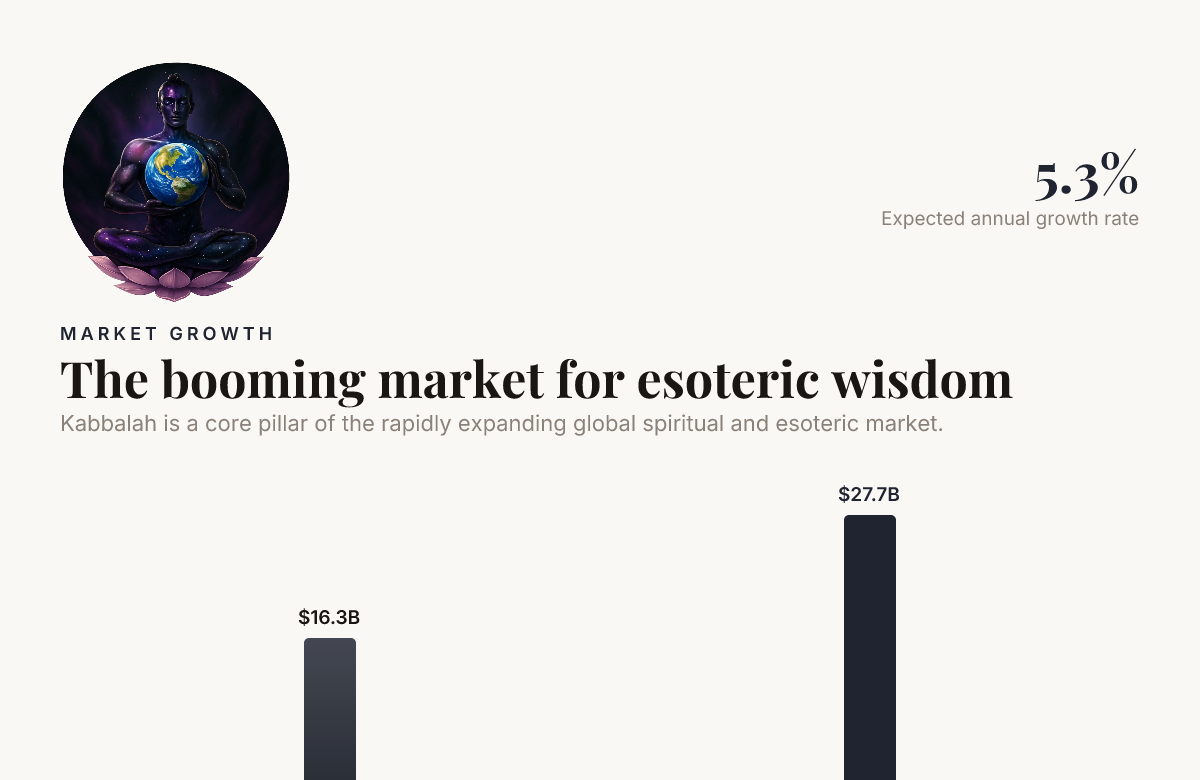
Kabbalah is a core pillar of the rapidly expanding global spiritual and esoteric market.

Kabbalah History: The Origins of the Hidden Tradition
When you ask about kabbalah history, you are asking about a tradition that refuses to be pinned to a single date or a single author. Kabbalah’s roots stretch back to antiquity, but it crystallised into a formal system over centuries.
The earliest Kabbalistic ideas appear in the Sefer Yetzirah, or “Book of Formation,” which may date as early as the 2nd century. This short but dense text describes how God created the world through twenty-two Hebrew letters and ten sefirot, or emanations. It treats language not as a tool for communication but as the very architecture of reality.
This is not metaphor. The Sefer Yetzirah states that letters are the building blocks of creation, that combinations of letters produce specific effects in the material world. This principle, that language and imagination shape reality, is the same principle we see in the lineage of teachers who influenced Neville Goddard, where Hebrew letters and Kabbalistic principles form the backbone of manifestation teaching.
Kabbalah flourished in the 12th and 13th centuries in Provence and Spain. Thinkers like Isaac the Blind, the Girona circle, and then Moses de León brought the tradition from oral, whispered teachings into written texts. The esoteric wisdom that had been guarded for generations became accessible, at least to those who could read the symbolic language.

By the 16th century, Kabbalah had moved to Safed in Galilee, where Isaac Luria, known as the Ari, developed an entirely new system. Lurianic Kabbalah introduced the concepts of tzimtzum, or divine contraction, and the breaking of the vessels. It described creation as a process of limitation, withdrawal, and repair, a framework that mirrors what we understand as the movement from infinite possibility to specific, crystallised experience.
The Kabbalah Book Zohar: When Was Kabbalah Written?
The central question for anyone studying this tradition is simple: when was kabbalah written? The answer centers on one book above all others: the Zohar.
The kabbalah book zohar, which means “Splendor” or “Radiance,” is the foundational text of Kabbalistic thought. It is not a single book but a sprawling commentary on the Torah, written in Aramaic, filled with mystical interpretations of every verse, every letter, every grammatical oddity in the Hebrew Bible.
The Zohar appeared in Spain in the late 13th century, specifically around 1270 to 1300. Moses de León, a Jewish mystic and writer in Castile, began circulating portions of the text, claiming he was copying from an ancient manuscript written by the 2nd-century sage Shimon bar Yochai.
Here is where the kabbalah zohar story gets complicated, and we will not skirt this. Modern scholarship, based on linguistic analysis and historical evidence, points to Moses de León as the primary author. The Aramaic contains medieval Spanish loanwords and grammatical forms that did not exist in the 2nd century. De León himself reportedly confessed on his deathbed that he wrote portions of it himself.
But here is the deeper point. Whether the Zohar was written in the 2nd century or the 13th century does not diminish its power. The text itself declares that its meaning is not in its historical origin but in its symbolic content. The Zohar is a psychological map of consciousness, and its truth is verified not by carbon dating but by the inner experience of the reader who applies its principles.

Answering what is Kabbalah fully means also answering who actually wrote it down, since the authorship question shapes how seriously the tradition gets taken.
\n\n
Who Wrote the Kabbalah? The Authorship Mystery
The question of who wrote kabbalah has multiple answers, because Kabbalah is not a single book by a single author. It is a living tradition that accumulated texts over a thousand years.
Here are the primary figures:
- Shimon bar Yochai , a 2nd-century rabbi and mystic, traditionally credited as the author of the Zohar. According to tradition, he hid in a cave for thirteen years during the Roman persecution and received secret teachings through divine inspiration.
- Moses de León , the 13th-century Spanish mystic who compiled, edited, and likely authored significant portions of the Zohar as we know it today.
- Abraham Abulafia , a 13th-century mystic who developed a system of prophetic Kabbalah based on meditation on Hebrew letters and divine names.
- Isaac Luria , the 16th-century master whose teachings, recorded by his disciple Chaim Vital, form the basis of Lurianic Kabbalah.
What matters is not the identity of the human author. What matters is the principle: scripture contains a hidden layer, and that hidden layer describes the structure of consciousness and the mechanism of creation. The authors of Kabbalah understood what we teach now: the Christ is the human imagination, and the God of scripture is your imagination.
When you decide on a specific outcome, you are using your imaginative power to collapse the quantum wave of possibilities. The Kabbalists knew this. They encoded it in letter combinations, in the geometry of the Tree of Life, in the numerical values of Hebrew words. They did not use the language of quantum physics, but they described the same reality: decisions act as waves of probability until your focused imagination collapses them into a physical experience.
The Hidden Layer: Kabbalah Explained as Esoteric Bible Interpretation
This is where the kabbalah def connects directly to everything we do at TrueCosmic. Kabbalah’s central insight is that scripture is not literal. It is symbolic. Beneath every story, every commandment, every genealogy lies a coded teaching about consciousness, about the nature of God, about your own creative power.
This is exactly what we call Esoteric Bible Interpretation. The Bible is an allegory. Its dark sayings are not historical puzzles to be solved by archaeologists. They are psychological instructions to be lived by the individual who is ready to receive them.
Kabbalah reads the story of creation in Genesis not as a cosmology of the physical world but as a description of how consciousness descends through ten emanations, the sefirot, from infinite potential to finite form. The exile of the Israelites is not a historical event. It is the descent of the soul into the far country, into identification with the senses, into the illusion that the 3D world is real and final.
The return from exile is the awakening. It is the moment you remember that you are the operant power. It is living in the end, holding the wish fulfilled, and watching the outer world conform to your persistent assumption.
I spent 25 years treating God as something outside of me, something to beg, something to fear, something I had never met. Kabbalah points to the same truth I discovered: God is not external. The work is internal. Your reasonable mind and outer senses may deny it, but I promise you: if you will persist, you will receive your assumption.

Is Kabbalah Satanic? Is Kabbalah Occultism?
We must address this honestly, because the fear is real and the misinformation is widespread. People ask: is Kabbalah satanic? Is Kabbalah occultism?
The answer is no. Kabbalah is not satanic. It is not occultism in the way popular culture defines those words. But we understand why the question exists. Institutional religion has always feared mystical interpretation because it removes the middleman. If scripture is a psychological map of consciousness, then you do not need a priest, a pastor, or an institution to access God. You need only your own imagination.
The label “satanic” has been applied to Kabbalah, to alchemy, to Hermeticism, to every tradition that teaches the individual is the creative power. It is a control mechanism. When the religious establishment cannot control the interpretation, it demonizes the interpreter.
Kabbalah is deeply Jewish. It emerged from within Judaism, was developed by rabbis, and is studied in yeshivas to this day. Its framework of Hebrew letters, divine names, and sefirot is rooted entirely in Jewish scripture and tradition. To call it satanic is to misunderstand it entirely.
Is it occultism? If by occultism you mean “hidden knowledge,” then yes. Kabbalah literally deals with the Sod, the secret layer of scripture. But if by occultism you mean dark rituals, demonic invocation, or anything contrary to the elevation of consciousness, then no. Kabbalah is the systematic study of how consciousness creates reality, expressed through the symbolic language of Jewish scripture.

Once you know what is Kabbalah at its root, the Tree of Life stops looking like religious art and starts looking like a working diagram.
\n\n
The Tree of Life and Other Kabbalistic Frameworks
Kabbalah is not a single system. It is a constellation of frameworks, each illuminating a different aspect of how consciousness operates. The kabbalah def includes several core structures that you should know.
The Tree of Life, or Etz Chaim, is the most famous Kabbalistic diagram. It maps ten sefirot, or emanations of divine consciousness, arranged in three pillars and connected by twenty-two paths. Each sefirah represents a specific quality of awareness, from Keter, the infinite, down to Malkuth, the physical kingdom. The Tree is a psychological map of consciousness that shows how pure potential descends into material form.
We treat the Tree of Life as one feature of Kabbalah among several. For a full breakdown of the diagram, the ten sefirot, and the twenty-two paths, we recommend exploring our dedicated Kabbalah Tree of Life resource.
Beyond the Tree, Kabbalah includes:
- Gematria , the practice of assigning numerical values to Hebrew letters and words, revealing hidden connections between seemingly unrelated concepts. Mentioned here only in passing, it is a vast discipline in its own right.
- The Sefer Yetzirah , the Book of Formation, which describes creation through letter combinations and the ten sefirot.
- The Zohar , the central mystical commentary on the Torah, which we discussed in detail above.
- Prophetic Kabbalah , Abraham Abulafia’s system of meditating on divine names and letter permutations to achieve prophetic states of consciousness.
Each of these frameworks points to the same truth: the outer world is a reflection of inner states. The current reality is not the truth. It is the past crystallised into form. When you shift your inner state, the outer world must conform.
What is Kabbalah’s reach today, beyond its own tradition? Considerable, once you start tracing its fingerprints through later teachers.
\n\n
Kabbalah’s Influence on Modern Esoteric Teachings
Kabbalah did not stay locked in medieval Spain or 16th-century Safed. Its principles permeate the esoteric teachings that have shaped modern consciousness work, including the lineage that informs everything we teach at TrueCosmic.
Consider Abdullah, the Ethiopian Rabbi who taught Neville Goddard. Abdullah was steeped in Kabbalistic thought. He taught Neville to read scripture not as history but as psychological instruction. He taught him that the names of God are states of consciousness, that the Hebrew letters encode the creative process, that imagination is the only operant power.
Neville took these Kabbalistic principles and translated them into language the modern mind could receive. He spoke of the Law of Assumption, of State Akin To Sleep (SATS), of living in the end. These are not new teachings. They are Kabbalah stripped of its Hebrew terminology and presented in universal language.
The attitude of Abdullah was Kabbalistic to its core: scripture is psychological, God is your own wonderful human imagination, and the outer world is effect, never cause. When you understand this, you understand why reject the intermittent efforts and the fast food manifestation myths. This is not a hobby. It is the rigorous application of principles that Kabbalists spent lifetimes decoding.
If you want to go deeper into these teachings, our collection of Neville Goddard’s works provides the practical application of Kabbalistic principles in modern language. We also recommend exploring our broader esoteric knowledge resources, which draw from Kabbalah, Hermeticism, and the esoteric core of every wisdom tradition.
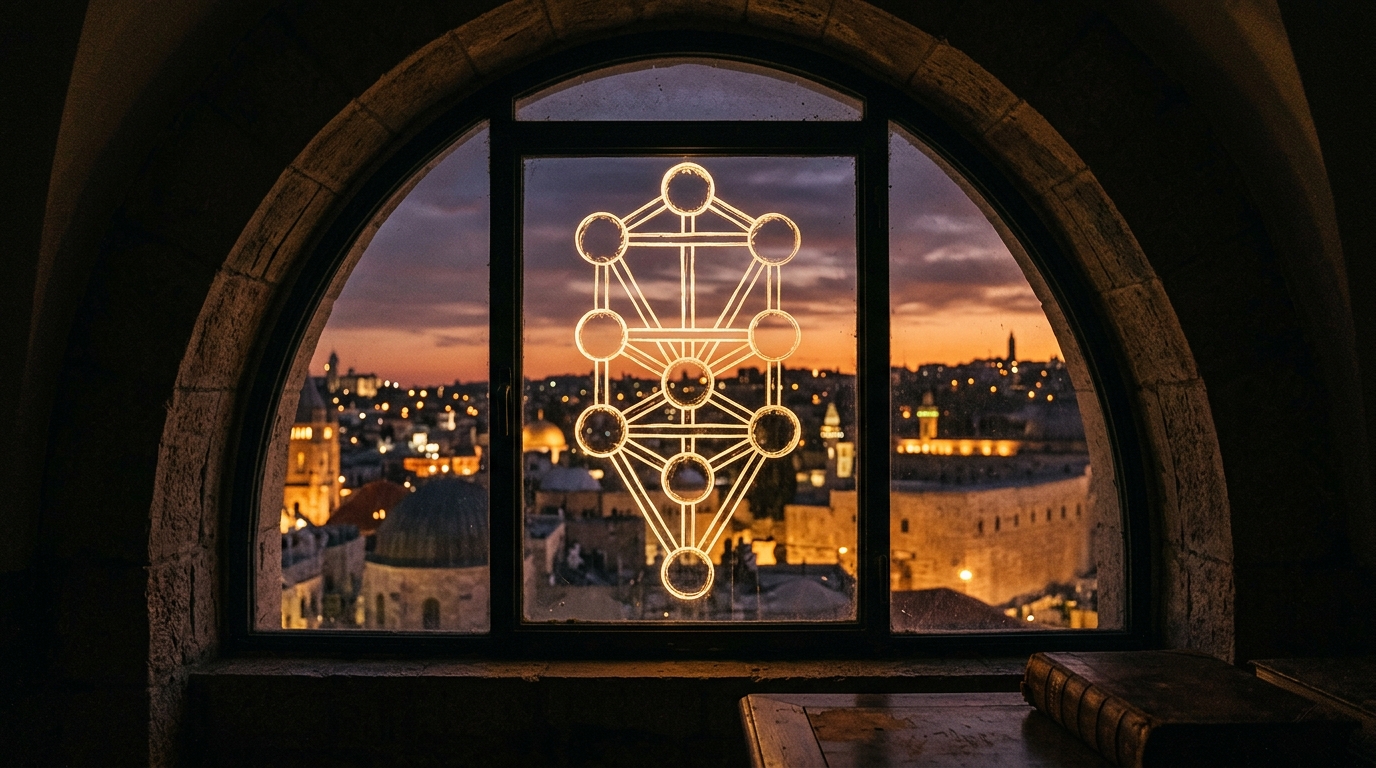
What is Kabbalah, in the end? Not a fringe curiosity, but one of the oldest maps of consciousness on record, still readable today by anyone willing to study it seriously.
\n\n
Conclusion
To arrive at a complete kabbalah def, we must say it plainly: Kabbalah is the esoteric tradition of reading scripture as a symbolic, psychological map of consciousness. It is not history. It is not superstition. It is not satanic. It is the systematic study of how your inner state creates your outer reality, encoded in the letters, numbers, and names of the Hebrew Bible.
The Zohar, whether authored by Shimon bar Yochai in the 2nd century or Moses de León in the 13th century, delivers the same message: God is within. The creative power is your imagination. The 3D world is a reflection, not a final truth. When you persist in a state, the outer world conforms to your persistent assumption.
This is the bridge between Kabbalah and our own Esoteric Bible Interpretation. We are not inventing something new. We are receiving the same truth that Kabbalists received, that the Vedic rishis received, that the mystics of every tradition have received: the Christ is the human imagination, and the God of scripture is your imagination. The work is internal. If you will persist, you will receive your assumption. I promise you.
If you are still asking what is Kabbalah at its core, the short answer is this: it is a Jewish mystical system for reading both scripture and consciousness as one continuous map.
\n\n
Frequently Asked Questions
When was Kabbalah written?
Kabbalah is not a single text but a tradition spanning centuries. The Sefer Yetzirah may date to the 2nd century, while the Zohar, the central kabbalah book, appeared in 13th-century Spain between 1270 and 1300. The kabbalah def you find today draws from texts written across a millennium.
Who wrote the Kabbalah?
The Zohar is mystically attributed to the 2nd-century sage Shimon bar Yochai but was compiled and likely authored by Moses de León in 13th-century Spain. Other key contributors include Abraham Abulafia in the 13th century and Isaac Luria in the 16th century. The question of who wrote kabbalah has no single answer because it is a cumulative tradition.
Is Kabbalah satanic?
No, Kabbalah is not satanic. It is a legitimate mystical tradition rooted deeply in Jewish scripture and developed by rabbis. The satanic label comes from institutional religion that fears esoteric interpretation because it removes the need for a priestly intermediary and places creative power directly in the individual’s imagination.
Is Kabbalah the same as Judaism?
No, Kabbalah is not the same as Judaism. Kabbalah is the mystical and esoteric dimension within Judaism, but its principles, that scripture is a psychological map of consciousness and that imagination creates reality, transcend any single religion. The kabbalah def applies to universal laws of consciousness, not exclusively to Jewish practice.
What is the meaning of Kabbalah?
The meaning of Kabbalah is “receiving” or “that which is received.” It refers to the esoteric wisdom tradition that interprets scripture symbolically rather than literally, teaching that the outer world is a reflection of inner states of consciousness and that human imagination is the creative power behind all experience.
What is the Zohar in Kabbalah?
The Zohar, meaning “Splendor,” is the foundational text of Kabbalah. It is a mystical commentary on the Torah written in Aramaic, appearing in 13th-century Spain. The kabbalah book zohar teaches that every verse of scripture contains a hidden, symbolic layer that describes the structure and mechanism of consciousness.
Is Kabbalah occultism?
If occultism means the study of hidden knowledge, then yes, Kabbalah deals with the Sod, the secret layer of scripture. But if occultism means dark or harmful practices, then no. Kabbalah is the rigorous study of how consciousness creates reality, expressed through the symbolic language of Hebrew letters and divine names.
Understanding Is Only the Beginning
Reading about Kabbalah’s principles is not the same as living them. Like a pianist who hits bum notes before ever playing a concert, applying these principles , treating scripture as a map of consciousness rather than history, recognizing your own imagination as the creative power behind experience , takes consistent, devoted practice, not a single afternoon of study. Most platforms sell you the instant insight. TrueCosmic teaches the practice that makes it real.
No matter what you are facing , housed within you lies the solution to every problem and the fulfilment of every desire. The same power that animates and created this entire universe exists in you, at your beck and call. Only you are the operant power. You have to activate it. And when you do, no problem, no circumstance, no situation can stand in its way. Fear not.

Michael Sutherland is the founder of Truecosmic, a global platform dedicated to Neville Goddard’s teachings and the Law of Assumption. Passionate about empowering individuals through conscious creation, Michael blends esoteric wisdom with practical insight to help people transform their lives from within.












0 Comments