

Jonah and the whale is the story I lived long before I ever understood it. Facing financial ruin, the potential loss of my partner and the loss of my standing in the community, I found myself in the dark belly of my own life. Every attachment I believed defined who I was, I was on the verge of losing.
Only later did I make the discovery that changed everything. Being the operant power, the centre and creator of my own experience, I could reclaim all of it and more, if I so imagined. That discovery is why this ancient tale of a runaway prophet and a great fish matters so deeply to me.
On this blog, I approach the Bible as a vessel of meaning rather than a record of events. The seers who shaped these books chose story deliberately, because a story can carry a truth that plain instruction never could. Our work is to decipher it. And when we do, we usually discover that the story describes us, and that it is summoning a power that has long lain dormant within us.
I write for those who still hold the Bible sacred yet have grown tired of the way it was taught to them, or weary of the hypocrisy they have witnessed in religious institutions. This is no attack on faith. If you read the story of Jonah as literal history, I honour that, and you are welcome here. But the two readings do not sit side by side for ever: the literal comes first, and the inner meaning is where the story is leading you.
The story of Jonah and the whale, as scripture tells it
The book of Jonah runs to a mere four chapters. It opens with an unmistakable command:
“Now the word of the LORD came unto Jonah the son of Amittai, saying, Arise, go to Nineveh, that great city, and cry against it; for their wickedness is come up before me.” (Jonah 1:1 to 2, KJV)
Jonah does precisely the opposite. He goes down to the port of Joppa and boards a ship bound the other way:
“But Jonah rose up to flee unto Tarshish from the presence of the LORD” (Jonah 1:3, KJV)
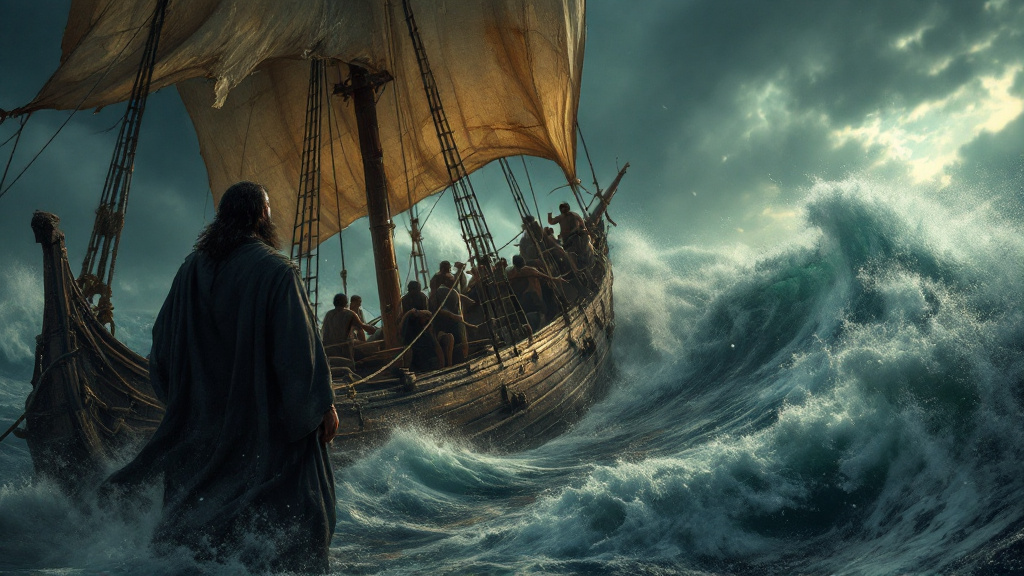
A great storm rises. The sailors are terrified, while Jonah lies asleep below deck. They cast lots to discover who has brought this calamity upon them, and the lot falls on Jonah. He confesses that he is fleeing from the LORD and bids them throw him into the sea, for then the sea will grow calm. Reluctantly, they do, and the storm ceases.
“Now the LORD had prepared a great fish to swallow up Jonah. And Jonah was in the belly of the fish three days and three nights.” (Jonah 1:17, KJV)
From within the fish, Jonah prays. His prayer is among the most moving passages in the Old Testament: “out of the belly of hell cried I, and thou heardest my voice” (Jonah 2:2, KJV). Then “the LORD spake unto the fish, and it vomited out Jonah upon the dry land” (Jonah 2:10, KJV). The call comes a second time. This time Jonah goes to Nineveh, and the city turns around.

Neville and Jonah: an honest note
Let me be plain with you. Neville Goddard did not address Jonah and the whale directly, so I will not put words in his mouth. What follows is TrueCosmic’s own reading.
Yet Neville did hand us the key that unlocks it. He taught that the stories of scripture concern no distant people of long ago. In his lecture “Prophetic Sketches 1967”, he said:
“These prophetic sketches are sketches of events which will happen in you.”
Like Neville, I read these stories as myth and allegory, not history. That is no dismissal. It is the highest tribute I can pay them, because it means the story is still unfolding, and it is unfolding in you.
Nineveh and Tarshish: the calling and the escape
In this reading, Nineveh is your calling. It is the thing you know, somewhere in the depths of you, that you are here to do. It is seldom comfortable, and every fibre of Jonah longed to go the other way.
Tarshish is that other way. It is the distant port, the place that appears safe and prosperous. So often we pursue material wealth and status, chasing the outer prize because it seems more substantial than a quiet inner call. Yet when you are driven by purpose, whatever you pour your effort into becomes all the more worthwhile. Tarshish promises everything and gives nothing that endures. Nineveh asks everything and returns you to yourself.
Notice, too, that Jonah flees “from the presence of the LORD.” Read inwardly, you can never truly leave that presence, because it is your own awareness. You can only fall asleep to it, which is precisely what Jonah does in the hold of the ship.
The storm and being thrown overboard
The storm is what arises when you live against your own grain. Life begins to pitch and roll. The sailors, in this reading, are all the outer helpers we call upon, and not one of them can still the sea.
Then comes the strangest turn in the story. The storm will cease only when Jonah is cast into it. There comes a moment in every crisis when you stop struggling to keep the ship afloat and surrender yourself to the deep. It feels like the end. It is, in truth, the beginning.
The belly of the whale: where every attachment is stripped
The belly of the great fish is the dark night. It is where everything you believed yourself to be is taken from you, leaving only your awareness in the dark.
I know that place. Facing the greatest crisis of my life, with ruin, the possible loss of my partner and the loss of my standing all bearing down at once, I felt swallowed whole. Raised a Jehovah’s Witness and a Baptist, I had walked away from the church at 18. Now, in the belly of it all, I turned to Neville Goddard as a lifeline.
Before that, I sought another way out. At one point, to numb the anxiety, I began to drink. The moment the alcohol wore off, the dreaded thoughts returned, and this time they felt stronger still. Wherever you go, there you are, alone with your own thoughts. Drink and other substances only numb the mind for a while, and then you must face your demons. I was drinking more and more, and I realised this could end in only one place: my becoming an alcoholic.
If alcohol or anxiety has a grip on you right now, please hear this: speaking to your GP or a support service is a strength, not a failure.
The question I could not answer was how to deal with the thoughts themselves. That was when someone mentioned meditation. I confess I have never looked back. Drinking was my Tarshish in a bottle, another ship sailing away from the presence. Meditation was the moment I stopped running and turned to face what lay inside the fish with me.
That is what Jonah does too. “Out of the belly of hell cried I, and thou heardest my voice.” He does not escape the fish by struggling. He turns within, and he is heard.

Three days and three nights: the time of transformation
Jonah is not inside the fish for an hour. He remains there three days and three nights: the full span of a passage from one state to another. The old self must die completely before the new one can rise.
This is why the dark night cannot be hurried. It is not punishment but gestation, and when what is forming within you is ready, the fish releases you.
The great fish as initiation
Neville did not address Jonah directly, but this inner reading is far older than TrueCosmic. The mystic Manly P. Hall, in The Secret Teachings of All Ages (1928), writes in his chapter “Fishes, Insects, Animals, Reptiles and Birds (Part One)” that “The story of Jonah is really a legend of initiation into the Mysteries”. In the ancient symbolism, he explains, the fish could stand for the tomb, and the great fish of Jonah
“represents the darkness of ignorance which engulfs man when he is thrown over the side of the ship (is born) into the sea (life).”
(Manly P. Hall, The Secret Teachings of All Ages)
Notice what that does to the story. Being thrown overboard is not merely a crisis that befalls a few unlucky souls. It is what befalls every one of us when we are born into this world and forget who we are. The belly of the fish is that forgetting, and the three days are the long labour of remembering.
Hall also records that certain early church fathers saw the whale as a symbol of God the Father, who “accepted Jonah into His own nature until a place of safety was reached.” That accords beautifully with Neville’s teaching that God is your own awareness. In TrueCosmic’s reading, the fish that swallows you in the dark is not your enemy. It is your own deeper being, cradling you until you are ready for dry land.
Vomited onto dry land
It is hardly a graceful exit. Jonah is cast up onto the beach. But he is on dry land, solid ground, and the call comes once more. This time he goes. If you are emerging from a hard season and wondering what lies ahead, I have written more on spiritual guidance during life transitions.
The man who emerges from the fish is not the man who went in. He has lost his attachments, and with them he has lost his fear of losing them. He is free to go to Nineveh.
What is the sign of Jonah?
The Jesus of scripture was asked for a sign, and he refused every sign but one:
“But he answered and said unto them, An evil and adulterous generation seeketh after a sign; and there shall no sign be given to it, but the sign of the prophet Jonas” (Matthew 12:39, KJV)
“For as Jonas was three days and three nights in the whale’s belly; so shall the Son of man be three days and three nights in the heart of the earth.” (Matthew 12:40, KJV)
Read inwardly, the sign of Jonah is the pattern of descent and rising within. You go down into the dark, into the heart of the earth, into the belly of the fish. Everything outer falls away, and from there something rises. The sign is no miracle performed in the sky. It is the death of an old self and the birth of a new one, within you.
How to apply it
- Name your Nineveh. Ask yourself honestly what you are being called to do that you keep evading. Write it down in a single sentence.
- Name your Tarshish. Notice where you run instead. There is no need to judge it, only to see it.
- Turn within in the dark. When the storm comes, do not simply reach for another ship. Sit quietly for a few minutes each day, as I learned to do through meditation, and let the thoughts come and go.
- Decide the end, not the route. The greatest mistake is micromanaging how the result arrives. Jonah did not choose a fish as his means of passage. Decide where you wish to land and leave the pathway open. If you are new to this, begin with what manifesting really is.
- Enter the dry land every night. In the drowsy state before sleep, enter one brief scene that implies your wish fulfilled: perhaps someone congratulating you, or you standing within the life your calling has made. Feel it as done, and fall asleep in it.
This is a practice, not a trick. Picture a swimmer learning to breathe in rhythm. At first every breath feels like a gasp, and the swimmer swallows water and longs to stop. But stroke by stroke, length by length, the rhythm settles until breathing in the water becomes second nature. Living from the end works in the same way: not one heroic effort, but a steady rhythm you return to until it carries you.
Each time you decipher a story like this, it is like discovering a door in your own house that you have walked past for years. Behind it lies an unopened room, already furnished, already yours. Jonah’s three days in the dark are the turning of the handle, and the power to remake your life was in that room all along. This is the heart of the Law of Assumption.

Keep reading: Crossing the Red Sea Meaning: Passing Over Into a Freer State. For the bigger picture, see our complete guide to esoteric Bible interpretation.
Keep reading: Lazarus Meaning: What the Raising of Lazarus Reveals About the Power Within You.
Frequently Asked Questions
What is the sign of Jonah?
In Matthew 12:39 to 40, the Jesus of scripture declares that the only sign given will be “the sign of the prophet Jonas,” likening Jonah’s three days and three nights in the whale’s belly to the Son of man’s three days in the heart of the earth. Read inwardly, it is the pattern of descending into darkness and rising transformed, a death and rebirth that takes place within you.
Was Jonah really swallowed by a whale?
The book of Jonah calls it “a great fish,” while the King James Version of Matthew 12:40 says “whale,” so tradition has used both. Many people read the event as literal history, and that is a reading worthy of respect. At TrueCosmic we read it as allegory, a portrait of the dark night every person passes through. The mystic Manly P. Hall read it in the same way, as a legend of initiation in which the great fish stands for the darkness that engulfs us when we are born into this life.
What does Jonah and the whale mean spiritually?
Spiritually, it is the story of fleeing your calling, being stripped of your attachments in a dark season, and emerging changed. Nineveh is the calling, Tarshish is the escape, and the belly of the fish is the place where the old self dies so that a new one can rise.
Am I going against my faith by reading Jonah as an inner story?
Reading scripture for its inner meaning is an ancient practice. Origen, one of the most influential early Christian teachers, taught that scripture holds a spiritual sense beneath its literal sense. The literal reading is where we all begin. But scripture’s pattern is that the elder serves the younger, and the inner meaning comes to govern the outer. And that realisation is no side note: it is the very catalyst for transformation.
Did Neville Goddard teach about Jonah and the whale?
Neville did not address Jonah and the whale directly, so the reading in this article is TrueCosmic’s own. It does, however, follow his wider principle that the stories of scripture describe events which happen within you.
Conclusion: the dark is not the end of the story
Jonah and the whale is the story of everyone who has ever fled their calling, been swallowed by a crisis, and wondered whether they would ever see daylight again. The belly of the fish is real, but it is no tomb. It is a womb, and the three days always end on dry land.
Whatever is swallowing you right now, the way out is not waiting in some distant port. It already lies within you, and so does the very power that set the stars in their places. You are the operant power in your own life. It waits for you to awaken it, and when you do, no storm, no sea and no circumstance can hold you down. Fear not.

Michael Sutherland is the founder of Truecosmic, a global platform dedicated to Neville Goddard’s teachings and the Law of Assumption. Passionate about empowering individuals through conscious creation, Michael blends esoteric wisdom with practical insight to help people transform their lives from within.
Enter your email and get instant FREE access to your report.
No credit card required. 🔒 Your details are secure. You can unsubscribe at any time.














0 Comments