
Who Is Neville Goddard?
Neville Goddard (1905–1972) was a Barbadian-born spiritual teacher best known for popularizing the Law of Assumption — the idea that human imagination and feeling, not external circumstance, shape reality. Trained in Kabbalah and Hebrew mysticism by his mentor Abdullah, Neville spent four decades lecturing in New York and Los Angeles, and his teachings remain one of the most cited foundations of modern manifestation and Law of Assumption practice.
The Neville Goddard biography is one of the most remarkable stories in modern spiritual history, and it begins not in a university or a church, but on a small Caribbean island at the dawn of the twentieth century. Today, over 245,256 members are actively discussing his ideas in the r/NevilleGoddard Reddit community as of May 2026, growing at nearly 1,000 new subscribers every single week. That is not the footprint of a forgotten mystic. That is the footprint of a man who decoded something real about consciousness, and whose life story is as extraordinary as anything he ever taught.
This article is your complete guide to understanding Neville Goddard as a person before you dive into his teachings. Where he came from. What shaped him. How a dancer from Barbados became the most important metaphysical teacher of the twentieth century.
Key Takeaways: Neville Goddard Biography at a Glance
- Full name: Neville Lancelot Goddard
- Born: February 19, 1905, in St. Michael, Barbados
- Family: One of nine children in a large, prosperous Barbadian family
- Moved to New York City: As a teenager to pursue a career in dance and theatre
- Turning point: Met Ethiopian mystic Abdullah in New York, who taught him Hebrew, Kabbalah, and the inner meaning of scripture
- Career as a teacher: Lectured in New York through the 1930s and 1940s, then moved to Los Angeles where he taught until his death
- Death: August 1, 1972, in Los Angeles, California. Explore the full account of how Neville Goddard died and the final chapter of his life.
- Legacy: Over 14 major books, hundreds of lectures, and a global revival that is accelerating in 2026
Born Into a World of Possibility: Neville Goddard’s Early Life in Barbados
To understand the Neville Goddard biography fully, you must start in Barbados. On February 19, 1905, Neville Lancelot Goddard was born in St. Michael, a parish on the southwestern coast of the island.
He was the second son of Joseph Nathaniel Goddard and Wilhelmina Neville Goddard, and he grew up in a household that was large, lively, and deeply rooted in the British colonial tradition of the Caribbean. Neville was one of nine children, a detail that is easy to pass over but that says something important about the world he entered. Large families in Barbados at that time fostered an environment of close communication, shared storytelling, and the kind of social fluency that Neville would later bring to the lecture podium with remarkable skill.
The Goddard family was well-established in Barbados. They were in the provisions trade and held a respectable position in the community. Neville grew up in an environment that was not impoverished but was also far removed from the glittering world of New York theatre that would soon consume his young imagination. The contrast between his quiet island origins and the life he would build in America is one of the great dramatic arcs of the full Neville Goddard biography.
Even as a boy, Neville was drawn to the expressive arts. There was something in his nature that was always reaching beyond the visible. That restlessness would eventually carry him four thousand miles north.
A Young Man in New York: The Dancer Who Would Become a Prophet
At the age of seventeen, Neville Goddard left Barbados and sailed to New York City. He came to dance. His goal was a career in the performing arts, and in the early 1920s, New York’s theatre district was the beating heart of Western entertainment.
He found work. He performed on Broadway as a dancer and as an actor. He was not, by any account, struggling in obscurity. He had talent, presence, and the natural charisma that would later fill lecture halls. But beneath the sequined surface of the performer’s life, something deeper was stirring.
The early years in New York were years of formation. Neville was absorbing the city, its ideas, its intensity, and its extraordinary diversity of thought. New York in the 1920s was a crucible of spiritual experimentation, New Thought philosophy, and metaphysical inquiry. It was exactly the right environment for a young man whose real questions were never about choreography but about the nature of reality itself.
Then came the meeting that rewrote everything.
The Meeting That Changed Everything: Abdullah and the Mystical Keys
Of all the Neville Goddard facts that define his biography, none is more pivotal than his encounter with a man known as Abdullah. The year was around 1931. Neville was still working as a performer when a chance introduction brought him face to face with an Ethiopian rabbi who would reshape his entire understanding of existence.
Abdullah was not a gentle, encouraging mentor in the modern self-help sense. He was rigorous, demanding, and utterly certain. He taught Neville Hebrew. He taught him the Kabbalah, the ancient Jewish mystical framework that interprets scripture as a map of consciousness rather than a record of historical events. He drilled into Neville the understanding that the Bible is not a biography of men who once lived but a psychological drama happening inside every human being, right now, in every moment.
Read the deep dive on Neville Goddard’s biography and the core teachings that emerged from this period to understand just how radical this reinterpretation was.
Abdullah also taught Neville the practice of assuming a state. Not wishing for it. Not asking for it. Assuming it as already real, in consciousness, before any physical evidence appeared. This was the seed of what Neville would later crystallize as the the Law and what the TrueCosmic community explores in full today.
One of the most remarkable stories from this period involves Neville wanting to return to Barbados but having no money for the journey. Abdullah told him, with complete conviction, that he was already in Barbados, that he should sleep as though he were there, feel the island air, assume the reality of having arrived. Weeks later, through a sequence of events that defied ordinary logic, the money and the passage materialized. This was not theory to Neville. It was lived experience. And it planted a certainty in him that no argument could later dislodge.

Neville Goddard Facts: What Abdullah Actually Taught Him
Understanding what Abdullah transmitted to Neville is essential to understanding why the teachings work the way they do. Most people who come to the Neville Goddard biography for the first time are surprised to discover that his philosophy is not a product of New Age culture. It is rooted in ancient Hebrew mysticism, reworked through the lens of pure psychology.
Abdullah taught Neville that every figure in the Bible, from Abraham to Jesus, represents a state of consciousness available to every human being. The stories are not about people who lived in the distant past. They are about you. They are instructions, written in the language of myth, for how consciousness creates reality.
This is one of the most important neville goddard facts for a new reader to absorb. Neville did not invent these ideas from thin air. He inherited a lineage of mystical scholarship and then spent decades testing it in his own life and teaching others to do the same.
The concepts of the wish fulfilled, of imaginal acts that harden into fact, of sleeping in a state of assumption, these all trace directly back to what Abdullah showed him in those years of private study in New York. The teacher planted the seed. Neville grew it into one of the most coherent and practical bodies of spiritual work the twentieth century produced.
You can explore the full scope of these ideas in the TrueCosmic Neville Goddard library, which houses an extraordinary collection of his recorded lectures, transcripts, and books.

From the Stage to the Lecture Hall: Becoming a Spiritual Teacher
After his years with Abdullah, Neville did not immediately abandon the performing arts. The transition was gradual. But by the late 1930s, the pull of teaching had become undeniable.
He began giving lectures in New York City. Small gatherings at first. Rented halls. Audiences who had heard about this extraordinary West Indian speaker who interpreted the Bible in ways that no church had ever dared to attempt. Word spread. The rooms got bigger.
Neville had a gift that is genuinely rare. He could take an abstract metaphysical principle and make it feel as immediate and urgent as a telegram. He spoke without notes. He was fluid, warm, precise. People left his lectures not with vague inspiration but with a specific, actionable understanding of what to do when they closed their eyes that night.
His first book, At Your Command, was published in 1939. It is a slim, concentrated text, barely sixty pages, but it contains the essential architecture of everything that followed. You can access it directly in the At Your Command edition available through TrueCosmic. The premise is breathtaking in its directness: you are the operant power. Consciousness is the only reality. Your assumptions about what is true are the commands that the outer world obeys.
The 1930s and 1940s: Books, Radio, and the New York Years
Through the late 1930s and the 1940s, Neville Goddard built his teaching career steadily and seriously. He was not chasing celebrity. He was delivering a message he believed with complete conviction, and he delivered it through every channel available to him.
He lectured continuously. He wrote prolifically. Your Faith Is Your Fortune appeared in 1941, developing his interpretation of the New Testament with a depth and precision that rewarded multiple readings. The full text is part of the Your Faith Is Your Fortune collection at TrueCosmic.
Feeling Is the Secret followed in 1944. This short, precise book introduced the idea that it is not the thought but the feeling of the wish fulfilled that impresses the deeper levels of consciousness and sets the creative process in motion. It remains one of his most immediately applicable works.
Prayer: The Art of Believing also emerged from this period, redefining prayer not as petition but as the act of assuming the reality of the desired state. The Prayer: The Art of Believing PDF captures this teaching in its purest written form.
These were not years of fame in the mainstream sense. Neville was not on the cover of national magazines. But among those who found their way to his lectures or his books, the effect was transformative. His audience was devoted, intellectually serious, and growing.
The 1948 Classroom Series: Where The Law Was Formalized
If you want to understand the Neville Goddard biography through a single lens, point it at 1948. That year, Neville delivered a lecture series that became foundational to everything his teaching community has built since.
The 1948 classroom series is where Neville most clearly articulated what he called the Law: the principle that consciousness is the only reality, that assumption creates fact, and that the imaginal act of feeling the wish fulfilled is the mechanism by which outer circumstances are shaped. The 1948 Classroom Series is preserved in full and remains the clearest entry point into his systematic teaching on the Law.
He also distinguished, during this period, between what he called the Law and the Promise. The Law is the practical mechanics of consciousness. The Promise is the mystical dimension: a series of inner visions and experiences that he taught were available to every human being, not as metaphor, but as literal inner reality. The difference between these two dimensions of his work is crucial and often misunderstood by newcomers.
For a deeper reading of how the Law and the Promise function together, TrueCosmic’s dedicated resource on the Law and the Promise is the most comprehensive guide available.
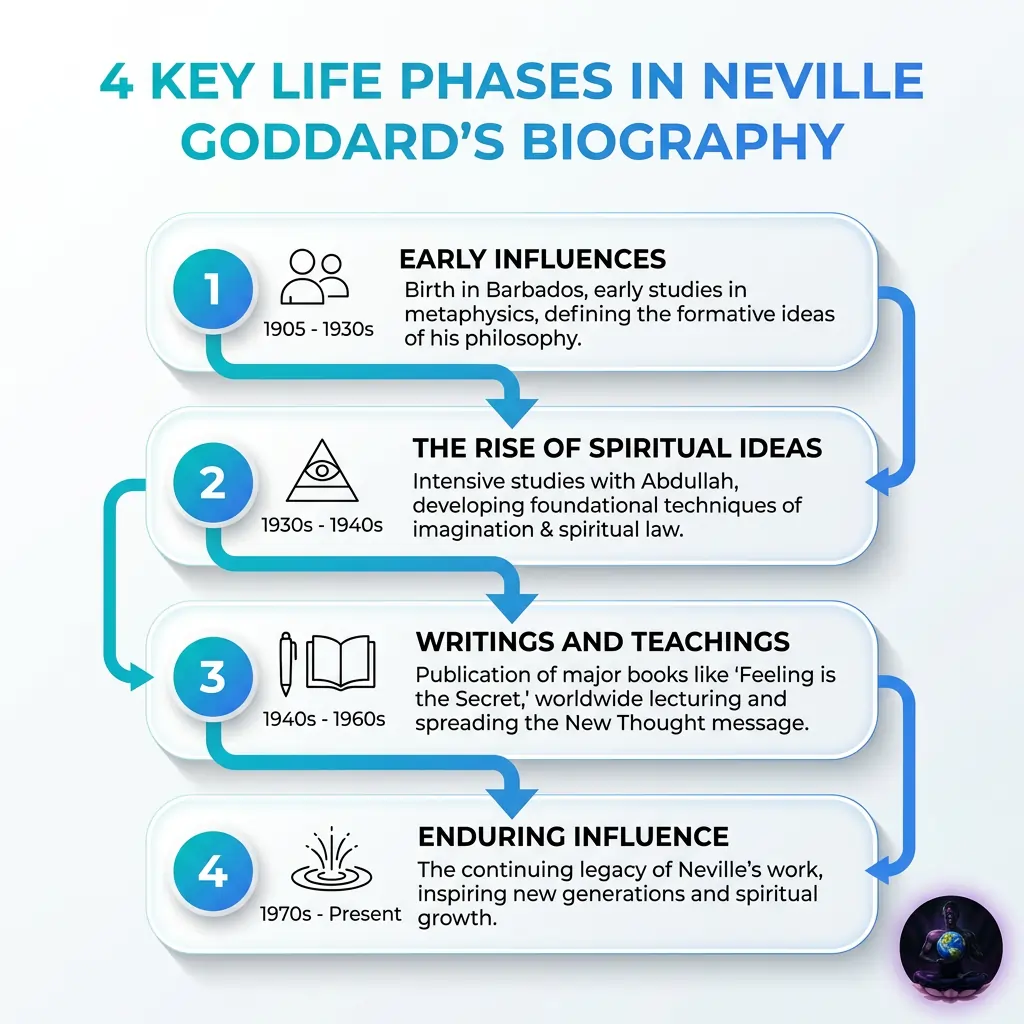
Explore the four pivotal phases in Neville Goddard’s life. See how each phase shaped his spiritual teachings and influence.
For the complete guide to the Law of Assumption, see our definitive resource: The Law of Assumption — The Complete Guide.
To learn more about Neville Goddard’s life and complete body of work, read our definitive guide: Neville Goddard — The Complete Guide.
Los Angeles and the Peak Years of His Teaching Career
By the early 1950s, Neville Goddard had relocated to Los Angeles. This move marked the beginning of the most prolific and widely heard chapter of the full Neville Goddard biography.
Los Angeles in the 1950s was hungry for exactly what Neville offered. The city was expansive, forward-looking, and spiritually curious in a way that suited his message perfectly. He found large, enthusiastic audiences and a platform that amplified his reach dramatically.
His 1950s television show on KTTV is one of the most remarkable chapters in his story. In an era long before internet distribution or podcasts, Neville was delivering his teachings to hundreds of thousands of households every week. The response was immediate and overwhelming. Five thousand letters arrived after a single telecast. People were ready for what he was saying.
Through the 1950s and 1960s in Los Angeles, Neville lectured almost continuously. He moved between hired halls, private homes, and larger venues as his audience demanded. He also produced some of his most enduring written work during this period.
The Power of Awareness, published in 1952, is widely considered his masterwork. It is a sustained, elegant argument for the single claim that consciousness is the only reality, and that shifting one’s awareness to the state of the wish fulfilled is the complete and sufficient mechanism for changing any circumstance in the outer world. The TrueCosmic edition of The Power of Awareness preserves this text in its complete form.
Seedtime and Harvest appeared in 1956, extending his biblical interpretation into the practical mechanics of planting assumptions in consciousness and waiting with confidence for them to ripen into physical reality. Access the full text through the Seedtime and Harvest resource at TrueCosmic.
The Law and The Promise, published in 1961, gathered accounts from his students of the Law working in their own lives, paired with Neville’s exposition of the deeper mystical Promise. It is perhaps the most human of his books, grounded in real stories of real people who had tested these principles and found them reliable.

Neville Goddard Facts: His Personal Life and Mystical Experiences
The personal dimensions of the Neville Goddard biography are often overshadowed by the philosophy, but they deserve attention. Neville was married twice. His first marriage ended in divorce. His second marriage, to Victoria Goddard, was a long and stable partnership. Together they had a daughter, Victoria.
He was by most accounts a warm, grounded, and remarkably undramatic person in his private life. People who knew him personally described a man without pretension, one who genuinely believed that every person he met carried the same divine creative power he taught about on stage. He did not position himself as uniquely gifted. He insisted, with great emphasis, that everything he had experienced was available to anyone willing to take the inner work seriously.
His mystical experiences were central to the second half of his teaching. Beginning in 1959, Neville began describing a series of inner visions that he taught as the unfolding of what the Bible calls the Promise. He described a resurrection experience, a sense of being born from above, encounters with scripture enacted as inner reality. He taught these not as symbolic experiences but as literal events in consciousness, ones that he believed every person would eventually undergo.
He was also direct about what he saw as the limits of the Law. The outer world, he taught, is a faithful mirror of inner assumption. But the ultimate destination of the human journey is not the accumulation of outer things. It is the awakening of consciousness to its own divine nature. The imaginal acts that produce physical results are, in his framework, only the beginning of the story.
These are among the most important neville goddard facts for someone coming to his work through the modern manifestation community, because they reveal the full depth of what he was actually teaching.
The Prophecy of His Own Death and His Passing in 1972
One of the most quietly remarkable chapters in the Neville Goddard biography is the way his life ended. In the years before his death, Neville spoke openly about his own departure. He treated it not as tragedy but as the next phase of a journey that consciousness never interrupts. He had taught his entire life that death is not what it appears to be from the outside, and he did not retreat from that position when it became personal.
On August 1, 1972, Neville Lancelot Goddard died in Los Angeles, California, at the age of 67. The official cause was an aortic aneurysm. He was found at his home. There was no prolonged illness, no dramatic final scene. He simply stepped out of the physical story, much as he had always said consciousness eventually does.
For a full account of the circumstances surrounding his death and what the historical record tells us, the detailed article on how Neville Goddard died is the most thorough resource available.
He left behind a body of work that is, if anything, more alive today than it was during his lifetime. That is not a metaphor. It is a fact you can measure in community sizes, in book sales, and in the daily testimonials of people whose circumstances changed after applying what he taught.
The Legacy: Why the Revival Is Accelerating in 2026
The final chapter of the Neville Goddard biography is still being written, and it is being written by the thousands of people who are discovering his teachings for the first time every week.
The revival of Neville’s ideas in the digital era is not difficult to explain once you understand what he actually taught. His framework is not dependent on any religious institution, any guru, or any external authority. It requires nothing but a willingness to take your own consciousness seriously as the operant power in your life. That message travels well across platforms and across cultures.
The TrueCosmic community has been central to this revival, building what is now the most comprehensive archive of Neville’s recorded lectures and written works available anywhere. The TrueCosmic Neville Goddard library is the best place to begin if you want to go beyond biography and into the teachings themselves.
For those ready to understand the mechanics of what Neville actually taught about consciousness and assumption, the law of assumption guide is the clearest systematic overview available, drawing directly from his lectures and books.
And for those who want to understand the man who first decoded these principles for Neville himself, the deep-dive article on Abdullah, the Ethiopian mystic who taught Neville Goddard, is essential reading.
Neville taught that consciousness is the only reality. That your assumptions must harden into fact if you persist in them. That there is no one to change but self. Fifty-four years after his death, the world is catching up to what he knew. And the biography of Neville Goddard, in that sense, is also the biography of an idea whose time has fully arrived.
Conclusion: The Neville Goddard Biography as a Living Teaching
The Neville Goddard biography is more than the story of a man. It is the story of an idea moving through a man, of ancient mystical knowledge finding a twentieth-century voice precise and direct enough to carry it into the modern world.
He was born in Barbados in 1905, one of nine children, and he died in Los Angeles in 1972, leaving behind a body of work that is reshaping how hundreds of thousands of people understand consciousness, reality, and the mechanics of a life lived from the inside out. The dancer became a teacher. The teacher became a prophet. And the prophet, characteristically, insisted the whole time that he was simply showing you something that was already true about yourself.
That is the Neville Goddard biography. And if it lands the way he always intended, it does not end when you finish reading it. It begins.
Frequently Asked Questions
What was Neville Goddard’s net worth?
Neville Goddard was not a wealthy man by conventional measures. He lived modestly as a lecturer and writer, and no verified estate records establish a specific net worth figure. His wealth, by his own account, was measured in the freedom his teaching gave him to live and teach on his own terms.
Was Neville Goddard married?
Yes. Neville Goddard was married twice. His first marriage ended in divorce, and his second wife, Catherine, remained with him until his death in 1972. Their daughter, Victoria, has spoken publicly about her father’s life and teaching in later years.
Q: Who was Neville Goddard and why is he important in 2026?
A: Neville Goddard was a Barbadian-born spiritual teacher who lived from 1905 to 1972. He taught that human consciousness creates outer reality through assumption and imaginal acts, drawing on Hebrew mysticism and Kabbalistic interpretation of scripture. His importance in 2026 lies in the fact that his teachings are experiencing a massive revival, with hundreds of thousands of new students discovering his work through online communities and archives like TrueCosmic.
Q: What is the most important Neville Goddard biography fact to know before reading his books?
A: The single most important neville goddard fact is that his teachings were not invented from scratch. They were transmitted to him by a mentor named Abdullah, an Ethiopian rabbi who taught him Kabbalah and the mystical interpretation of scripture. Understanding this lineage explains why Neville’s framework is so structurally coherent and why it differs so sharply from generic positive-thinking content.
Q: What books did Neville Goddard write and which one should a beginner start with?
A: Neville wrote over fourteen major books across his career, including At Your Command, Feeling Is the Secret, The Power of Awareness, The Law and The Promise, and Seedtime and Harvest. For a complete beginner, Feeling Is the Secret is the most accessible entry point, while The Power of Awareness is widely considered his most complete and definitive statement of the teaching.
Q: How did Neville Goddard die and did he predict his own death?
A: Neville Goddard died on August 1, 1972, in Los Angeles from an aortic aneurysm. In the years before his death, he spoke openly about his own departure, treating it as the next phase of the conscious journey rather than an ending. Many of those who knew him personally noted that he seemed at peace with the timing in a way that went beyond ordinary acceptance.
Q: Where can I access Neville Goddard’s lectures and books online in 2026?
A: The most comprehensive collection of Neville Goddard’s original lectures, transcripts, and books is the TrueCosmic Neville Goddard library, which now preserves over 400 original recordings. It is the most thorough archive of his life’s work currently available and the natural companion to anyone reading the full Neville Goddard biography and wanting to go deeper into the teachings themselves.

Michael Sutherland is the founder of Truecosmic, a global platform dedicated to Neville Goddard’s teachings and the Law of Assumption. Passionate about empowering individuals through conscious creation, Michael blends esoteric wisdom with practical insight to help people transform their lives from within.












0 Comments