

The Lazarus meaning most of us inherited is a miracle report: a man four days in the grave, a stone rolled away, a dead body walking out into the daylight. I read it differently. To me the story is metaphorical far more than it is literal, and its real subject is not a tomb outside Bethany but the places in your own life where you have quietly given up.
Think of how many situations we pronounce dead. A marriage gone cold, a calling abandoned, a friendship we no longer mention, a hope we buried so long ago that we have stopped visiting the grave. We have given up all hope on them. Yet as this story illustrates, there is nothing that imagination, awakened imagination, cannot resurrect.
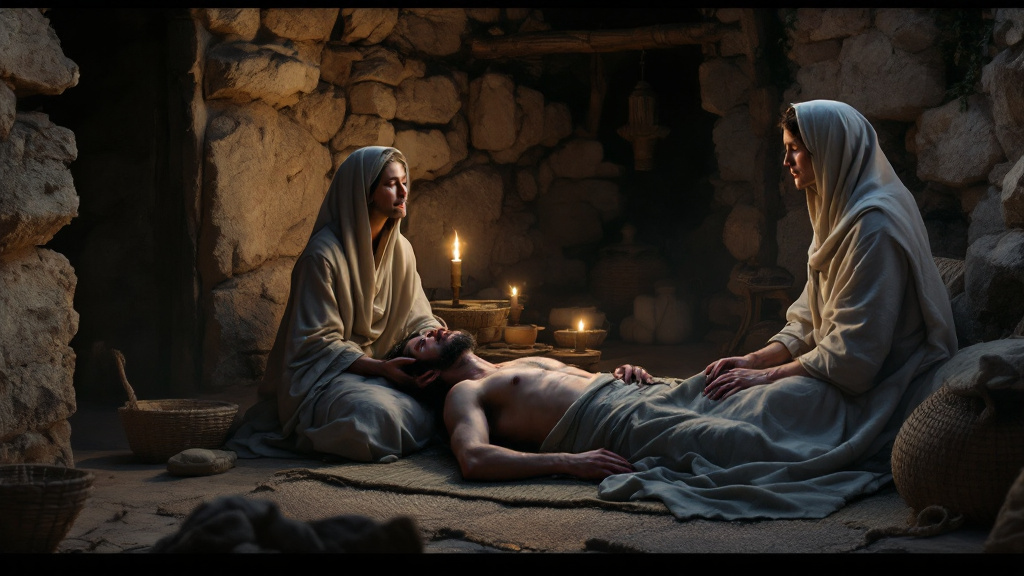
That is why I treat this chapter of John as a bearer of meaning rather than a page of history. The sages who shaped scripture chose story deliberately, because a story can carry a truth past the guarded door of the reasoning mind. Our task is to unwrap it, as Lazarus himself had to be unwrapped. And when we do, what we find inside is a portrait of ourselves, and of a power within us that has only been sleeping.
I write for those who still hold the Bible as sacred but have grown weary of the way it was taught to them, or of the hypocrisy they witnessed in the institutions that claimed to own it. This is not an attack on anyone’s faith. I honour those who read Lazarus as a literal event, but the two readings are not equals: the literal is the first rung of the ladder, and it must give way to the inner reading, as the elder serves the younger.
The story of Lazarus in John 11
The account appears only in the Gospel of John, and it opens simply:
“Now a certain man was sick, named Lazarus, of Bethany, the town of Mary and her sister Martha.” (John 11:1, KJV)
The sisters send word: “Lord, behold, he whom thou lovest is sick.” (John 11:3, KJV). The Jesus of scripture does not hurry. He says, “This sickness is not unto death, but for the glory of God, that the Son of God might be glorified thereby,” and then, astonishingly, “he abode two days still in the same place where he was.” (John 11:4 to 6, KJV)
When at last he speaks of going, he chooses a curious word:
“Our friend Lazarus sleepeth; but I go, that I may awake him out of sleep.” (John 11:11, KJV)
By the time he reaches Bethany, Lazarus “had lain in the grave four days already.” (John 11:17, KJV). Martha comes out to meet him with a sentence every grieving heart knows: “Lord, if thou hadst been here, my brother had not died.” (John 11:21, KJV). He answers her, “I am the resurrection, and the life: he that believeth in me, though he were dead, yet shall he live.” (John 11:25, KJV)
Then comes the shortest verse in the whole of scripture: “Jesus wept.” (John 11:35, KJV)
At the tomb he asks for the stone to be taken away, and Martha, ever practical, protests:
“Lord, by this time he stinketh: for he hath been dead four days.” (John 11:39, KJV)
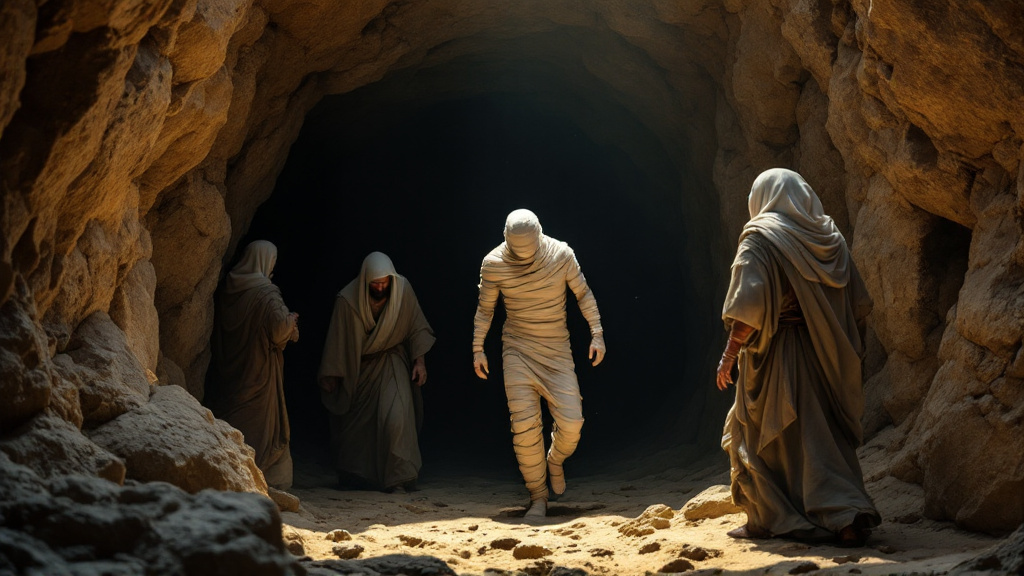
The stone is moved. Before anything has visibly happened, the Jesus of scripture lifts up his eyes and says, “Father, I thank thee that thou hast heard me.” (John 11:41, KJV). Then “he cried with a loud voice, Lazarus, come forth.” (John 11:43, KJV). The dead man walks out “bound hand and foot with graveclothes,” and the last command is given to the onlookers: “Loose him, and let him go.” (John 11:44, KJV)
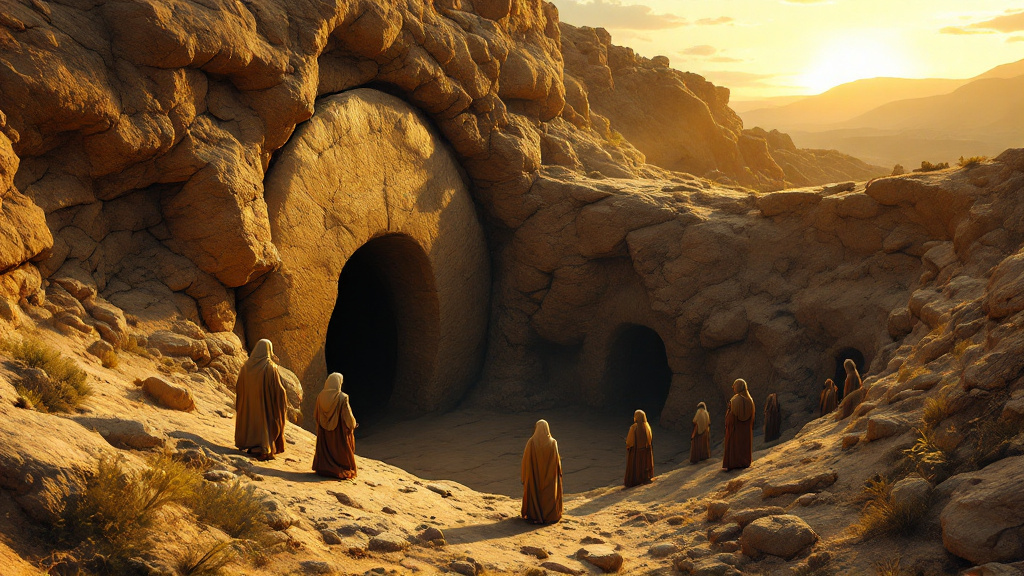
Lazarus meaning: the name and the promise inside it
Neville Goddard returned to this story with a single, quiet observation about the name itself:
“It is the story of Lazarus, which means “God has helped.””
And he went further, refusing to leave the miracle in first century Judea:
“but his story is a foreshadowing of that which is going to happen in you!” (Neville, in his lecture “Prophetic Sketches 1967”)
That one line changes everything. If the story is a foreshadowing of something within you, then Lazarus is not a stranger from long ago. He is the part of you that has fallen asleep, the dream you laid in the tomb and sealed with a stone. And his name is the verdict written over the whole drama before it even begins: God has helped. Not God might help, not God will help if you are good enough. The help is already given; the story simply unfolds what was already true.
This is myth and allegory in the oldest and most honourable sense, a vessel built to carry inner truth, not a newspaper account. Neville read scripture this way, and so do we.
The inner reading: sleep, the stone and the voice
Neville gave us the name and the principle. The detailed reading that follows is, built on that foundation.
Sleep, not death. The Jesus of scripture calls the condition sleep before he ever calls it death. That is the first clue. Nothing you have given up on is truly dead. It is dormant, waiting beneath the surface of your attention, and what sleeps can be woken.
Four days. The delay is not cruelty. In the story it ensures that no one can mistake what follows for a lucky recovery. Martha says it herself: by now he stinks. Your own dead situations often look exactly like this. Every sensible voice agrees it is over, the evidence is overwhelming, and reason has already written the obituary. That is precisely the condition in which awakened imagination does its work.
Martha and Mary. Both sisters greet him with the same words: if you had been here, my brother had not died. They had decided not only what they wanted but how and when it ought to arrive. Help was supposed to come before the death, by the road they expected. It came after, by a road they could not have imagined.
The stone. Before a dead thing can rise, something must be moved: the heavy, settled conviction that it is finished. In practice the stone is the story you keep telling about the situation. Roll it away, and the tomb is open to a new voice.
Thanks before the evidence. Notice the order. He gives thanks for being heard while the tomb is still silent. This is assumption in its purest form: living from the end, grateful for what the senses cannot yet confirm.
“Lazarus, come forth.” The call is spoken with authority, from the state of the thing already done. And notice that he is the one who earlier said, “I am the resurrection, and the life.” In the inner reading, that I am is not a man standing at a graveside. It is your own awareness of being, the only power that can call anything out of the dark.
The graveclothes. Even after Lazarus walks out, he is still bound. Old habits of thought cling to what has been raised, and they have to be loosed deliberately. Resurrection is the beginning, not the end, of the work.
If this pattern of descent and return feels familiar, it echoes another story of apparent death and rising again, which I explore in the inner meaning of Jonah and the whale.
What “Jesus wept” means
When I think of those two words, I think of Neville, because he referenced them in his lectures. He did not treat the tears as a passing detail. He saw in them the nature of God Himself:
“The shortest verse in scripture is, “Jesus wept.” Here is God shedding a tear. When someone leaves your life and you can no longer touch him physically, you suffer in your imagination; therefore Christ suffers.” (Neville, in his lecture “The Core Of Man”)
Read that slowly. The Jesus of scripture weeps at the tomb not because he doubts the outcome, but because loss is real and grief is felt in the imagination, which is where God lives in us. Your sorrow over what you have lost is not a failure of faith. It is the divine within you, feeling.
Neville went further, and saw purpose in that suffering:
“it is only from an experiencing nature that the furnaces of affliction can refine the essence of faith, hope and love.” (Neville, in his lecture “Faith Hope And Love”)
So the tears and the resurrection belong to the same chapter. The one who weeps is the one who calls the dead to rise. You do not have to pretend the loss does not hurt before you can imagine it restored.
The ancient witness: the tomb of winter
This idea of a sleeping divinity waiting to be raised is far older than John’s Gospel. The mystic Manly P. Hall, in The Secret Teachings of All Ages (1928), describes the Christos as “the god-man imprisoned in every creature,” and writes that “it was the first duty of the initiate to liberate” that eternal presence within himself.
Elsewhere, writing of the savior stories found across the ancient world, Hall observes that the sun was seen as the one who “dies annually for every creature within his universe, but year after year rises again victorious from the tomb of winter.”
The tomb of winter is exactly where we leave our hopes. And the ancients knew that winter is never the end of the year.
How to apply the story of Lazarus
- Name your Lazarus. Choose one situation you have pronounced dead. Be honest and specific. Not “my life”, but the particular thing you buried.
- Roll away the stone. Notice the sentence you keep repeating about it: “it’s too late”, “that’s over”, “it has been gone too long”. Decide to stop rehearsing it, even when the evidence seems to agree.
- Give thanks before the tomb opens. Ask what you would feel if this were already restored. Let that gratitude come first, while nothing outward has changed.
- Leave the route open. Martha and Mary had already decided how help should have come. Decide only on the end, the thing alive again, and let the way it arrives be none of your business. Micromanaging the how is the surest way to shut the tomb again.
- Call it forth each night. In the drowsy state just before sleep, enter one short scene that would only happen if your wish were fulfilled: a conversation, an embrace, a moment of quiet celebration. Feel it as done, and fall asleep inside it.
For the principle beneath these steps, read our guide to the Law of Assumption.
Remember that this is a practice, not a trick. A gardener does not plant a bulb in autumn and dig it up every morning to check on its progress. He prepares the ground, sets the bulb at the right depth, waters it, and trusts the season. Some springs bring a fuller bloom than others, and the gardener learns from each one. What makes a garden flourish is not one inspired afternoon but steady, faithful return, year upon year. Your inner life grows the same way.

The seed in the winter soil
Picture a seed lying in the frozen ground of January. Dig it up and it looks dead: hard, dark, utterly still. Nothing about it promises a flower. And yet the whole of the plant is folded inside it, waiting only for the warmth that calls it out.
That is Lazarus. That is the hope you buried and the gift you stopped using. Unwrapping this story is not an exercise in Bible study. It is the moment you realise that what you took for death was dormancy, and that the warmth which calls the seed upward is your own awakened imagination. God has helped. The power was never gone. It was asleep, and it is waiting for your voice.
Frequently Asked Questions
What does the name Lazarus mean?
Neville Goddard taught that Lazarus means “God has helped.” In the inner reading the name is the verdict written over the story before it begins: the help is already given, and the raising simply reveals it. That is why Neville called the story a foreshadowing of what will happen in you.
Why did the Jesus of scripture wait four days?
John 11 gives its own reasons. He says the sickness is “for the glory of God” (11:4), he stays two more days where he is (11:6), and he tells the disciples he is glad he was not there, “to the intent ye may believe” (11:15). By the time he arrives Lazarus has lain in the grave four days, so dead that Martha warns “he stinketh” (11:39), which leaves no room to doubt what follows.
What does “Jesus wept” mean?
John 11:35 is the shortest verse in scripture. Neville read it as “God shedding a tear”: when someone leaves your life you suffer in your imagination, and because God lives in your imagination, Christ suffers too. Grief is not a lapse of faith but the divine within you feeling the loss.
Would reading the raising of Lazarus as an inner allegory be considered heresy?
Reading scripture for its hidden meaning is ancient; Origen, one of the great teachers of the early church, insisted that scripture has a spiritual sense beneath the letter. The literal reading is where we begin, but it gives way to the inner one. Realising that the story is about you, not a distant event, is the very thing that sets transformation in motion.
Is this the same Lazarus as in the parable of the rich man?
No. Luke 16 tells a parable about a beggar named Lazarus who lay at a rich man’s gate. The Lazarus of John 11 is the brother of Martha and Mary of Bethany. They share a name, and the name’s meaning fits both, but they are different figures in different stories.
Conclusion: the Lazarus meaning is your own resurrection
The Lazarus meaning is not confined to a tomb in Bethany. It is the story of every hope you have buried, every situation you declared beyond saving, and the voice within you that can still call it out into the light. What looks like death is sleep, and what sleeps can be woken.
Whatever has been laid in the grave of your life, the answer to it is not waiting outside you. It already dwells within you, together with the very power that brought the universe into being, and it answers to you alone. You are the operant power. Nothing rises until you speak, but once you do, no stone is heavy enough and no tomb sealed tightly enough to hold it back. Fear not.

Michael Sutherland is the founder of Truecosmic, a global platform dedicated to Neville Goddard’s teachings and the Law of Assumption. Passionate about empowering individuals through conscious creation, Michael blends esoteric wisdom with practical insight to help people transform their lives from within.
Enter your email and get instant FREE access to your report.
No credit card required. 🔒 Your details are secure. You can unsubscribe at any time.
















0 Comments