

The question “is Gilgamesh in the Bible” was never an academic curiosity for me. Raised as one of Jehovah’s Witnesses, I was warned by the elders and by my own teacher that Babylonian culture was steeped in idolatry and false gods, a thing to be held in disdain. I was told never to investigate it or question it, for that would mean falling under the sway of Satan.
Then, of all places, I stumbled upon the Gilgamesh flood story in a tabloid newspaper, the Daily Mirror.

I read scripture as inner wisdom conveyed through story, not as a historical record. I believe the seers of every culture told the same inner truth, clothed in the garments of their own culture. I write for those who, like me, were raised being told what every story meant, yet still sense something real stirring in these pages. If you read the Bible literally, you are welcome here too, and nothing here asks you to surrender that.
The day an older story shattered my faith
For all the fear that had been instilled in me, my reasoning mind could not dismiss the coincidence. Here was a flood story, a man warned to build a boat, birds sent out in search of dry land, and the tablets bearing it were older than the dates I had been taught for Noah’s flood. I had to unearth the truth. I simply had to.
It did not merely shake my faith; it shattered it, and my whole identity was thrown into question. It was like believing a man to be your father and then discovering you had been adopted. The child sets out on a quest to learn who they truly are, and that is precisely how I felt. I felt as though I had been lied to for all those years.
That quest is what eventually led me back to scripture, by way of Neville Goddard, and through a very different door. The question ceased to be merely “which story came first?” and became “what are these stories telling me about the life inside me?”
Is Gilgamesh in the Bible? The direct answer
No. Gilgamesh is named nowhere in the Bible. His story comes from ancient Mesopotamia, the land between the Tigris and the Euphrates, and it was inscribed in cuneiform on clay tablets. What the Bible and the Epic of Gilgamesh share is not a character but a story: a great flood, and a man who survives it.
Who Gilgamesh was and how the epic took shape
Gilgamesh was a legendary king of Uruk, a city in what is now southern Iraq. He appears in the Sumerian King List and is thought to have reigned at some point in the early third millennium BCE, though the details of his life remain uncertain and much of what we know reaches us through legend.
The Epic of Gilgamesh grew over centuries. Earlier Sumerian poems about him were later woven into a longer Babylonian work, and its best-known form, the Standard Babylonian version, unfolds across twelve tablets.
In the epic, Gilgamesh first encounters the limits of his power through his friendship with Enkidu. When Enkidu dies, grief drives Gilgamesh to seek some means of escaping death, and that search carries him to Utnapishtim, a man who survived a great flood and was granted a life beyond ordinary death. In Tablet XI, Utnapishtim recounts how he was warned, built a vessel, survived the flood, and sent out birds to find dry land.
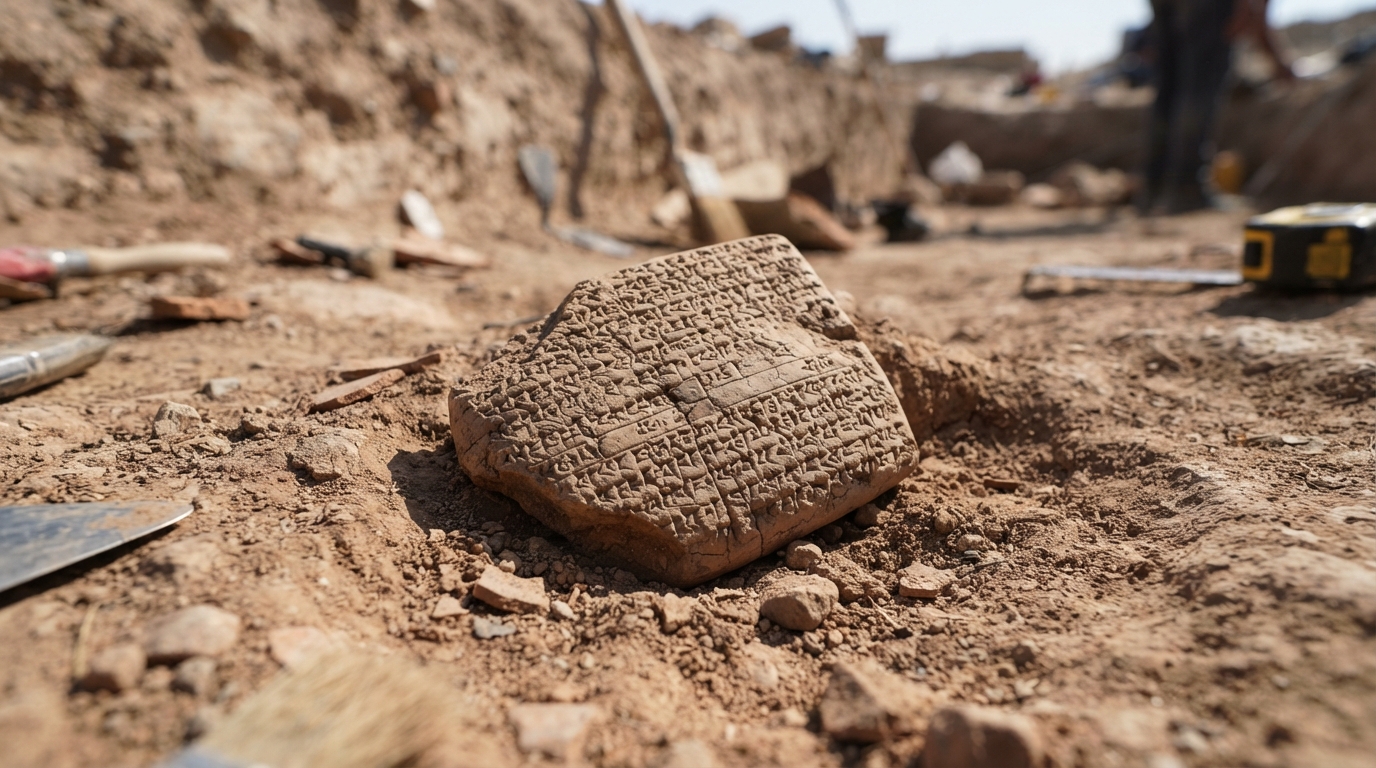
In 1872, George Smith, working at the British Museum, deciphered that flood tablet and recognised how closely it echoed Genesis. You can still see the flood tablet in the British Museum’s collection. An even older Mesopotamian flood story, the Atrahasis epic, reveals that the flood tradition was ancient and far reaching, not a single isolated tale.
One honest caveat: the date of a surviving tablet is not the date a story was first told. Stories passed from mouth to mouth long before they were written, and a later manuscript can preserve far older material. Both the Genesis account and the Mesopotamian accounts took shape gradually, over time.

Utnapishtim and Noah: a shared flood story, different details
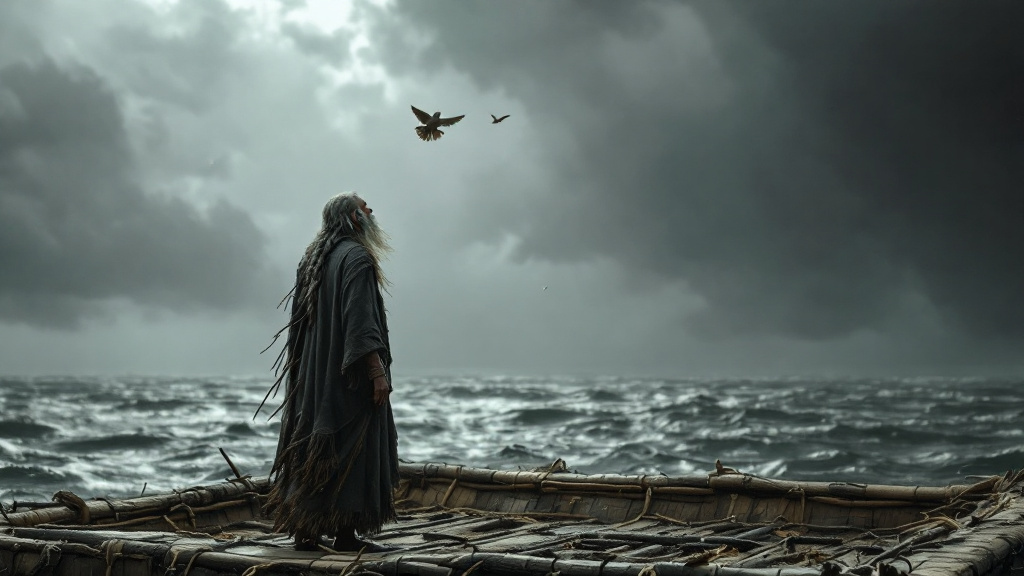
Lay the two flood stories alongside one another and the parallels simply keep coming. These are no mere handful of loose echoes: point by point, the two accounts follow the same design, often in the very same order. Here is the comparison in full, the ancient tablet on one side and the King James Bible on the other. The Gilgamesh lines are from Maureen Gallery Kovacs’s translation of Tablet XI, as published by Livius, and the Genesis lines are from Genesis 6 to 9 (KJV).
| Point of comparison | Utnapishtim (Gilgamesh, Tablet XI) | Noah (Genesis 6 to 9, KJV) |
|---|---|---|
| Before the flood | The Babylonian priest Berossus numbers ten kings who reigned before the flood. The last of them, Xisuthrus, is the flood hero. | Ten generations stretch from Adam to Noah (Genesis 5). |
| A half-divine hero | Gilgamesh himself is the son of the goddess Ninsun and of Lugalbanda, king of Uruk. | Just before the flood, the sons of God and the daughters of men bear children who “became mighty men which were of old, men of renown” (6:4). |
| Why the flood comes | “The hearts of the Great Gods moved them to inflict the Flood.” Tablet XI offers no reason. In the older Atrahasis epic, the god Enlil complains of the clamour of mankind: “I am losing sleep over their racket.” | Human wickedness: “every imagination of the thoughts of his heart was only evil continually” (6:5), and “the earth is filled with violence” (6:13). |
| How the hero is warned | The god Ea addresses the wall of Utnapishtim’s reed house: “Reed house, reed house! Wall, wall!” Later he claims he “only made a dream appear”. | God speaks to Noah directly (6:13). |
| The instruction | “Tear down the house and build a boat! Abandon wealth and seek living beings!” | “Make thee an ark of gopher wood” (6:14). |
| Shape and size | A perfect cube. “It was a field in area”, with walls of 120 cubits and every side of equal length. | A long box: “three hundred cubits, the breadth of it fifty cubits, and the height of it thirty cubits” (6:15). |
| Decks and rooms | “I provided it with six decks, thus dividing it into seven levels.” Within lie nine compartments. | “Lower, second, and third stories”, with rooms, a single window and a door set in the side (6:14, 6:16). |
| Waterproofing | Prodigious quantities of bitumen and pitch: “Three times 3,600 units of raw bitumen I poured into the bitumen kiln”. | “Pitch it within and without with pitch” (6:14). |
| The building | Utnapishtim feeds his workers, and “they made a party like the New Year’s Festival!” The boat is finished by sunset. | No workers are mentioned, and no building time is given. |
| What the neighbours hear | Ea furnishes Utnapishtim with a cover story for the city: Enlil has rejected him, so he cannot remain. | Genesis records no message to the neighbours. |
| Who goes aboard | His wife, “all my kith and kin”, the craftsmen, and his wealth: “Whatever silver I had I loaded on it, whatever gold I had I loaded on it.” | Eight souls: Noah, his wife, his three sons and their wives (6:18, 7:13). No treasure. |
| The animals | “The seed of all living beings” and “all the beasts and animals of the field”. | “Two of every sort”, “male and female” (6:19). Yet the clean beasts go in “by sevens” (7:2). |
| Shutting the door | Utnapishtim seals the entrance himself, and bestows his palace on the boatman, Puzur-Amurri. | “The LORD shut him in” (7:16). |
| How long it lasts | “Six days and seven nights came the wind and flood”. The older Atrahasis speaks of a “seven-day deluge”. | Seven days’ warning (7:4), rain for “forty days and forty nights” (7:12), and waters that “prevailed upon the earth an hundred and fifty days” (7:24). From onset to dry ground is a little over a year (7:11, 8:14). |
| The gods in the storm | “The gods were cowering like dogs”. The goddess Ishtar “shrieked like a woman in childbirth”. | God’s grief precedes the flood: “it repented the LORD that he had made man on the earth” (6:6). |
| Where it lands | “On Mount Nimuš the boat lodged firm”, and the mountain holds it fast for six days. | “Upon the mountains of Ararat” (8:4). |
| The birds | A dove (it returns), a swallow (it returns) and a raven, which “does not circle back”. | A raven that goes “to and fro”, then a dove sent forth three times, seven days apart: it returns, it returns with “an olive leaf pluckt off”, and at last it “returned not again” (8:7 to 8:12). |
| The sacrifice | “The gods smelled the sweet savor, and collected like flies over a sacrifice.” | “The LORD smelled a sweet savour” (8:21). |
| The sign in the sky | The goddess raises her lapis lazuli necklace and vows: “may I be mindful of these days, and never forget them!” | The rainbow: “I do set my bow in the cloud” (9:13), and “I will remember my covenant” (9:15). |
| The promise | Ea rebukes Enlil: “Charge the violation to the violator”. Next time, send a lion, a wolf, famine or plague, but not a flood. | “Neither will I again smite any more every thing living, as I have done” (8:21), and no more flood (9:11). |
| The hero’s fate | Utnapishtim and his wife are made like the gods and settled “at the Mouth of the Rivers”. | Noah plants a vineyard, becomes drunk (9:20 to 9:21) and dies at 950. |
| The serpent | After the flood story, a snake steals Gilgamesh’s plant of youth and sloughs its skin. | The serpent appears before the flood, in Eden (Genesis 3). |
Other sources in the table: the Atrahasis lines are from Stephanie Dalley’s translation in Myths from Mesopotamia (1991), quoted by Grand Valley State University. Berossus’s ten kings are from Livius, and Gilgamesh’s parentage is from The Metropolitan Museum of Art.
Older still: the round ark and “two by two”
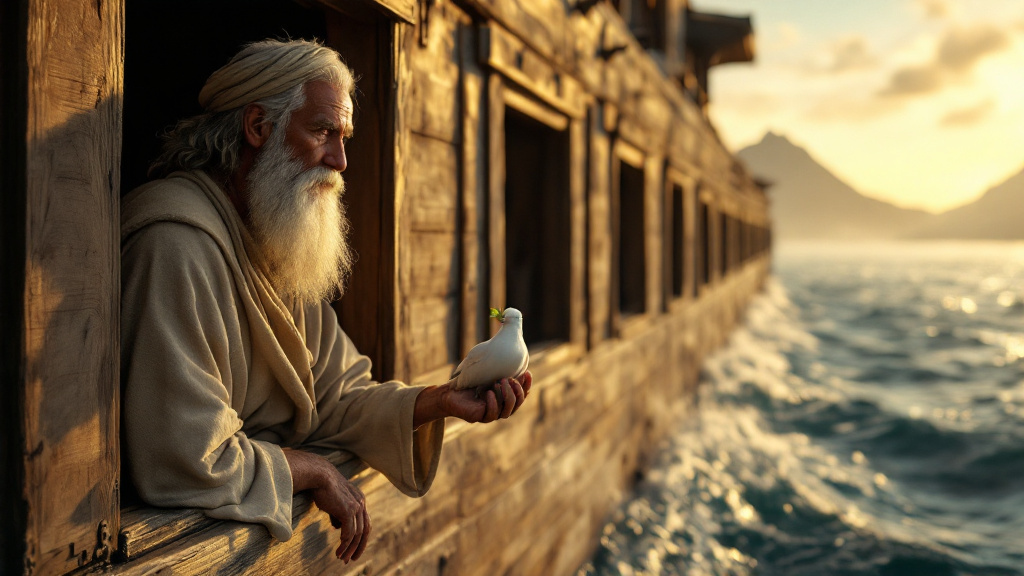
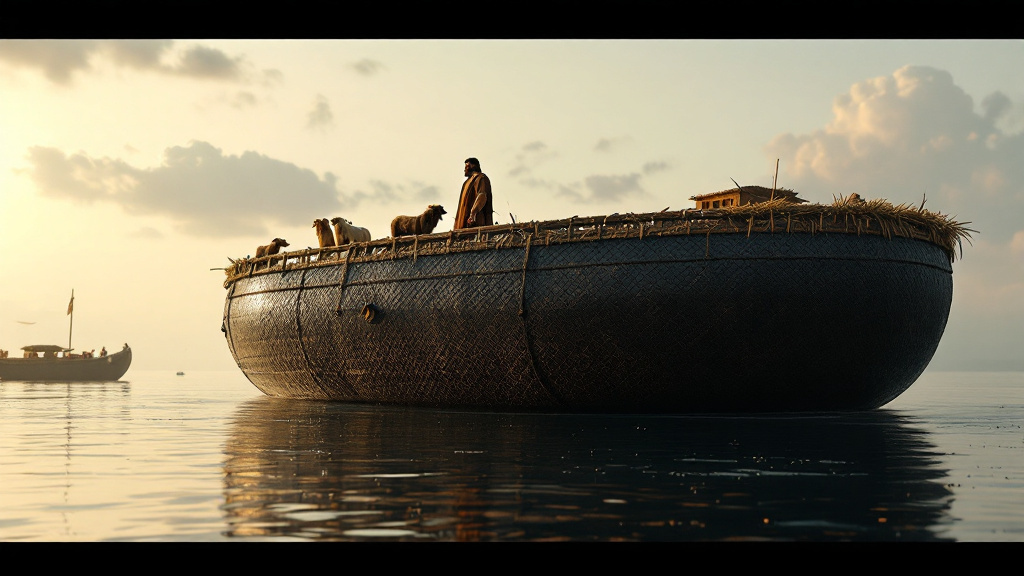
Most of us learned of the animals going in “two by two” as Noah’s story, yet a Babylonian tablet told it first. The Ark Tablet, translated by Irving Finkel of the British Museum, dates to around 1900 to 1700 BCE and describes a round boat, a colossal coracle some 230 feet across, woven of palm fibre rope and sealed with bitumen. Finkel noticed a sign in it that the Chicago Assyrian Dictionary glosses as “two each, two by two” (Biblical Archaeology Society). Three tellings, three shapes of ark: a circle, a cube and a long box. The story kept its bones and changed its garments.
Two flood stories inside Genesis itself
Look at the table again and you will find Genesis at odds with itself. Is it one pair of every animal, or seven pairs of the clean ones? Forty days, or a hundred and fifty? Most scholars resolve this by reading Genesis 6 to 9 as two accounts woven into one: one strand holds the sevens, the forty days of rain and Noah’s sacrifice, while the other holds single pairs, the hundred and fifty days and the rainbow covenant. As for where the whole story came from, the scholarly verdict is blunt: “Numerous and often detailed parallels make clear that the Genesis flood narrative is dependent on the Mesopotamian epics” (Genesis flood narrative).
The detail that changes everything
There is one line in Genesis with no counterpart anywhere on the tablets. The flood begins because “every imagination of the thoughts of his heart was only evil continually” (6:5). And it ends with God declaring he will never again curse the ground, “for the imagination of man’s heart is evil from his youth” (8:21). The Babylonian gods loosed the waters because humans were too noisy; Genesis opens and closes its flood with the word imagination.
This is TrueCosmic’s reading, but I do not believe it is an accident. The writers of Genesis took a story that was already ancient and set imagination at its very heart. That is the key Neville spent his life restoring to us: the flood is what an imagination steeped in fear does to a life, and the ark is the inner state that bears you through it. The tablet tells you what befell one man; Genesis tells you what unfolds in you.
If you want the inner reading of Noah’s version, turn to our article on Noah’s Ark meaning, where I set the two flood accounts side by side.
Is Gilgamesh Nimrod?
Some writers associate Gilgamesh with Nimrod, because both are bound up with ancient Mesopotamian kingship and with the city of Erech, which is usually identified with Uruk. Genesis names Nimrod, not Gilgamesh:
“And Cush begat Nimrod: he began to be a mighty one in the earth. He was a mighty hunter before the LORD: wherefore it is said, Even as Nimrod the mighty hunter before the LORD. And the beginning of his kingdom was Babel, and Erech, and Accad, and Calneh, in the land of Shinar.” (Genesis 10:8 to 10, KJV)
The shared connection to Erech is one reason the comparison attracts attention. Yet it remains a popular theory rather than an established fact, and there is no scholarly consensus that Gilgamesh and Nimrod were one and the same. The biblical text itself draws no such link.
What the parallels mean
For years I believed the parallels meant only one thing: somebody had copied somebody, and so the whole edifice was a lie. Today I see it otherwise. Seers in different cultures told the same inner truth in the idiom of their own time and place, and Neville put it plainly in one of his Five Lessons question sessions:
“The story of Jesus is the identical story as that of the Hindu savior, Krishna. They are the same psychological characters.”
He was speaking of the Jesus of scripture, not offering a history lesson. His point is that these stories describe one and the same inner drama. Seen in that light, finding the flood in Gilgamesh did not prove the Bible worthless; it showed me the flood was a human story, told wherever people awoke to what lives within them.
The inner reading of Gilgamesh
Neville never addressed Gilgamesh directly, so what follows is TrueCosmic’s own reading.
Gilgamesh’s quest for immortality is every person’s search for the eternal self, and his grief is what makes that search so human. He longs for what no outer power can bestow: a life that cannot be taken away. He travels to the ends of the earth in pursuit of it, and in the epic he returns home without it.
The mystic Manly P. Hall, in The Secret Teachings of All Ages (1928), says almost nothing about Gilgamesh himself, but he describes what the ancient Mysteries held that search to be truly for. In his “Conclusion” he writes of the wise:
“Having once communed with Self, they realize that within there is an immortal foundation that will not pass away.”
(Manly P. Hall, The Secret Teachings of All Ages)
Hall adds at once: “By this should not be inferred physical immortality.” That is the turn Gilgamesh could not make. He craved a body that would never die, and the epic sends him home without one, whereas the Mysteries pointed to a life that was never housed in the body to begin with.
Hall also writes: “In both the heart and mind of man the gates which lead from mortality to immortality are still ajar.” In TrueCosmic’s reading, that gate is the very one Neville kept pointing towards: your own I AM, the awareness of being that no flood can reach. Gilgamesh never needed to cross the waters of death to find it.
Utnapishtim’s boat, in this reading, is a state of consciousness that outlasts the flood of the senses. The flood is everything that surges in to tell you what is real: fear, loss, bad news, the evidence before your eyes. The boat is the inner sanctuary you return to and seal yourself within while the waters rise. The eternal life Gilgamesh sought was never at the ends of the earth; it dwelt in the one who was seeking.
How to apply it
- Name what you are trying to hold on to. When life shifts or something comes to an end, ask what you are clinging to: a relationship, an old identity, a sense of safety. Be precise.
- Find your boat. Ask which inner state would keep you steady through it. Then define one brief scene that could only occur if you were already living from that state.
- Return to it nightly. In the drowsy state before sleep, enter that scene and feel it as accomplished. When the flood of the senses rises during the day, come back to it.
This is a practice, not a trick. Consider a sourdough starter: it will not be ready simply because you want it by tonight. You feed it a little each day, and the life within it grows stronger because you keep returning. Inner work matures in just the same way, through patient, steady feeding rather than one dramatic effort.
Sometimes you discover that what you thought was lost was only waiting beneath the surface, like a seed that needed nothing but water.

Keep reading: Who Were the Nephilim? Giants, the Sons of God and the Giants You Face Today and As in the Days of Noah: What Matthew 24 Really Means When You Read It Within.
Keep reading: Tower of Babel Meaning: The City of Confusion and the Pearl of Great Price.
Frequently Asked Questions
Is Gilgamesh mentioned in the Bible?
No. Gilgamesh is named nowhere in the Bible; his story comes from ancient Mesopotamia. What the Bible shares with the Epic of Gilgamesh is a flood story, not a character.
Is reading the flood story symbolically a form of heresy?
Reading scripture for its inner meaning is an ancient tradition, older than any church. But the literal and the inner do not sit side by side for ever: the outer story comes first, and the inner meaning ripens until it takes the lead, just as the elder serves the younger. Nor is that realisation a mere footnote: it is the very catalyst for transformation.
What are the similarities between Gilgamesh and Noah’s flood?
Almost every step corresponds: a divine warning, a command to build a sealed boat, family and animals taken aboard, a great storm, a landing on a mountain, birds sent out to test for dry land, a sacrifice whose “sweet savour” the divine smells, and a sign to remember by. The chief differences lie in the shape of the boat, the length of the flood, the reason it was sent and the hero’s fate: Utnapishtim is made immortal, while Noah dies at 950.
Is the Gilgamesh flood story older than Noah’s?
The surviving Mesopotamian flood tablets predate the earliest surviving copies of Genesis. But both traditions were told and refined over long periods, so the age of a tablet cannot settle when a story was first told.
Was Gilgamesh the same person as Nimrod?
Some writers propose it because both are associated with Erech, or Uruk. It is a popular theory, but there is no scholarly consensus, and the Bible itself does not make the link.
Who is Utnapishtim?
Utnapishtim is the flood survivor in the Epic of Gilgamesh. In Tablet XI he recounts to Gilgamesh how he was warned, built a boat, survived the flood, and was granted life beyond death.
Conclusion: what the older story opened in me
So, is Gilgamesh in the Bible? No. But the flood story he hears from Utnapishtim shares deep roots with Genesis, and facing that honestly broke open an identity I had been taught never to question. The search that followed led me back to scripture through a different door, and you can read where it took me in my story of struggling to accept Neville’s reading of the Bible.
Whatever is shaking your world right now, the answer is not buried in an ancient tablet or hidden at the ends of the earth. It already dwells within you, together with the same power that brought all things into being, and it is yours to summon. You are the one who sets it in motion, and once you do, no flood can sweep you away. Fear not.

Michael Sutherland is the founder of Truecosmic, a global platform dedicated to Neville Goddard’s teachings and the Law of Assumption. Passionate about empowering individuals through conscious creation, Michael blends esoteric wisdom with practical insight to help people transform their lives from within.
Enter your email and get instant FREE access to your report.
No credit card required. 🔒 Your details are secure. You can unsubscribe at any time.











0 Comments