

The Book of Enoch is one of the most talked about books that most people have never actually read. I was raised as a Jehovah’s Witness and later schooled in the Baptist church, and it formed no part of the scripture I was taught. Enoch was a name in a genealogy, a man who walked with God and then was gone.
I walked away from the church at eighteen and spent the next twenty five years or so a long way from scripture. It took the biggest crisis of my life to bring me back, and when I came back it was through Neville Goddard, who showed me that God is not a distant figure but my own awareness, the I AM. Read through that lens, a verse like Enoch’s means something altogether different.

I do not read the story of Enoch as a record of what one man did before the flood. I read it as a story that carries meaning, set down by sages who understood that a truth wrapped in narrative travels further than a truth stated plainly. Our work is to unwrap it patiently. What lies inside is a description of you, and of a capacity in you that most of us were never taught to use.
This page is written for those who still hold the Bible as sacred but have grown tired of how it was taught to them, or of the hypocrisy they have seen in religious institutions. It is not an attack on anyone’s faith. If you read Enoch’s story literally, I honour that, because it is where nearly all of us begin; but the literal reading is the first rung of the ladder, not its summit, and in time it gives way to the inner reading, as the elder serves the younger.
Who was Enoch in the Bible?
Enoch appears in the fifth chapter of Genesis, in the long line of descendants running from Adam to Noah. The book of Jude calls him “the seventh from Adam”. Genesis says he fathered Methuselah at sixty five, walked with God for three hundred years after, and lived three hundred sixty and five years in all. Then comes the verse that has fascinated readers ever since:
“And Enoch walked with God: and he was not; for God took him.” (Genesis 5:24, KJV)
Again and again that chapter closes a life with the same three words, “and he died”. Enoch’s life alone ends differently. The writer of Hebrews takes up the same mystery and gives it a new word:
“By faith Enoch was translated that he should not see death; and was not found, because God had translated him: for before his translation he had this testimony, that he pleased God.” (Hebrews 11:5, KJV)
Follow the genealogy a few lines further and you find that Methuselah fathered Lamech, and Lamech fathered Noah. Enoch is Noah’s great-grandfather, standing at the threshold of the flood, which I have read inwardly in the meaning of Noah’s Ark. Into the silence where his death should be, centuries later, poured a whole literature.
What is the Book of Enoch?
The Book of Enoch, known to scholars as 1 Enoch, is an ancient Jewish work of apocalyptic literature, a genre in which a seer is shown visions of heaven, of judgement and of the hidden order behind history. It is written in Enoch’s name, but it was not written by the patriarch of Genesis. Writings composed under the name of a revered ancient figure are called pseudepigrapha, and 1 Enoch is the most famous of them.
It is also not one book but a collection of several, gathered over a long period. The oldest parts are generally dated to around the third century BCE, and the latest section was added later still. It is distinct from 2 Enoch and 3 Enoch, separate works that share only the patriarch’s name.
The text has an extraordinary history. Fragments of it in Aramaic were found among the Dead Sea Scrolls in the caves at Qumran, most of them in Cave 4, proof that parts of it were being copied before the Christian era. Yet the only complete version to survive is in Ge’ez, the classical liturgical language of Ethiopia. Europe barely knew it until the Scottish traveller James Bruce brought Ge’ez copies home in 1773, and the English translation most people still read is that of the scholar R. H. Charles, first published in 1912 and issued again in 1917.

The five books inside the Book of Enoch
Read straight through, 1 Enoch can feel disjointed, so it helps to know its five parts, as set out in standard reference works.
The Book of the Watchers (chapters 1 to 36)
This is the section most people mean when they mention the Book of Enoch. It takes up a single cryptic verse in Genesis:
“There were giants in the earth in those days; and also after that, when the sons of God came in unto the daughters of men, and they bare children to them, the same became mighty men which were of old, men of renown.” (Genesis 6:4, KJV)
Where the King James Version says “giants”, the Hebrew has the word Nephilim. The Book of the Watchers turns that one verse into a full drama: heavenly beings called Watchers descend, take human wives, teach forbidden arts, and father giants whose violence fills the earth. Enoch, addressed as “Enoch, thou scribe of righteousness”, pronounces their judgement and is carried on journeys through heaven and earth.
The Parables, or Similitudes (chapters 37 to 71)
The Parables describe a heavenly figure called the Elect One and the Son of Man, who sits in judgement over the mighty of the earth. This section is the youngest part of the collection, and tellingly, no fragment of it was found at Qumran. Most scholars place it somewhere around the turn of the era, though its date is still debated.
The Astronomical Book (chapters 72 to 82)
Sometimes called the Book of the Luminaries, this is a detailed account of the courses of the sun, moon and stars, revealed to Enoch by the angel Uriel, together with a solar calendar of 364 days. It is among the oldest material in the collection.
The Dream Visions (chapters 83 to 90)
Here Enoch recounts two dreams to his son Methuselah. The second, often called the Animal Apocalypse, retells the history of Israel with its people portrayed as animals: sheep, rams, wild beasts and birds of prey.
The Epistle of Enoch (chapters 91 to 108)
The final section is a body of moral teaching and warning, contrasting the way of the righteous with the way of the oppressor, and promising that justice will be done.
Enoch in the New Testament: the quotation in Jude
Many Christians first hear of the Book of Enoch because the Epistle of Jude quotes it:
“And Enoch also, the seventh from Adam, prophesied of these, saying, Behold, the Lord cometh with ten thousands of his saints, To execute judgment upon all, and to convince all that are ungodly among them of all their ungodly deeds which they have ungodly committed, and of all their hard speeches which ungodly sinners have spoken against him.” (Jude 1:14 to 15, KJV)
Set that beside the opening chapter of 1 Enoch in R. H. Charles’s 1912 translation, and the source is unmistakable:
“And behold! He cometh with ten thousands of His holy ones To execute judgement upon all, And to destroy all the ungodly: And to convict all flesh Of all the works of their ungodliness which they have ungodly committed, And of all the hard things which ungodly sinners have spoken against Him.” (1 Enoch 1:9, tr. R. H. Charles, The Apocrypha and Pseudepigrapha of the Old Testament)
So at least one writer of the New Testament knew Enochic tradition and drew on it with respect. Whether Jude regarded the whole book as scripture is a separate question, and not one the letter answers.
Why was the Book of Enoch removed from the Bible?
People often ask this suspecting that something was hidden. The answer is plainer. The Book of Enoch was never removed from the Jewish Bible, because it was never part of it. The rabbinic tradition did not accept it, and it is absent from the Hebrew scriptures used in synagogues to this day.
In the early church the picture was more mixed. Some writers valued it highly; Tertullian, writing around the year 200, defended it as scripture. Augustine, in The City of God, acknowledged that Jude says Enoch prophesied, but explained that writings carrying Enoch’s name were set aside because of their great antiquity and because no one could be sure they were genuinely his. Jerome went further and recorded that Jude’s own letter was doubted by many precisely because it quoted Enoch.
Three reasons, none of them sinister. The book was late, far later than the patriarch whose name it bears. It was pseudepigraphal, and the church fathers knew it. And its authority was disputed among the very teachers who shaped the canon. By the fifth century it had largely fallen out of use in most Christian churches, and its Greek and Aramaic copies faded from circulation.
Not everywhere, however. The Ethiopian Orthodox Tewahedo Church, and the Eritrean Orthodox Tewahedo Church with it, kept 1 Enoch in their Bible and still regard it as scripture. The Beta Israel, the Jewish community of Ethiopia, also honour it. It is thanks to the scribes of those churches that the complete book survived at all.
Is the Book of Enoch in the Bible?
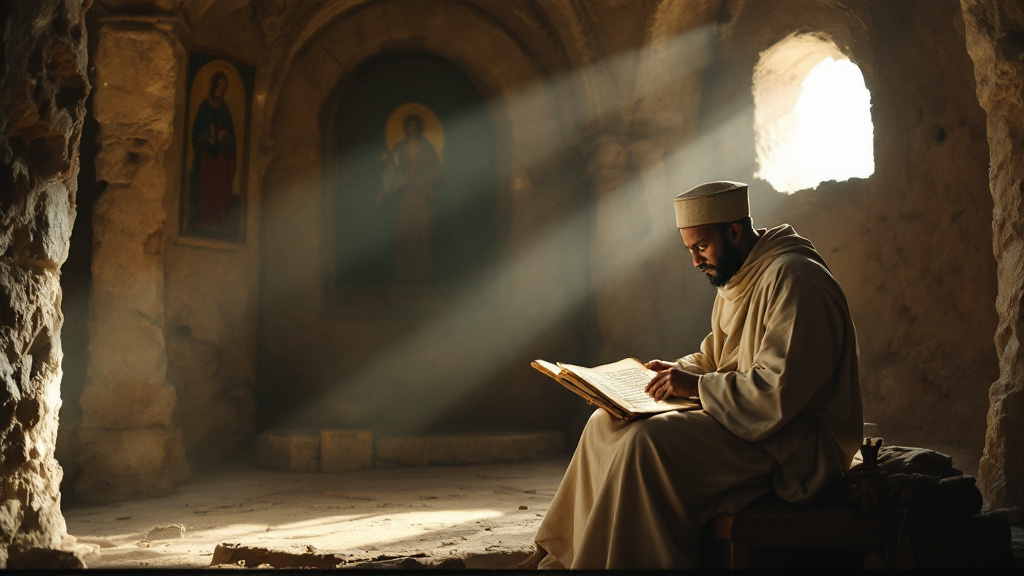
It depends whose Bible you hold. In the Ethiopian and Eritrean Orthodox Tewahedo canons, yes. In the Jewish Bible, the Catholic Bible, the Eastern Orthodox Bibles of the Greek and Russian traditions, and the Protestant Bible, no. Enoch the man is in every one of them, in Genesis, Hebrews and Jude. The Book of Enoch is in only a few.
What it means that Enoch walked with God: an inner reading
What follows is TrueCosmic’s own reading of Enoch, not a teaching Neville gave on this book. But it rests on the key Neville handed to every reader of scripture:
“When you read scripture in the future, don’t think of it as records of myth or secular history, but glorious revelations of God as eternal states of consciousness, personified.” (Neville, in his lecture “A State Called Moses”)
Read that way, Enoch is not a man who lived before the flood but a state of consciousness, and its defining mark is given in one phrase: he walked with God.
If God is the I AM, your own awareness of being, then to walk with God is not to follow an external deity at a respectful distance. It is to live in conscious awareness of the I AM through every ordinary hour. The prophet Amos asks, “Can two walk together, except they be agreed?” (Amos 3:3, KJV). To walk with God is to be in agreement with your own awareness: to stop contradicting, in your inner speech, the very state you wish to live from. The psalmist calls this dwelling in the secret place of the Most High. Enoch’s word for it is walking, and walking is something you do every day.
That word means a great deal to me. At eighteen I walked away from the church, and I stayed away for about twenty five years. What Neville showed me is that God is my own awareness, the I AM, which means the walk was never with someone far off. It is a walk with what I am.
“He was not; for God took him”
“He was not” does not describe a vanishing body. It describes the end of a former self. The man defined by the senses ceases to be found, because he has been taken up into a different state. Hebrews chooses exactly the right word: Enoch was translated. To translate is to carry across, to render the same meaning in a new form. Nothing essential is lost; everything outward is changed.
The Book of Enoch itself opens one of its sections with a striking line:
“Before these things Enoch was hidden, and no one of the children of men knew where he was hidden, and where he abode, and what had become of him.” (1 Enoch 12:1, tr. R. H. Charles, The Book of Enoch (1917))
Read inwardly, that is precisely what happens when you truly change your state. The old circle cannot find the old you. You have not gone anywhere; you have been translated. This is the heart of the Law of Assumption: you do not travel to a new life, you assume a new state, and the world rearranges itself to match it. The same movement appears in scripture as the ladder Jacob saw, with traffic ascending and descending between states, which I explore in what is Jacob’s ladder.
Even the number of Enoch’s years invites this reading. The mystic Manly P. Hall, in The Secret Teachings of All Ages (1928), describes the patriarch as “evidently a personification of the sun, since he lived 365 years.” A life of three hundred sixty five years is a full solar year written large: a complete cycle, ending not in death but in light.
The deeper awakening these old texts point towards cannot be manufactured or scheduled. What any of us can practise is the walk.
Legend and tradition: Enoch, Hermes and the two pillars
Enoch’s silence in Genesis attracted further legends, which I share as legend and tradition, not history. Hall reports that some writers identified Enoch with Hermes, the master of the Hermetic wisdom: “Investigators believe that it was Hermes who was known to the Jews as ‘Enoch,'” and one account of Hermes’ end held that he “was translated like Enoch and carried without death into the presence of God” (Hall, “The Life and Teachings of Thoth Hermes Trismegistus”).
The second legend belongs to Freemasonry. As Hall retells it in his chapter on Freemasonic symbolism, Enoch foresaw that the flood would sweep away the knowledge of the sacred Mysteries, and so he raised two pillars, one of metal and one of marble. On the first he engraved the secret teaching in symbols; on the second he left an inscription saying that a treasure lay hidden in a vault nearby. Then, his work complete, he was translated.
I love that story as a parable. The treasure is real, it lies close by, and the clue has stood in plain sight for ages. Scripture is that pillar. The vault is your own consciousness. The great traditions, down to the flood story the Gilgamesh epic shares with Genesis (which I discuss in is Gilgamesh in the Bible), keep pointing the reader inward.
How to walk with God the way Enoch did
- Return to the I AM before the day begins. Before you reach for your phone or rehearse your worries, rest for a minute in the simple awareness that you are. That awareness is the God Enoch walked with.
- Notice your inner speech. Two cannot walk together unless they agree. Through the day, catch the inner conversations that contradict the state you want, and quietly revise them.
- Decide the end, and leave the route open. Choose the state you want to be translated into, and stop there. The biggest mistake on this path is micromanaging how the result must arrive. Enoch did not plan his own ascent; he walked, and he was taken.
- Act from the new state where it is within your reach. Ask what the person who already lives in that state would do today, and do the part that belongs to you, with good judgement.
- Enter the scene each night. In the drowsy state before sleep, which is my own nightly practice, enter one short scene that implies your wish fulfilled, a moment you would only experience if you had already been translated, and feel it as done. Then let sleep carry you.
This is a practice, not a trick. Picture a shepherd who walks the same hill path every morning and every evening. On the first day there is no path at all, only grass and stones. But he walks it again, and again, through rain and frost, until the way is worn smooth and his feet find it in the dark. Walking with God is the same: not one dramatic moment, but a daily return that slowly wears a road into your consciousness, until the state you once had to reach for is simply where you live.

Unwrapped this way, Enoch’s story stops being a puzzle about a vanished patriarch and becomes a description of a power waiting in you, revealed only by walking. One day you look up and find you have been carried across into a life the old self could not have found.
Frequently Asked Questions
What is the Book of Enoch?
The Book of Enoch, or 1 Enoch, is an ancient Jewish collection of apocalyptic writings attributed to the patriarch Enoch. It has five parts: the Book of the Watchers, the Parables, the Astronomical Book, the Dream Visions and the Epistle of Enoch. Its oldest sections date to around the third century BCE. Aramaic fragments were found at Qumran, and the complete text survives in Ge’ez.
Why was the Book of Enoch removed from the Bible?
It was never part of the Jewish Bible, so in that sense it was not removed. Some early Christians valued it, but many church fathers doubted it because it was written long after Enoch’s time under his name, and its authority was disputed. By the fifth century most churches had set it aside. The Ethiopian and Eritrean Orthodox Tewahedo churches kept it as scripture.
Is the Book of Enoch in the Bible?
Only in some Bibles. It is part of the canon of the Ethiopian Orthodox Tewahedo Church and the Eritrean Orthodox Tewahedo Church, but it is not in the Jewish, Catholic, Protestant or most Eastern Orthodox Bibles. Enoch himself appears in all of them, in Genesis 5, Hebrews 11:5 and Jude, which quotes a passage that corresponds to 1 Enoch 1:9.
What does it mean that Enoch walked with God?
Literally, Genesis presents Enoch as a man of unusual closeness to God. In TrueCosmic’s inner reading, walking with God means living in conscious awareness of the I AM, your own awareness of being, through every ordinary hour. “He was not; for God took him” then describes a change of state, the old self translated into a new one, rather than a disappearance.
Is it wrong for a Christian to read the Book of Enoch?
Reading scripture for its inner meaning is ancient; Origen taught that the Bible has a spiritual sense beneath its literal one. A Christian can read 1 Enoch as the ancient literature Jude himself drew on. The literal reading is a worthy beginning, but it gives way to the inner reading, and that realisation is what sets real transformation in motion. It is faith maturing, not faith lost.
Conclusion: the Book of Enoch and the walk that translates you
The Book of Enoch is a remarkable ancient collection, preserved by the Ethiopian church, quoted by Jude and set aside by most others for reasons that were plain rather than sinister. But its deepest gift is the verse that inspired it: a man who walked with God, and then was not, because God took him. Read inwardly, that is the story of every state of consciousness you will ever outgrow.
So whatever you are carrying today, know that the answer is not waiting at the end of some distant road. It already lives within you, together with the same power that set the stars on their courses, and it moves at your word. You are the one who sets it moving. Walk with it, day after day, and no obstacle, no history and no circumstance will be able to bar the way. Fear not.

Michael Sutherland is the founder of Truecosmic, a global platform dedicated to Neville Goddard’s teachings and the Law of Assumption. Passionate about empowering individuals through conscious creation, Michael blends esoteric wisdom with practical insight to help people transform their lives from within.
Enter your email and get instant FREE access to your report.
No credit card required. 🔒 Your details are secure. You can unsubscribe at any time.













0 Comments