
Who Was Abdullah the Mystic and What He Taught is not just a historical question. It is a personal one.
Every serious student of Neville Goddard eventually asks it. Because to understand Neville, you need to understand the man who shaped him. Abdullah was to Neville what Neville became to millions of people who found his work in their own darkest moments.
I know something about that. I came to Neville’s teachings not out of casual curiosity but out of desperation. I was facing the biggest crisis of my life. And what I found in his work — the idea that God is not external, that the creative power lives within you, that your imagination is the only real force at work — did not just give me techniques. It gave me a lifeline. It was a revelation that rebuilt everything I thought I knew.
That is precisely what Abdullah did for Neville. And understanding the relationship between teacher and student is the fastest way to understand why Neville taught the way he did.
Key Takeaways
| 1) Abdullah as a teacher | He mentored Neville Goddard for years and centred practice on inner state of consciousness. |
| 2) Scripture as inner instruction | Abdullah taught that the Bible functions like a manual for imagination and inner authority. |
| 3) Bridge of incidents as alignment | The bridge of incidents Neville Goddard manifestation idea frames how your occupied state of consciousness shapes events. |
| 4) Living in the end | A core instruction echoed in Neville’s work, live in the end, is how belief becomes lived reality. |
| 5) Revision as reframing | Revision technique helps you re-anchor imagination to the preferred end state, revision technique. |
| 6) Abdullah’s influence on Neville | To understand what changed in Neville, start with Abdullah – Neville Goddard’s Teacher and Mentor. |
Who Was Abdullah the Mystic and What He Taught (In Simple Terms)
When people ask who was Abdullah the mystic and what he taught, they usually want two things: who Abdullah was, and what he actually taught in a way that could be practised. In the teaching tradition preserved by Neville Goddard students, Abdullah is presented as a mentor who shaped Neville’s understanding of imagination, inner sovereignty, and what it means to assume a desired identity as real.
Accounts describe Abdullah as a Jewish rabbi from Ethiopia who mentored Neville for about five years. The most repeated thread is practical — Abdullah insisted that your inner state of consciousness is the driver, not your external circumstances. That shift explains why Neville became so focused on imagination as the primary creative force.
Abdullah’s teaching is often summarised with a single idea: the Bible is a manual for human imagination, and the person who practises inwardly gains control over the conditions that show up outwardly.

Abdullah as Neville Goddard’s Teacher and Mentor
In the article tradition we base this overview on, Abdullah is treated as Neville Goddard’s teacher and mentor, not a vague influence. Neville’s later work consistently points back to what he learned from Abdullah — especially the idea that inner conviction becomes lived experience.
Many readers have tried positive thinking as a daily mood exercise and then wonder why nothing changes. Abdullah’s framing is different. It is not about hoping. It is about choosing and inhabiting a particular state of consciousness and staying faithful to it.
If you want a focused starting point, read Abdullah – Neville Goddard’s Teacher and Mentor, where the relationship and lessons are laid out in a clear narrative.
Core Teaching: The Bible, the Inner State of Consciousness, and the God of Scripture
One of Abdullah’s most direct teachings is that scripture speaks to the inner world. The God of scripture is described as your imagination — meaning that spiritual language points inward to the creative power of assumed meaning.
That is why Abdullah’s teaching is paired with Neville’s language about assumption and identity. If you treat scripture as external rules only, you miss the practical instruction. If you treat it as inner guidance for imagination, you gain a method.
This is also where the conversation touches the idea behind bridge of incidents Neville Goddard manifestation. You do not force an outcome by bargaining with the world. You occupy an inner state of consciousness first, and the circumstances begin to align around it.

Key Lessons from Abdullah on Imagination and Manifestation
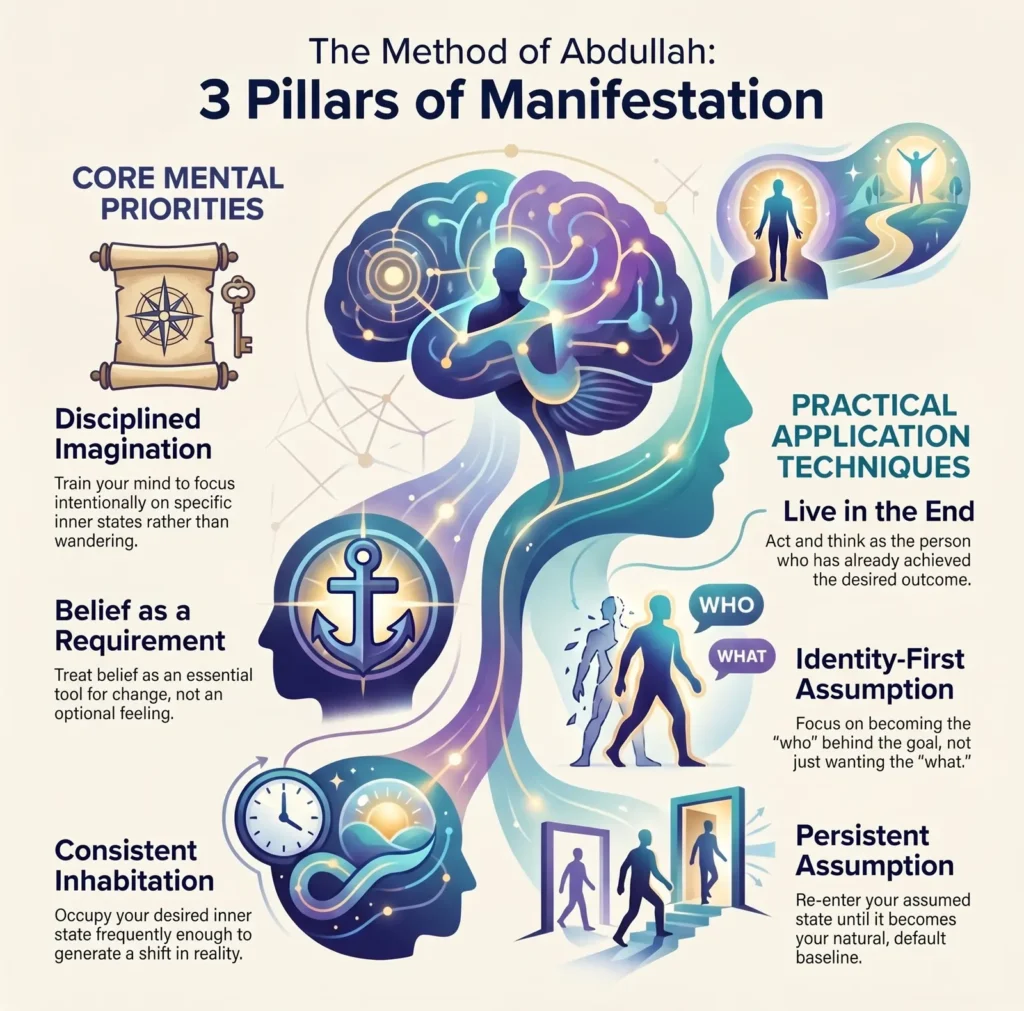
Across the preserved summaries of Abdullah’s influence, three practical priorities appear consistently. First, you become disciplined in imagination. Second, you treat belief as essential, not optional. Third, you accept that your inner state of consciousness must be inhabited consistently enough to generate change.
In practice, these lessons show up as techniques like living from the end, holding to a faithful assumption, and revising how you interpret your own past.
1) Live as though the end is already real
Living in the end is one of the clearest expressions of Abdullah’s influence on Neville’s later teaching. The idea is simple — you act as a person who already has what you desire, and let that inner experience guide your outer behaviour.
To explore how this principle is presented in Neville’s tradition, read Neville Goddard Live in the End.
2) Assume identity, not just wishes
Abdullah’s approach is identity-first. Instead of thinking only about a desired event, you occupy the who behind it. That is why the phrase state of consciousness appears everywhere in this teaching.
When your inner world starts to feel coherent in the assumed identity, the bridge of events becomes easier to recognise. That is the practical meaning behind bridge of incidents Neville Goddard manifestation for most readers.
3) Use persistent assumption until it feels natural
Another recurring theme is persistence. You do not abandon the assumed state the moment your day-to-day perception resists it. You keep re-entering it until it becomes your baseline.
For a closer look at how persistence works in this teaching, see Revealed: How a Persistent Assumption Always Manifests.
The Barbados Lesson: How Abdullah’s Approach Shows Up in Real Stories
One hallmark example used in this tradition is the Barbados Lesson. It is commonly presented as a concrete demonstration of how internal occupation leads to external confirmation. The teaching is not about the location — it is about the method. You live from the state of fulfilment, and the outer circumstances follow.
This is where the bridge of incidents Neville Goddard manifestation concept becomes easy to grasp. A change does not always arrive as a dramatic lightning bolt. It often comes through a sequence of aligned circumstances that make the end state feel inevitable.
To connect this example directly to Abdullah’s instruction, read How Abdullah Taught Neville Goddard the Art of Living in the End.

How the “Attitude of Abdullah” Affects Results
One of the best-known ways Abdullah’s teaching is summarised is through attitude. Not attitude as mood — but attitude as steadiness of inner commitment. The teaching emphasises that belief is essential, and that the internal state must be held with confidence.
That is why readers get frustrated when they treat practice like a one-time script. Abdullah-style practice is closer to training your inner state of consciousness until it becomes stable enough that manifestation feels like a natural consequence.
For a dedicated walkthrough of this angle, visit Neville Goddard – The Attitude of Abdullah Revealed.
Why Revision and Mental Re-Anchoring Matter (and How Abdullah’s Work Connects)
Abdullah’s core focus on inner state of consciousness leads many practitioners to ask: what do we do with past impressions? That is where revision becomes relevant. Revision technique is a method for reframing past experiences to align with the desired end state.
If your imagination keeps returning to the old story, you return to it deliberately and update it until your inner interpretation matches the state you want to inhabit.
To learn the technique in a structured way, read Neville Goddard – Revision Technique.
Revision also connects to bridge of incidents Neville Goddard manifestation because your internal narrative influences what you notice, what you interpret, and what you consider possible. When your interpretation updates, the bridge becomes easier to cross mentally — then easier to confirm externally.
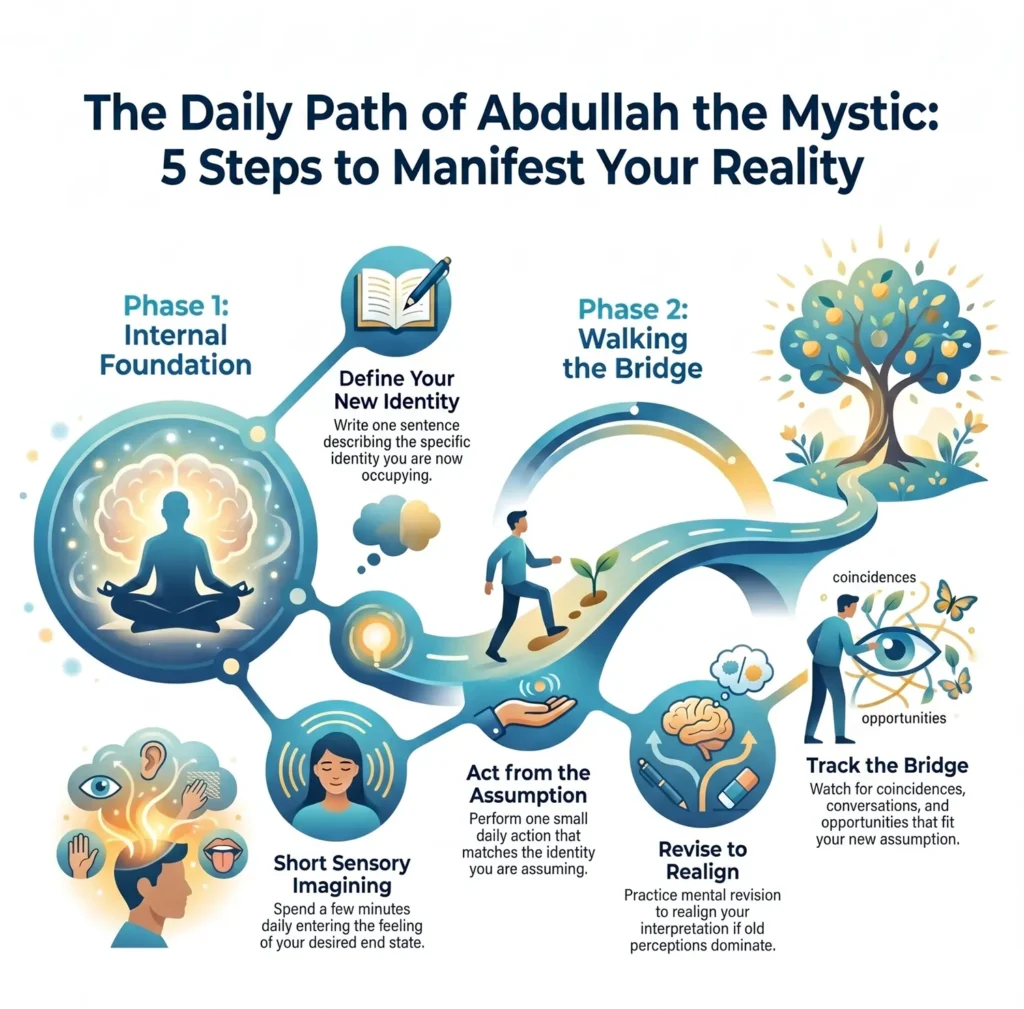
How to Apply “Who Was Abdullah the Mystic and What He Taught” in Daily Practice
If we reduce Abdullah’s teaching to a daily approach, we end up with something you can actually repeat. Most readers do best when practice is specific, small enough to do consistently, and clear about what inner state of consciousness means that day.
- Choose your assumed state: write one sentence that describes the identity you are occupying.
- Use short imagining: spend a few minutes daily entering the feeling of the end state.
- Act from the assumption: do one small action today that matches the identity you are assuming.
- Revise when you slip: if old perceptions dominate, practise revision to realign inner interpretation.
- Track the bridge: watch for aligned opportunities, coincidences, and conversations that fit the assumption.
For an overview of Neville’s life and how Abdullah’s influence is presented, Neville Goddard Biography is a useful companion reading.
Abdullah’s Enduring Legacy in Modern Spiritual Practice
Abdullah’s legacy endures because his teaching is practical. It does not rely on external spectacle. It relies on inner occupation, disciplined imagination, and belief that becomes felt reality.
That practical core is why readers still find value in the same themes — especially the idea that scripture points inward, that the God of scripture is your imagination, and that the bridge of incidents shows up as the external world begins to match the inner state of consciousness.
For readers who prefer a fact-style approach to Abdullah, we suggest 10 interesting facts about Abdullah the mystic to build context before returning to practice.

Conclusion
Who Was Abdullah the Mystic and What He Taught? He is remembered as Neville Goddard’s mentor who taught imagination as the core creative power, scripture as inner instruction, and the inner state of consciousness as the starting point for change.
Abdullah gave Neville a framework that transformed his life. Neville gave that framework to the world. And the people who find it in their own moments of need — as Neville found Abdullah, as I found Neville — discover the same thing every time: the power was never outside. It was always within.
Begin with Abdullah’s influence on Neville, practise living in the end, use revision when needed, and stay consistent with belief. That is the most faithful way to honour what Abdullah taught.
Frequently Asked Questions
Q: Who Was Abdullah the Mystic and What He Taught about imagination?
A: Abdullah taught that the God of scripture is your imagination, so your inner state of consciousness becomes the foundation for what you experience. Everything else — techniques, methods, practice — flows from that central truth.
Q: What is the bridge of incidents Neville Goddard manifestation concept in simple terms?
A: Once your state of consciousness is occupied, your external world begins aligning through events that match that inner assumption. It is a sequence of confirmations that follow consistent inner living.
Q: How does Abdullah’s teaching connect to living in the end?
A: Abdullah’s influence is reflected directly in Neville’s living in the end approach. You treat the desired identity as already real in your inner experience, then let your actions and attention reflect that assumption.
Q: Is revision technique part of what Abdullah the mystic taught?
A: Revision matches the same principle behind Abdullah’s teaching — re-anchoring imagination to the preferred end state. It helps keep your inner interpretation aligned when old impressions rise.
Q: How can I practise Abdullah’s teachings if I feel sceptical?
A: Start with the smallest version of the method — a few minutes of imagined end state plus one real action today that matches your assumed identity. Over time, the bridge of incidents Neville Goddard manifestation pattern becomes clearer.
Q: Where can I start reading more about Abdullah and Neville Goddard?
A: Start with Abdullah – Neville Goddard’s Teacher and Mentor. Then follow up with Neville Goddard Live in the End to connect Abdullah’s lessons to daily practice.

To learn more about Neville Goddard’s life and complete body of work, read our definitive guide: Neville Goddard — The Complete Guide.

Michael Sutherland is the founder of Truecosmic, a global platform dedicated to Neville Goddard’s teachings and the Law of Assumption. Passionate about empowering individuals through conscious creation, Michael blends esoteric wisdom with practical insight to help people transform their lives from within.














0 Comments